


For most of the last decade, the smart home has been a promise with fine print. You could have the lights, locks, cameras, and climate control, but you also got a second job managing apps, hubs, accounts, and the constant feeling that everything might break after the next router reboot. CES 2026 did not magically solve all of that, but it showed something important: the center of gravity is shifting away from clever demos and toward the unglamorous work of making connected devices behave like normal products.
The easiest way to describe what changed is this. Fewer companies tried to sell the smart home as an ecosystem you join. More tried to sell it as something you add to your life without rewriting it. That shift showed up in three places across the show: wider adoption of Matter and Thread, cheaper and more straightforward devices from mainstream brands, and a growing focus on local control, reliable power, and consolidation inside the platforms people already use.
Matter stopped being a slogan and started acting like plumbing
The most noticeable difference at CES 2026 was how many products treated Matter support as table stakes rather than a headline. You could feel it in the way companies talked about compatibility, which increasingly sounded like a checklist instead of a negotiation. Aqara’s Smart Lock U400 is a clean example of where this is headed. It is built on Thread, works with Matter platforms without requiring a proprietary hub, and layers in ultra wideband for intent aware “unlock on approach” behavior. It also supports a long list of backup entry methods including fingerprint, PIN, NFC, app control, voice assistants, and a physical key, plus an IP65 rating and an auto locking gyroscope, with battery life stated at up to six months per charge. Under the hood, this is the kind of product that only makes sense when the standards layer is real. Thread gives you a low power mesh that does not collapse when Wi Fi is flaky, and Matter means the lock can live inside Apple Home, Google Home, Alexa, SmartThings, and Home Assistant without the user having to learn a whole new universe first. Aqara even positioned the U400 as Aliro ready, which matters because Aliro is meant to be a cross ecosystem standard for digital keys and tap to unlock style experiences.
IKEA made the smart home feel like something you can buy casually
The other moment that made the smart home feel easier was IKEA showing up with pricing and scale that changes expectations. The company announced a new range of 21 Matter compatible smart home products focused on lighting, sensors, and control, built around the idea that smart devices should be more affordable and easier to fit into real routines.
When smart home gear is priced like a home accessory instead of a hobby, people stop overthinking it.
CES 2026 also showed IKEA getting more specific with actual items and how they work. The Varmblixt donut lamp and a matching pendant lamp were updated with Matter support, color and warmth control options, and integration through the DIRIGERA hub for access to wider color choices and app control. IKEA also talked about low cost Matter over Thread bulbs and other basics like smart plugs, remotes, and a broader lineup of sensors including air quality, humidity, motion, and water leak detectors.
The point was not that any one bulb is revolutionary. The point was that smart home building blocks are becoming normal retail items, not specialist purchases.
Control panels are back, and that makes the home less app shaped
One of the strangest smart home lessons of the past few years is that voice and phone apps did not replace physical control. People still want a screen on the wall, a button they can press, and a quick way to check what the house is doing without unlocking a phone. CES 2026 had a strong theme of smart home devices that double as hubs and control surfaces, which is exactly the kind of boring improvement that makes a system feel easier.
Aqara’s Thermostat Hub W200 is a good snapshot of this new category. It has a 4 inch touchscreen, functions as a thermostat, and also acts as a hub for Aqara devices and third party Matter devices. It includes millimeter wave presence sensing for more precise automation triggers than motion sensors, can display compatible Aqara video doorbell feeds, and can provide lock control when paired with Aqara locks. It connects via dual band Wi Fi and is positioned as part of a broader ecosystem that includes Thread and Zigbee support across its controllers.
This is the kind of product that reduces friction simply by existing. When the thermostat is also a home dashboard and a hub, there are fewer boxes to install, fewer apps to bounce between, and fewer mental steps between noticing a problem and fixing it.
Lights are getting simpler to install and more flexible to live with
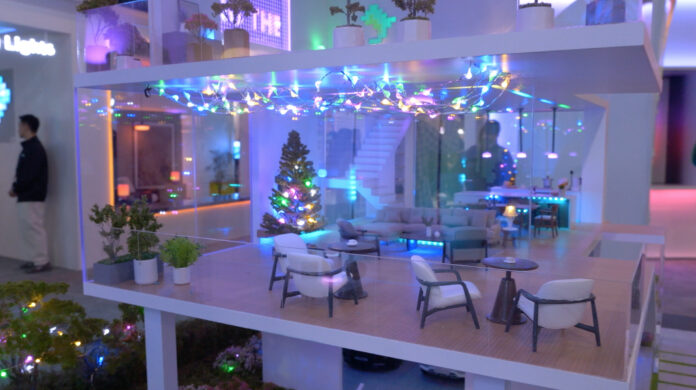
Smart lighting is often the entry point for people building a connected home, and it has traditionally been where the compatibility story gets messy. CES 2026 pushed lighting forward in a way that felt less about novelty and more about removing barriers. You could see it in products that emphasize Matter compatibility, higher quality light output, and effects that do not require a specialized setup.
Govee’s Ceiling Light Ultra is a good example. It is a 21 inch Matter compatible ceiling light with a 616 LED matrix that can render detailed patterns and animated scenes, plus support for layered effects and presets. It is also built to function as a real ceiling light with brightness levels meant for common living spaces. Govee also showed a Sky Ceiling Light designed to mimic daylight and sky tones, with brightness specified at up to about 5,200 lumens and a coverage target of roughly 200 to 300 square feet.
The refinement here is not just effects. It is the idea that you can install one fixture, connect it through a standard, and have it behave like both functional lighting and flexible ambience without turning your ceiling into a fragile science project.
Front door tech got closer to truly set it and forget it
If you want to measure smart home “ease,” look at the front door. Locks, doorbells, and cameras expose every weak spot: latency, battery life, false alerts, and ecosystem friction. CES 2026 showed real progress, mostly by combining standards support with better sensing and better power strategies.
Eufy leaned hard into this with a small lineup aimed at the whole front door. Its Video Doorbell S4 uses a 3K camera and tracking features designed to keep visitors in frame, with a wide field of view and a stated ability to monitor activity at meaningful distances. It is also tied to a broader ecosystem pitch that includes local intelligence and, in some configurations, support for Apple Home via HomeKit Secure Video through its base station. Eufy also showed the Solar Wall Light Cam S4, combining an outdoor light with a 4K security camera and a solar panel accessory, aiming at continuous power so you are not constantly recharging batteries. Its Smart Lock E40 layers in face recognition style features alongside camera based monitoring, which signals how quickly locks are turning into security devices, not just entry devices. Meanwhile, Chamberlain showed the opposite direction, which is also useful to see because it highlights what still makes the smart home hard. Its myQ Secure View 3 in 1 Smart Lock combines a smart lock, a 2K HDR video doorbell, and facial detection, and it can respond to unknown faces by locking and shutting the garage. But it does not integrate with major smart home platforms like Apple Home, Alexa, or Google Home, and it pushes users toward its own ecosystem and subscriptions for premium features.
The device is ambitious, but it also demonstrates how quickly “ease” disappears when a product walls itself off from the standards layer.
Smart home platforms started absorbing complexity instead of adding to it
Another reason CES 2026 felt easier is that platform owners are increasingly trying to reduce the number of apps a user needs to manage a home. Samsung’s SmartThings offered a concrete example by deepening its integration with Arlo so users can monitor and manage Arlo security devices directly in the SmartThings app rather than juggling multiple apps.
That kind of consolidation is not flashy, but it is exactly what people have been asking for. You do not need more notifications. You need fewer places where you have to respond to them.
Amazon also used CES to outline expansions across its smart home surface area, including new Ring features and a wider set of Alexa related integrations and experiences. At the same time, the show also included criticism from privacy and consumer advocacy groups aimed at the rise of AI enhanced surveillance features in consumer devices, including concerns about how some camera products use AI and collect data.
Both things can be true. The smart home is getting easier to operate, and the consequences of what it observes are getting more serious.
Robots and the “Zero Labor Home” pitch, still aspirational, still instructive
CES will always have at least one vision of the home as a place where robots do everything. This year that future was represented by LG’s CLOiD home robot, positioned as part of a “Zero Labor Home” concept and integrated with the ThinQ ecosystem. LG described the robot as using AI and vision based technology to handle household tasks such as cooking and laundry and to operate as a physical agent in the home rather than only a voice assistant.
Even if you treat this as more concept than product, it still reflects a useful shift. The smart home is moving away from the idea that you must micromanage every routine. The goal is increasingly that the home senses and responds, while giving you control surfaces that are easy to understand and standards that keep you from being trapped.
Why it finally felt easier
CES 2026 did not eliminate the hard parts of the smart home. Cameras still raise privacy questions. AI features still tempt companies into overreach. Some brands still want you locked into one ecosystem. But the baseline improved in ways that matter.
The easiest smart home products this year shared a few traits. They used Matter and Thread so they could join existing platforms without drama. They leaned into real control surfaces like the Aqara W200 so basic management does not require constant phone time. They invested in power strategies like solar accessories so security devices can run continuously. They got cheaper and more mainstream, especially in lighting and sensors, which makes experimentation less risky. And the major platforms started doing more of the integration work for you, which is what platforms are supposed to do. That is what “easier” looks like in the smart home. Not one killer device, but a stack that stops fighting you.
