

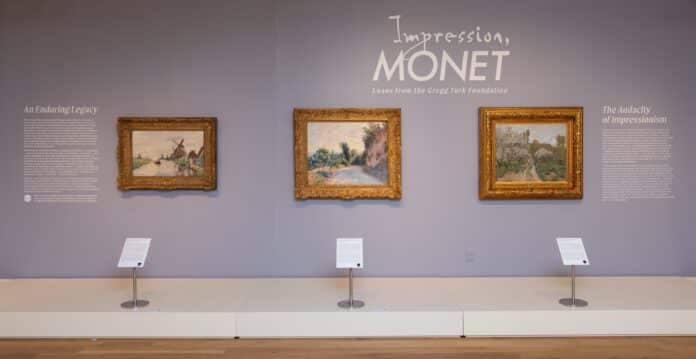

Apple trees in bloom, a country road near Giverny, windmills across a Dutch landscape. These are the subjects of three paintings by Claude Monet now hanging at the Gibbes Museum of Art in Charleston, where Impression, Monet: Loans from the Gregg Turk Foundation remains on view through October 25. The exhibition is entering its final weeks, and it is a rare chance to see these works. They are privately held by the Gregg Turk Foundation and are on special loan to the museum, with generous support from Dr. Joseph and Meghan Scalea and Kiawah Partners.
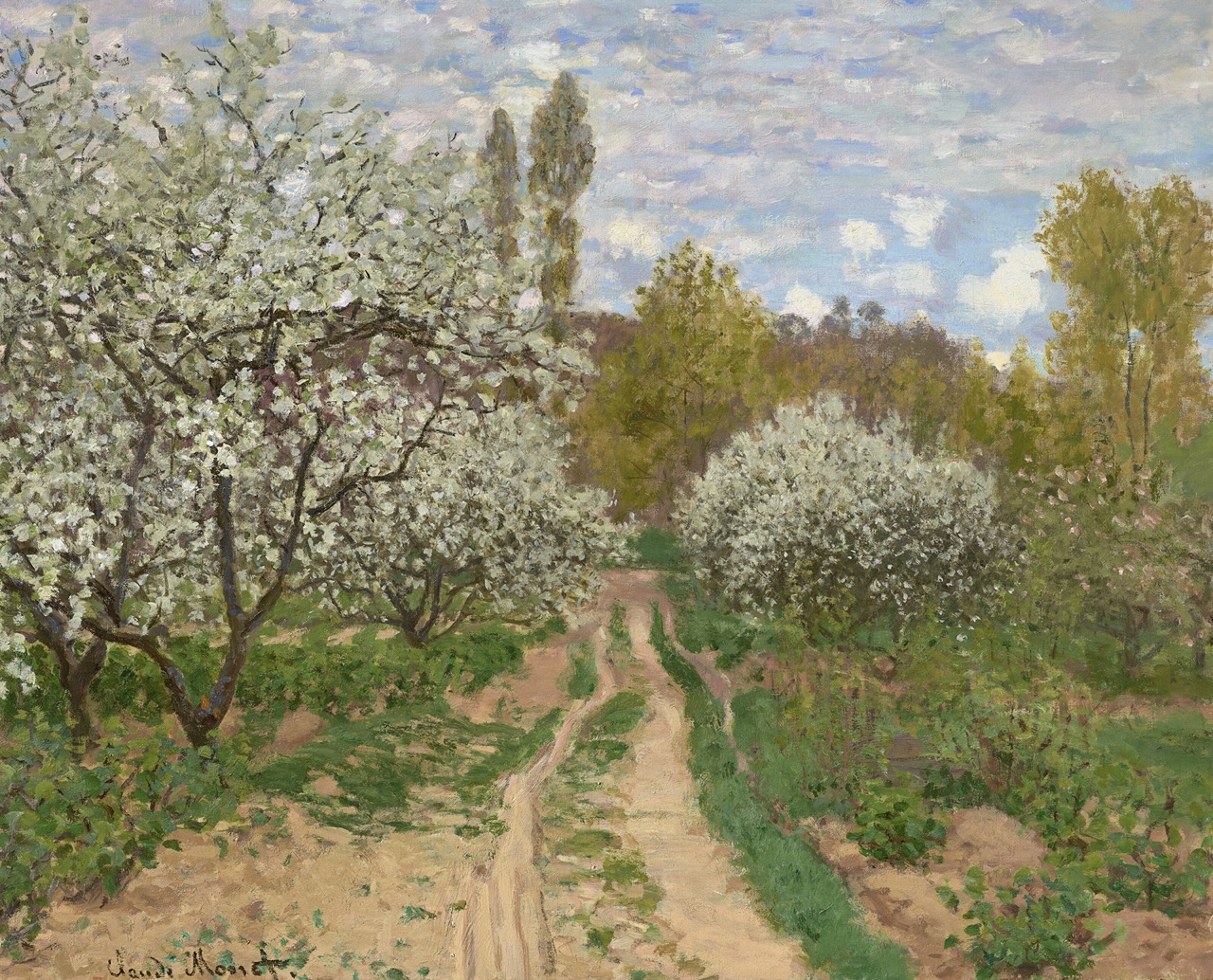
The three landscapes, Moulins en Hollande (1871), Pommiers en Fleurs (1872), and Route près de Giverny (1885), were painted at pivotal moments in Monet’s career. Together they span more than a decade of his development, and they mark the first time the Gibbes has exhibited Monet’s work. The presentation honors the 100th anniversary of the artist’s death in 1926.
Because the landscapes are the paintings that have come to stand for Impressionism, they make a fitting introduction to its central idea: paint only as much as the eye can see. That notion was still groundbreaking in the 1860s and 1870s. Monet’s focus on fleeting atmosphere and changing light has shaped how the movement is imagined today, and his version of Impressionism has traveled farther across continents than any other.
The year of Pommiers en Fleurs also connects it to the movement’s name. In 1872, Monet completed Impression, Sunrise, painted outdoors to capture a single moment rather than a polished, finished scene. When it was shown publicly in 1874, the critic Louis Leroy used its title in a mocking review, calling the exhibiting artists “Impressionists.” They adopted the label themselves, and an insult became the name of one of modern art’s most consequential movements.
What those artists shared was an interest in the world around them, both social and physical. Everyday life and changing surroundings became worthy subjects, and visible brushwork, shifting light, and loosely defined forms pushed against the finished surfaces of the academic tradition. The art establishment was shocked at first. By the 1880s, Impressionism had become a leading force of the avant garde across France and Europe, and its influence soon reached the United States.
That crossing of the Atlantic is the second thread of the exhibition. Monet’s paintings are placed in conversation with works from the Gibbes permanent collection, inviting visitors to look for his influence in the art of William Merritt Chase, Robert Henri, Childe Hassam, William H. Johnson, and Edmund Charles Tarbell. Dr. H. Alexander Rich, the museum’s President and CEO, said the response from local art lovers and from visitors to Charleston has been outstanding. He described the show as an examination of both Monet’s art historical legacy and his broad impact, and as proof that a century later Monet still inspires audiences as the world’s most celebrated Impressionist.
Monet himself was wary of too much explanation. He once observed that everyone discusses his art and pretends to understand it, as if understanding were required, when what is needed is simply to love it. After a century, these three landscapes still invite that kind of looking.
About the Gibbes Museum of Art: Since 1858, when its collection was founded as the Carolina Art Association, the Gibbes has been a beacon for arts and culture in the American South and one of the country’s earliest and most enduring arts institutions. Its collection spans 350 years and includes historical, modern, and contemporary works by celebrated artists. Through rotating exhibitions and a visiting artist residency program, it is a southern museum with a global perspective, committed to engaging people of every background with art of enduring quality.
