

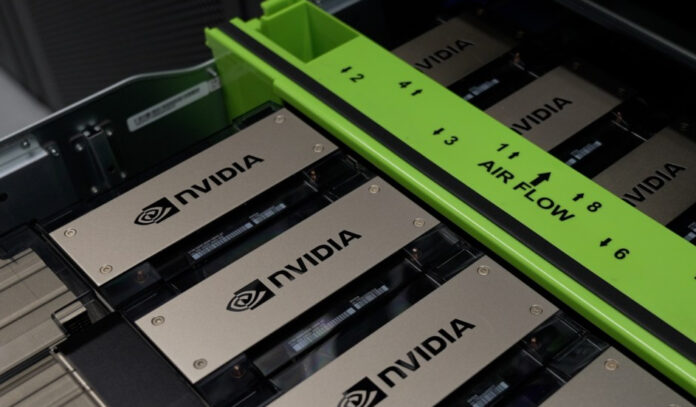

The rack that used to need a wall of fans now needs plumbing. That is the short version of what has happened inside Meta’s newest AI data centers over the last two years, and it explains why one of the more interesting stories in the AI infrastructure race is not about chips at all. It is about water.
The problem with air
For most of the internet’s history, cooling a data center meant moving air. Blow enough cold air across a server rack and the heat carried by the electronics gets carried away with it. That approach worked fine for the kind of computing that powers a Facebook News Feed or an Instagram search, and it still does. Traditional data centers used for tasks like searching for a favorite creator on Instagram or liking a post on Facebook still rely on air cooling, and even a few years ago, air cooling was an achievable solution for AI hardware. A data center in Altoona, Iowa, kept racks of 16 Nvidia H100s cool almost entirely through air, using minimal water only to cool the air itself during warmer months, with none of that water ever touching the hardware directly.
That changed as AI accelerators got hungrier. Training and running today’s large models means packing far more powerful, far hotter chips into the same physical space, and at a certain density, air simply stops being able to carry heat away fast enough. Direct to chip and rear door liquid cooling approaches exist precisely because they circulate coolant directly to the processor rather than cooling an entire room, which allows for higher operating temperatures and greater use of free, ambient air cooling. Water conducts heat far more effectively than air does, which is the entire reason the industry has spent the last few years quietly replumbing its data centers.
What closed loop cooling actually is
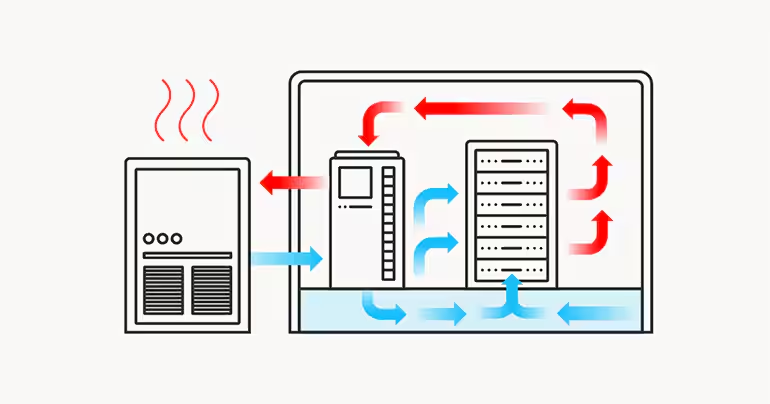
The mechanism itself is not exotic. A liquid coolant, a mix of water and glycol, is passed through the server hardware to move heat away from the racks. The important design choice is what happens next. Rather than expelling that liquid from the facility, it gets pumped through a series of heat exchangers that dissipate and transfer the heat away from the liquid, and once it has cooled down it is sent back around to the server racks in a continuous loop. The same batch of coolant just keeps making the trip, over and over, rather than being consumed and replaced.
Meta says that consistency is remarkable in its own right. The company expects to use the same coolant mixture for up to a decade without needing to replace it. A useful comparison, and one that shows up repeatedly across the industry, is the air conditioner sitting in a window or a car’s radiator. An air conditioner is a closed loop system because the cooling fluid inside it circulates in a sealed loop and is reused, and data centers are increasingly applying that same basic idea at a much larger scale.
This is worth dwelling on because it cuts against a common assumption about AI infrastructure. There is a widespread misconception that AI data centers are automatically heavy water users, but the reality depends entirely on the cooling design, and Meta’s closed loop system recirculates water in a sealed loop, using very little on an ongoing basis. The evaporative systems that earned data centers their reputation as water hogs work more like a swamp cooler. In evaporative cooling, water is consumed in the process and must be continuously replaced, unlike a sealed, closed loop system. Closed loop and evaporative are not the same category of technology, even though both get lumped under liquid cooling in casual conversation.
Retrofitting old buildings
Not every data center Meta operates was built with liquid cooling in mind, and ripping out an existing facility’s floor to install piping is expensive and slow. Meta’s answer is a bridge technology called Air Assisted Liquid Cooling, or AALC. When Meta needs to place liquid cooled equipment into facilities that lack built in liquid cooling infrastructure, it uses AALC, which consists of racks containing pumps and heat exchangers that function like the large building level system on a smaller, more distributed scale. Practically, that means an adjacent rack does the work a whole building’s plumbing would otherwise do. AALC uses a closed loop cooling system with a rear door heat exchanger, where cool air from the existing room level cooling passes through the rear door to cool the hot water exiting the server, and a Reservoir and Pumping Unit housed in an adjacent rack keeps the water moving through the cold plates and heat exchanger. It lets Meta slot high power GPU racks into buildings that were never designed for them, without a full construction overhaul.
Why density is the real payoff
Water conservation gets most of the headlines, but engineers inside Meta describe the space efficiency argument as the bigger deal. Attempting to cool the same servers with air would likely require nearly double the size of the server tray to fit the necessary air cooling equipment, which means a much larger tray for the same amount of compute, eventually hitting diminishing returns as air cooled solutions get larger and larger. Liquid cooling flips that math. With direct to chip closed loop liquid cooling, engineers can fit far more GPUs into the same sized server rack, which means fewer racks are needed overall, so a facility of the same physical footprint can scale its compute capacity without needing more space. In an era where new data center capacity is bottlenecked by land, permitting, and power interconnection, squeezing more compute into an existing shell is arguably more valuable to Meta than the water savings.
Open sourcing the plumbing
Meta has a long habit of publishing its infrastructure designs rather than keeping them proprietary, largely through the Open Compute Project, the open source hardware and software initiative it helped found in 2011. Consistent with that legacy, in 2025 Meta announced IcePack, a liquid cooled network rack platform shared openly and for free through the Open Compute Project. The logic mirrors what Meta has done with chip designs and server racks for over a decade. If the whole industry adopts a common cooling standard, component suppliers build at scale, costs fall, and Meta benefits from a supply chain it does not have to build alone.
Letting software tune the thermostat
The newest layer of Meta’s cooling strategy is not mechanical at all. Meta’s engineering teams have started using reinforcement learning to optimize how the cooling infrastructure behaves. Cooling a data center is not as simple as picking a temperature and leaving the system running, since conditions change constantly depending on the weather, the location, and how much work the servers are doing, meaning cooling infrastructure has to be purpose built and flexible for each site. Rather than experimenting on live, production hardware, Meta’s engineers built a physics based simulator of a data center environment that can model variables such as weather conditions, server load, and the behavior of the cooling equipment, giving a reinforcement learning model a safe space to test decisions that reduce cooling demand while keeping servers within safe operating conditions. The results were tangible enough to move past the pilot stage. In a pilot at one Meta data center, this reinforcement learning approach cut the energy consumed by air cooling supply fans by an average of 20 percent, while also reducing water usage by 4 percent across varying weather conditions, and the approach has since scaled across the air cooled portion of Meta’s fleet.
How it stacks up against the rest of the industry
Meta is far from alone in making this pivot, and comparing notes across the big cloud and AI infrastructure players shows both a shared direction and some real differences in approach.
Microsoft has leaned hardest into the marketing of near zero water consumption. Its newest Fairwater class facilities push the vast majority of cooling load onto a sealed system. Over 90 percent of one new facility’s cooling relies on a closed loop liquid cooling system that is filled once during construction and then continuously recirculates that same water. Microsoft has framed the shift around its water positive by 2030 pledge, and has said publicly that some of its newest AI facilities use, on an annual basis, roughly as much water as a single restaurant, a comparison Meta makes about its own facilities as well. A typical AI optimized data center using a closed loop liquid cooling system with dry coolers uses less water annually than a couple of full service restaurants.
Google took a different path to arrive in roughly the same place, driven by its custom TPU chips rather than third party GPUs. Google first showed off liquid cooling for its hardware years ago, when its TPU v3 chips generated more heat than the company’s existing data center cooling solutions could handle, bringing coolant directly to a cold plate sitting atop each chip. That approach has matured considerably since. Google’s Project Deschutes cooling distribution unit design now delivers 2 megawatts of cooling at a 3 degree Celsius approach temperature, with the company describing seven years of experience deploying closed loop systems across more than 2,000 TPU pods at gigawatt scale, citing 99.999 percent uptime. Google has also emphasized the physics behind the shift more explicitly than most competitors. The company notes that water conducts heat roughly 4,000 times more effectively than air, which is the physical basis for why liquid to liquid cooling has become a requirement rather than an optional upgrade as chip densities pass 50 kilowatts per rack and head toward 100 kilowatts and beyond. Zero water sites are also part of Google’s roadmap. Google has zero water pilot sites in Phoenix, Arizona and Mount Pleasant, Wisconsin as of 2026, with a scale up of additional zero water sites planned for late 2027.
Oracle has taken the most consumer friendly, explain it like a household appliance approach to describing the same underlying technology. Oracle’s data centers use a direct to chip, closed loop, non evaporative liquid cooling system that reuses water and only needs to be filled once, a choice the company frames explicitly around helping nearby communities understand what its new AI facilities will and will not draw from local water supplies. Oracle plans to deploy similar systems at upcoming sites in New Mexico, Michigan, Texas, and Wisconsin, the same regions where Meta, Microsoft, and Google are all also racing to build.
Nvidia, for its part, has started treating closed loop liquid cooling as a baseline spec for its hardware rather than something left to individual data center operators to figure out. Nvidia describes its Rubin architecture as the industry’s first entirely liquid cooled AI infrastructure platform, with closed loops operating at up to 45 degrees Celsius that can bring facility cooling water consumption down from roughly 2.6 million gallons per megawatt annually under conventional cooling tower systems to near zero. Nvidia’s director of data center cooling and infrastructure has described the shift in blunt terms. Because these systems rely on dry coolers rather than evaporation for roughly 99 percent of the year, the change effectively eliminates massive amounts of power usage and nearly all water usage.
Where the companies genuinely diverge is not so much the cooling technology itself, which has converged on the same closed loop principle industry wide, but how much of each company’s fleet actually runs on it, and how transparent each company is about the numbers. Google disclosed using 10.9 billion gallons of water in 2025, an increase of 34 percent, while Amazon disclosed 2.5 billion gallons, and analysts have noted that the gap between companies is not primarily a technology story since Amazon and Google both operate at scale and use similar cooling architectures in many regions, but instead reflects differences in fleet composition, geographic siting, and how quickly AI workloads have been absorbed into each company’s infrastructure. Meta’s own disclosures lag the other hyperscalers. Meta’s most recently disclosed water figure was 813 million gallons in 2023, and its 2025 figure had not yet been published as of mid 2026, with analysts estimating Meta’s 2025 consumption at approximately 1 billion gallons based on its capacity expansion rate.
The bigger picture
The industry wide numbers suggest this is now the default architecture for frontier AI hardware, not a boutique option. Google has taken the lead among cloud service providers in extending liquid cooling from individual servers to full rack scale system designs, and analysts at TrendForce project liquid cooling penetration among AI chips will reach 53 percent in 2026 and approach 60 percent in 2027. That trajectory tracks with how quickly rack power densities have climbed industry wide, and closed loop liquid cooling is the common answer every major player has landed on, even as they differ on how fast they are rolling it out, how much of it is retrofit versus purpose built, and how forthcoming they are willing to be about the underlying numbers.
The plumbing, in other words, turned out to be just as important a competitive battleground as the chips running through it.
