

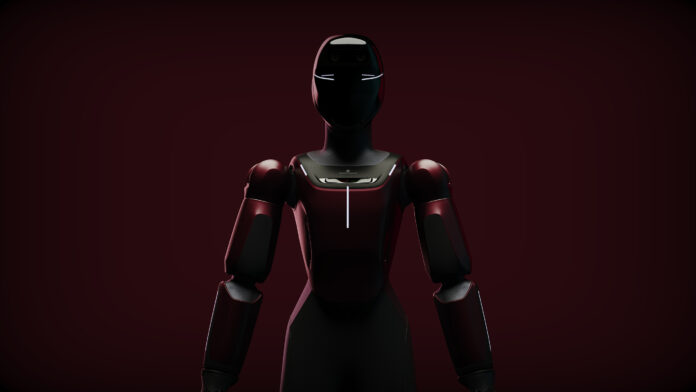

Generative Bionics’ appearance at CES 2026 marked its first major public step into the global conversation around humanoid robotics. The Italian company unveiled GENE.01 during the AMD opening keynote, presenting it as a foundational concept rather than a finished commercial robot. The message was clear and deliberately grounded: this is about setting direction, not making bold promises.
GENE.01 introduces how Generative Bionics thinks about humanoid robots, from design and hardware to how intelligence is distributed across the system. The timing is significant. The unveiling follows an $81 million funding round, one of the largest in Europe for humanoid robotics, and represents the first visible checkpoint in the company’s industrial roadmap. Rather than focusing on near term commercialization, the company used CES to explain what it is building toward and why that approach matters.
At the center of the concept is a simple but important idea. Intelligence in a humanoid robot should not sit only in a central processor. Instead, it should emerge from the interaction between the robot’s body, its sensors, and its control systems. During the keynote, Generative Bionics CEO Daniele Pucci, joined by AMD Chair and CEO Dr. Lisa Su, described this as Physical AI, an approach inspired by how humans move and react in the real world. People rely on fast physical feedback and local reflexes as much as on conscious reasoning, and GENE.01 is designed around the same principle.
This way of thinking shows up clearly in the robot’s tactile skin. GENE.01 is covered in a full body network of touch and force sensors that allow it to detect contact, pressure, and small interactions across its entire surface. Touch is not treated as a secondary feature or a safety add on. It is a primary source of information that helps the robot respond quickly and appropriately when working around people. In practical terms, this means safer interaction and better adaptation in environments that are unpredictable and shared with humans.
Design plays a supporting role in making that interaction work. GENE.01 reflects an Italian design approach where form and function are closely linked. Its proportions, posture, and movement are meant to be easy to read, helping people understand what the robot is doing and what it will do next. This is less about aesthetics and more about usability. Clear design helps reduce uncertainty and builds trust, which matters when machines are operating alongside human workers.
The computing side of GENE.01 is built in close collaboration with AMD, which is both an investor and a technology partner. AMD provides the CPUs, GPUs, and FPGA based embedded platforms that handle real time perception, control, and decision making. Together, these components support three core ideas behind the system. The first is treating the body as part of the compute, with processing happening close to sensors to reduce latency and improve efficiency. The second is enabling fast, low latency integration of tactile, visual, and force data so the robot can react safely during physical contact. The third is maintaining an open development approach, using open toolchains and platforms so the system can evolve over time rather than being locked into a closed stack.
That openness connects directly to how Generative Bionics sees industrial adoption. GENE.01 is designed to learn from physical experience and gradually refine its behavior, rather than relying entirely on pre programmed actions. This matters in real factories, where conditions change, tasks vary, and flexibility often matters more than speed or precision alone.
The company’s focus is closely aligned with the structure of European manufacturing, especially in Italy, where many factories are small or mid sized and rely on a mix of manual work and partial automation. In these environments, traditional industrial robots can be difficult to deploy because they require rigid workflows and major changes to existing layouts. Humanoid robots, by contrast, can fit into existing processes more easily, working alongside people without forcing a complete redesign of the facility.
GENE.01 also arrives at a time when labor challenges are becoming harder to ignore. Aging populations and smaller workforces are putting pressure on productivity across many industries. In that context, automation is increasingly seen as a necessity rather than a long term experiment. Generative Bionics positions its humanoids as tools meant to support human work, not replace it, with an emphasis on safety, adaptability, and clarity of interaction.
The concept is backed by a long research history at the Italian Institute of Technology, including projects like iCub and ergoCub, which explored embodied intelligence and safe human robot collaboration over more than a decade. That background gives context to GENE.01. It is not a sudden shift, but the next step in a longer effort to move humanoid robots out of research settings and closer to real world use.
In that sense, GENE.01 works best as a reference point. It defines the design language, technical approach, and underlying assumptions that will guide future Generative Bionics humanoids. Rather than presenting a dramatic leap forward, the company offers a measured view of how embodied intelligence could be introduced into industrial environments in a practical, understandable way.
