
HomeNewsTechnologyAutonomous Mobility Service is now available at Haneda Airport

Autonomous Mobility Service is now available at Haneda Airport

follow us on Google News

Haneda Airport, one of the largest airports in Japan, has been highly acclaimed in various rankings regarding usability and comfort of airports around the world and welcomed many tourists to Japan and also Tokyo in 2019, with the worldʼs 5th largest number of passengers arriving at and departing.

Haneda Airport
Haneda Airport

As of August 2021, two WHILL stations are implemented and working inside Haneda Airportʼs Terminal 1 and Terminal 2, respectively. The final goal is to have eight stations, four in each of the Terminals 1 and 2, with three WHILL devices per station for a total of twenty-four devices. While they currently sport a simple, Japanese-only interface with a limited number of destinations, the number of languages and destinations available can be easily increased and customized. Furthermore, application to Terminal 3 (International Terminal) is to be considered in collaboration with international airlines in the future.

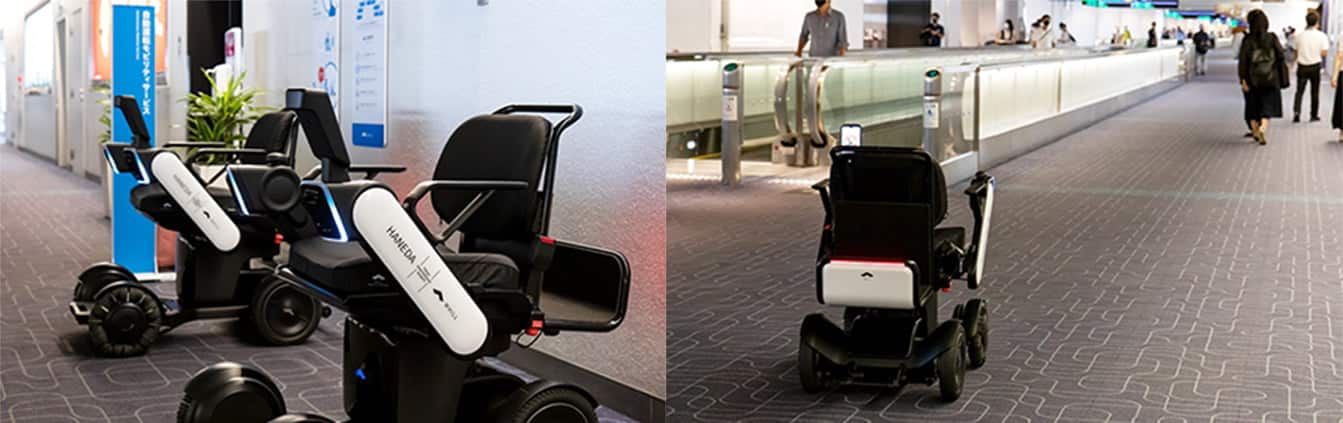
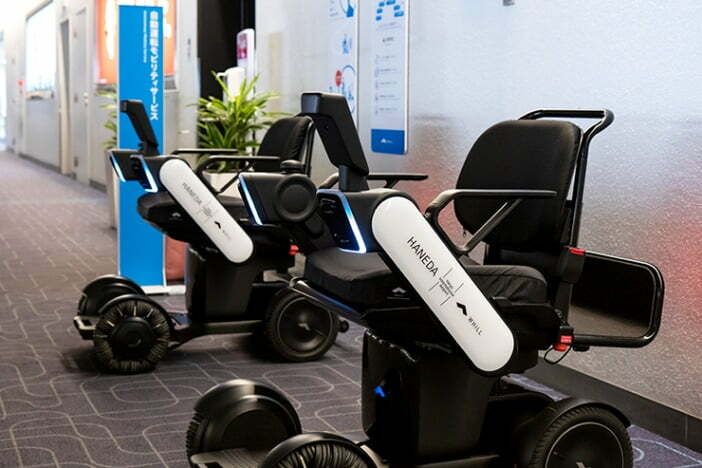
The WHILL Autonomous Mobility Service looks like a common wheelchair, but it is completely automatic and moves without the need for any airport staff, carrying people to various destinations within the airport. This is the worldʼs first implementation of autopilot personal mobility services at airports.

Autonomous Mobility Service at Haneda Airport

The WHILL Autonomous Mobility Service can be used by anyone free of charge. WHILL stations are located in several places inside the airport, such as near the entrance to the gates area after the security check. The station is unmanned, with instruction signs (currently in Japanese and English). To use the Autonomous Mobility Service, the user just sits on one of the chairs, which also have a baggage slot on the back. The integrated tablet prompts the user to choose one of the available destinations. Once the destination is entered, a countdown starts and the WHILL sets in motion. The user can stop the ride at any time by simply tapping the “pause” icon on the screen, and resume whenever they want. Once arrived at the destination, WHILL can be left where it is and it will automatically return itself to its designated station. The user can also pause and dismount before arriving at the destination, and leave WHILL to return itself to the station.
Ads
Autonomous Mobility Service at Haneda Airport

WHILL is equipped with sensors to recognize obstacles in its path, and it automatically stops if it detects something or someone in front of it. Once the way is clear, it automatically resumes its course.  Its main target are people with reduced mobility and disabilities, but it is available for anyone to use.   Compared to the traditional wheelchair, WHILL minimizes contact with airport staff, making it a preferable solution to manned services. Some users might also feel more comfortable with a fully automatic system that does not require them to ask for help.

Haneda Robotics Lab is working on a number of other useful services, some of which are already available inside the airport, including information robots, cleaning robots, and a face mask with incorporated translation features.

Julie Nguyen
Julie Nguyen

Julie is the founder of SNAP TASTE and a driving force in global storytelling, innovation, and creative leadership. A respected member of the Harvard Business Review Advisory Council, she also serves as a judge for the CES Innovation Awards (2024, 2025, and 2026), bringing her perspective to the intersections of business, culture, and breakthrough technologies.

Her immersive reporting has taken audiences behind the scenes of defining world moments, from the FIFA World Cup Qatar 2022 and Expo 2020 Dubai to CES, D23 Expo, and the Milano Monza Motor Show. Through her lens, global events become intimate, human stories.

An accomplished film critic and editorial voice, Julie has built a reputation for reviews that go beyond analysis, finding the heartbeat within the frame. Her work on National Geographic documentaries and other cinematic works speaks to audiences who believe that great storytelling has the power to shift perspectives and expand the world.

At the heart of everything Julie does is a belief that art, technology, and culture are not separate conversations. She has spent her career proving they never were.

Ad

Leave a Reply

More to Explore

AI Won’t Replace the 3D Artist, But It Will Change How They Work

For years, 3D artists have carried the same quiet burden: the gap between an idea and the finished model is long, tedious, and full...

Inside IFA Berlin 2026: AI Moves From Feature to Foundation of the Smart Home

IFA Berlin, one of the largest events in the world for consumer electronics, home appliances, and future tech, spent its opening days making one...

Google’s Gemini 3.8 Flash arrives with a cybersecurity sibling built for autonomous patching

Google is not slowing down. On September 2, 2026, the company rolled out Gemini 3.8 Flash, a new entry in its Flash lineup that...

Closed-Loop Cooling Explained: How Meta, Google, and Microsoft Are Solving AI’s Water Problem

The rack that used to need a wall of fans now needs plumbing. That is the short version of what has happened inside Meta's...

Google Flow gets a serious upgrade with Gemini Omni 1.1 Flash

Google is giving its AI filmmaking tool another major push forward. At its I/O developer conference earlier this year, the company introduced Gemini Omni...

Apple’s New Mac Mini Gets a Major AI Upgrade With M6 and M5 Pro Chips

Apple has unveiled a refreshed Mac mini, and the headline story is a big one for anyone who cares about on device AI performance....

Mac Studio Gets M5 Ultra, Thunderbolt 5, and Up to 512GB of Memory for Local AI

Apple's latest Mac Studio refresh lands as one of the more substantial internal updates the machine has seen since it first launched, and the...

Blender 5.2 LTS Features Guide: Node Editor, Outliner, and Interface Changes Explained

Blender 5.2 LTS shipped on July 14th, 2026, and it is not the modest interface polish pass the original document made it out to...

Blender Basics: The Beginner Guide Nobody Handed You

Okay, so you downloaded Blender. Good. That already puts you ahead of most people who talk about wanting to make 3D art and then...

Unity 7 Is Coming, and It’s Rethinking How Games Get Made

Game development has quietly become a team sport that includes AI. Studios of every size are now mixing human designers, artists, and producers with...

Red Dot Names Its 2026 Best of the Best: What the Winners Say About Where Design Is Headed

Essen doesn't usually make headlines, but for one night every year, the German city becomes ground zero for the design world. On July 7,...

From Pixels to the Body: Inside Midjourney’s Surprise Leap Into Medical Hardware

Midjourney has spent four years training the public to think of it as a company that turns text prompts into pictures. This week the...

Handpicked for You

You Might Also Like