


There is a particular quality to light on the Sancerrois hill in late afternoon, when the vines below turn the color of hammered brass and the Loire, somewhere past the rooftops, catches the sun in long, distracted flashes. It is the kind of light that makes a place feel less discovered than remembered, and it falls, most evenings, on a château that spent a century and a half declining to be seen.
For 150 years, the Château de Sancerre kept its distance. A private residence perched above one of France’s most storied wine appellations, it watched the vineyards ripen and the tourists pass without ever opening its gates. Now it has, and the result, Les Hauts de Sancerre, is less a hotel in the conventional sense than a slow, deliberate unveiling, a place still mid sentence, still becoming.
A Fortress That Refused to Disappear
The site’s memory runs deeper than the château itself. In the fourteenth century, the Counts of Sancerre built a fortress here, commanding the hill and its views with the blunt confidence of medieval power. Louis XIII had most of it dismantled in the seventeenth century, the kind of royal erasure that tends to leave only fragments behind. What survived was the Tour des Fiefs, forty meters of pale stone that still rises above the vines like a held breath, the last honest witness to everything that came before.
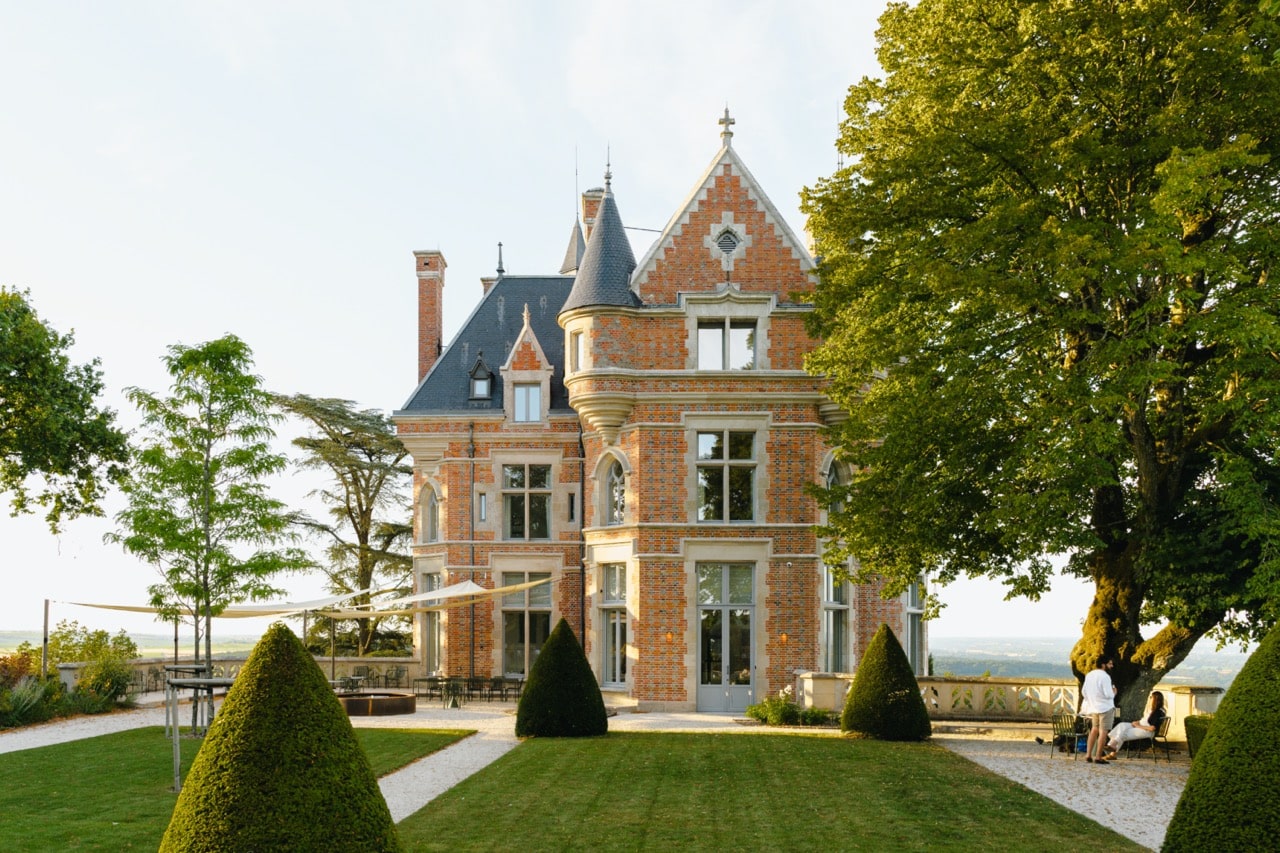
It was the d’Uzès family, in the nineteenth century, who gave the hill its second act, building the château that stands today and softening the fortress’s old severity into a romantic park, one that treated the ruins not as debris to be cleared but as characters worth keeping. The result is a landscape that reads like a palimpsest, each century visible beneath the last, the medieval tower and the nineteenth century folly sharing the same sightline over the same river.
Then came the long silence. The property passed eventually to the Marnier Lapostolle family and closed to the public entirely, a private world hidden in plain sight above a village that lived, quite publicly, on wine. It might have stayed that way indefinitely had Audrey Dumont and David Chicard not written, almost speculatively, to the family that owned it. The reply came quickly. The acquisition, improbably, followed within days. What began as a piece of correspondence became, through their tourism investment vehicle Collectible.house, a years long act of restoration, one still very much in progress.
A Village Assembling Itself
Les Hauts de Sancerre does not present itself all at once. Spread across 4.5 hectares and four historic buildings, including the château and the Tour des Fiefs, it has the unhurried logic of a village rather than the fixed completeness of a resort. It opened its first chapter on July 1, 2025, with eight suites divided between the château and La Villa des Cedres, a wellness space, a wine library set into the château’s twelfth century cellar, and a pop up restaurant that felt, deliberately, like a rehearsal for something larger.
The plan extends to 2027, by which point the estate intends to hold 27 rooms across its four buildings, alongside a signature restaurant, a permaculture garden, a landscaped pool, a full spa, and a scattering of ten to fifteen forest lodgings tucked into the wooded edges of the property. There is something almost narrative about this staging, a hotel that unfolds in installments rather than announcing itself complete on opening day, as though the château understands that trust, like restoration, cannot be rushed.
Entry to the grounds still carries the theater of the old fortress. Guests arrive through the Porte César, with a second exit at the Place du Connetable, and can choose between a gentler pedestrian route to the esplanade or a steeper path favored by the more athletically inclined. Each evening, from six o’clock until sunset, the Tour des Fiefs opens to hotel guests, its narrow stair delivering them to a view that makes the whole valley feel, briefly, like private property.
Restraint as a Design Philosophy
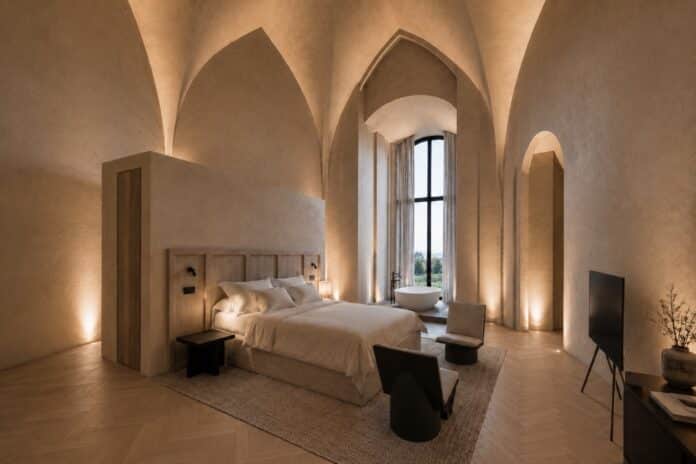
The interior transformation, led by designer Jerome Lescrenier, resists the temptation to compete with the château’s ornate, weathered façade. Inside, the palette turns quiet: natural stone, pale woods, rooms stripped of clutter and given over to space and light. It is a decision that trusts the architecture to carry the emotional weight, rather than layering on the gilt and brocade one might expect from a nineteenth century château. The effect is closer to a monastery reimagined by a minimalist than to a conventional grand hotel, proportions borrowed from history, atmosphere entirely of the present.
Art as Inheritance
Contemporary art here is not decoration so much as argument, a way of insisting that a building this old can still have something to say about now. The program is overseen by Stanislas de Poucques, formerly at the helm of Brussels’ Museum of Contemporary Art, taking on his first hotel commission with a curatorial eye tuned to conversation rather than contrast.
The inaugural season paired fifteen woven, geometric pieces by Emma Terweduwe with the raw, unresolved textures of Roan van Oort’s canvases, an interplay of precision and instinct that suits a property caught between eras. Elsewhere on the grounds, a monumental sculpture titled Hexa 8, a relic of a 2024 exhibition staged in partnership with the Vasarely Foundation, still stands, a leftover from the summer the château first tested what it might mean to let the public back in. That exhibition, as it turned out, drew more than 30,000 visitors before the hotel itself had even opened its doors, an early sign that the château’s second life would be watched closely.
The Table: A Story Told in Courses
If the architecture speaks in restraint, the kitchen speaks in memory, and it has grown more articulate with time.
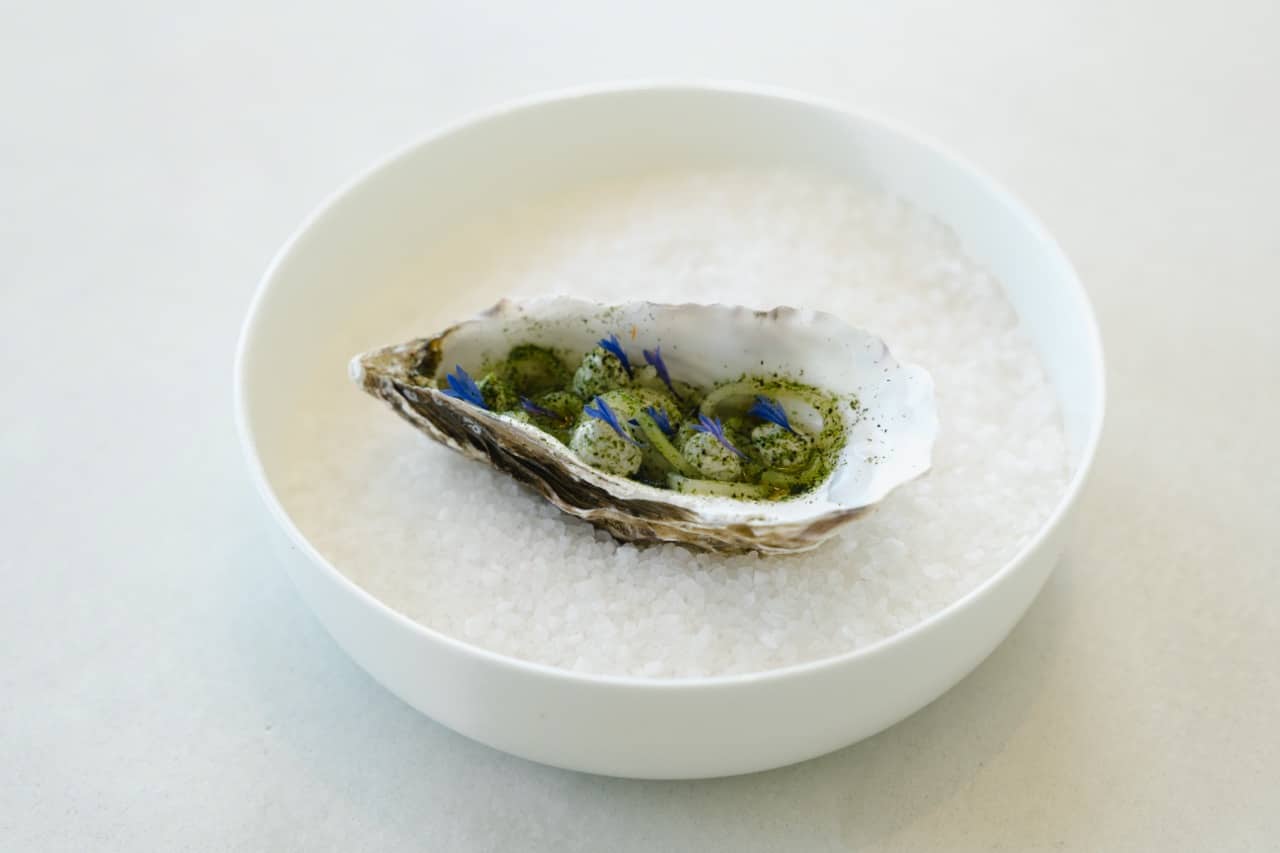
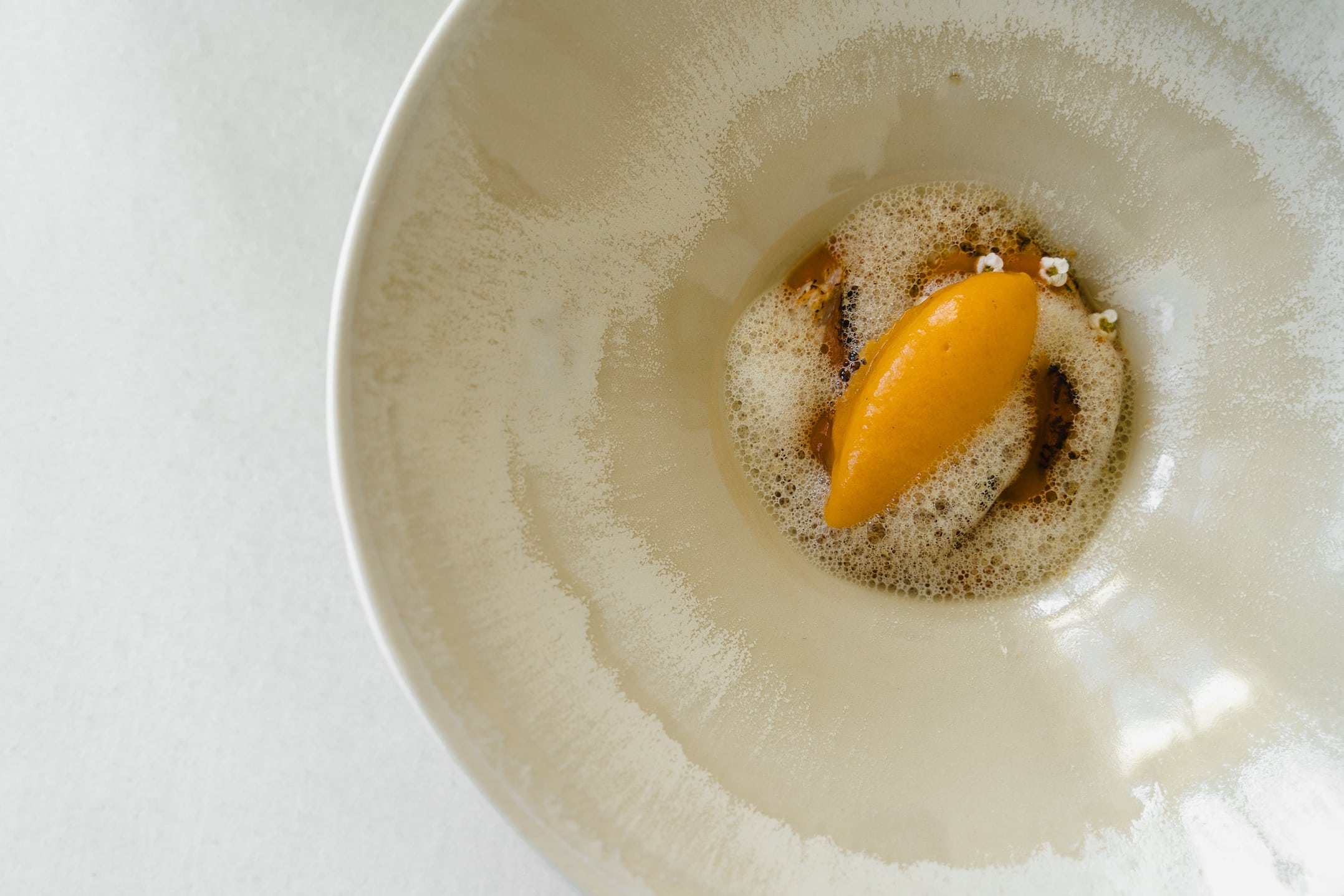
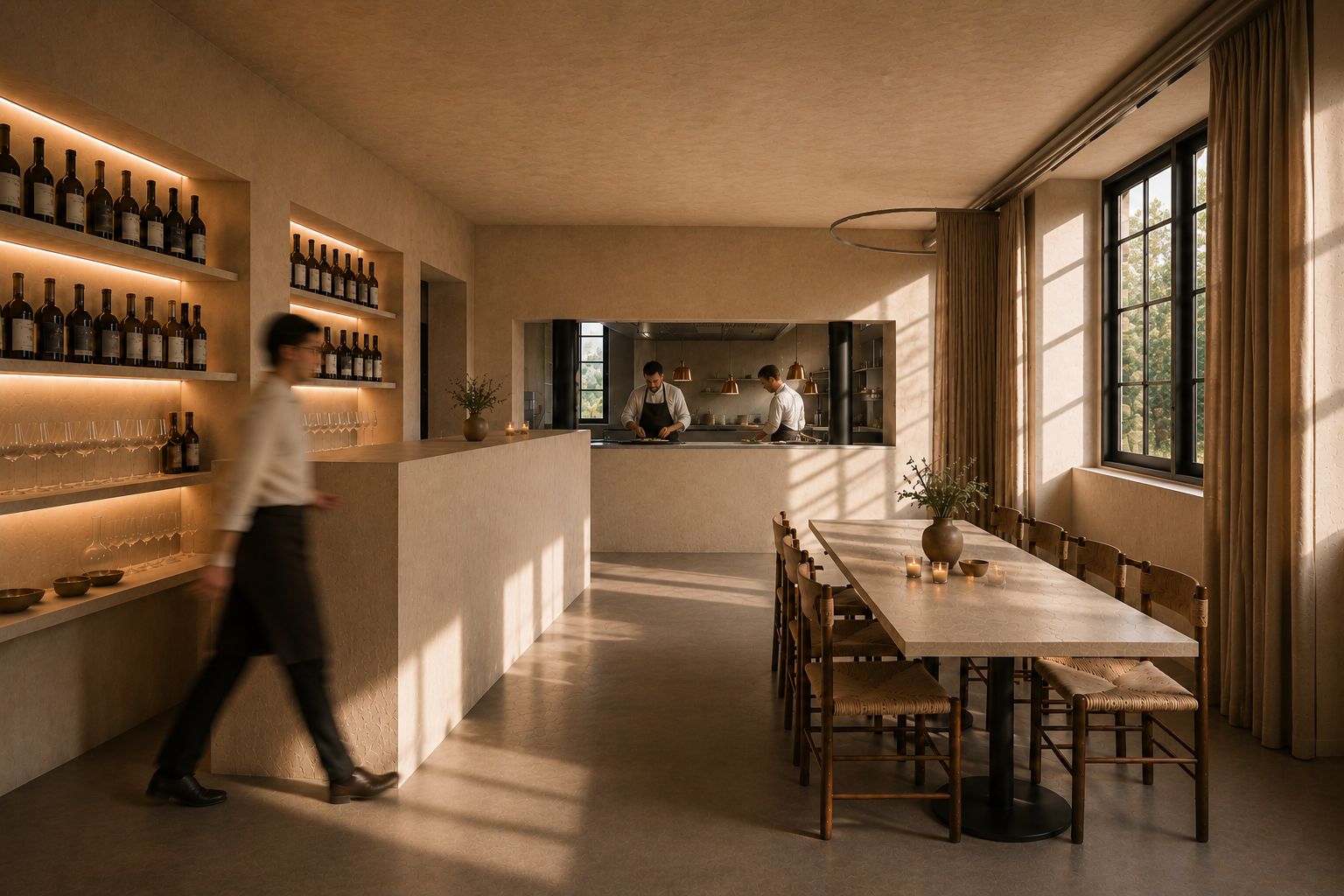
The estate’s first culinary chapter belonged to La Table d’Arnaud, an intimate sixteen seat dining room led by chef Arnaud Munster, a Belgian raised inside a family of Michelin starred restaurateurs and known more widely for his turn on season fifteen of Top Chef. His cooking, shaped by the precision of chefs like Jonnie Boer and Mauro Colagreco, favored a single evolving tasting menu at 90 euros, matched with wines chosen as much for mood as for pairing logic. It felt, from the start, like a promise rather than a destination, a chef testing ideas he intended to expand.
That expansion arrived roughly a year later, with the opening of L’Atelier du Cedre, a room grown to 32 seats and a kitchen now shared between Arnaud and his father, Eddy Munster, a Michelin starred chef whose arrival turns the restaurant into something closer to a family conversation than a solo performance. Their menu reaches back millions of years, to a version of Sancerre that existed beneath an ancient sea, the geological ancestor of the terres blanches, caillottes, and silex that still define the region’s wines today. Each dish, in their telling, is a small act of translation, carrying that submerged history forward into the present vineyard, the plate itself a kind of sediment, layered and legible if you know how to read it. It is a concept that only makes sense in a place this old, where the ground beneath the dining room has its own long memory to draw from, and where the wine list, understandably, leans toward Sancerre’s own bottles as the most natural possible pairing.
The table has also welcomed guests from beyond the estate’s own kitchen, including a run of four hands dinners with Thibault Nizard, the 2023 world champion of lievre a la royale, a collaboration built around seasonality and a shared reverence for terroir.
The Slow Ritual of Care
Wellness at Les Hauts de Sancerre borrows its philosophy from the forest just beyond the vineyards. The estate’s spa partner, La Chenaie, builds its treatments around the oak tree, an emblem chosen deliberately for its associations with resilience and quiet endurance, its extracts drawn sustainably from French forests and prized for their antioxidant properties.
The facial menu moves from Source de vie, a 60 minute ritual built on hydrating oak sap and priced at 110 euros, to Chene eternel, which folds Kobido massage technique into a firming treatment featuring Quercus Petraea concentrate for 125 euros. The most elaborate offering, Eveil du bourgeon, unfolds over 90 minutes and 180 euros, opening with a back relaxation sequence before moving through an oak bud extract application and a wood gua sha massage meant to even and tone the skin, a treatment that feels less like a service and more like a small ceremony.
The body treatments follow a similar logic. Immersion en foret, the estate’s signature, uses warmed pouches of oak chips and essential oils to draw tension from the body, customizable toward relaxation, decongestion, or toning, and available as a 60 minute session for 110 euros or a fuller 90 minute version, extending to face and scalp, for 160 euros. Shorter rituals, a Kobido facial massage, a scalp treatment, a foot reflexology session, each unfold over fifteen minutes at 35 euros, small punctuations rather than full sentences. In these earliest seasons, the spa exists as a single treatment room and a fitness studio, a placeholder for the fuller spa promised in the estate’s next chapter.
The Region as an Extension of the Table
The château does not attempt to contain the experience within its own walls. Guests are guided out into the surrounding landscape, toward the Charlois cooperage, where the vessels that shape Sancerre’s wines are still built by hand, and into thirteenth century cellars for tastings led by a resident oenologist who treats the wine less as product than as narrative. Bicycles carry guests through the vineyards themselves, and the ceramic village of La Borne, with its long tradition of stoneware, offers a different register of craft entirely, earth transformed by fire rather than by fermentation.
A First Anniversary, Marked in Three Gestures
A year into its second life, the château offered not a retrospective but three new additions, each extending the story rather than closing it, arriving alongside recognition from Conde Nast Traveler’s 2026 Hot List and Travel and Leisure’s list of the year’s hundred best new hotels.
The most poetic of the three is La Suite de la Tour, roughly 50 square meters carved into the very top of the Tour des Fiefs, the one piece of the medieval fortress that never stopped standing. To sleep there is to sleep inside the oldest sentence the property has ever written, with the vineyards and the river laid out below like something meant to be seen only from that particular height.
Nearby, hidden among the historic gardens, a new twelve meter lap pool now offers a quieter register entirely, a long, cool line cut into the landscape, built less for spectacle than for the kind of solitary, meditative swimming that suits a property so attuned to stillness.
And then, at last, L’Atelier du Cedre itself, the gastronomic room long promised, now open, the Munster family’s fullest culinary statement yet.
Arriving
The château sits some two hours from Paris by car, or a similar distance by direct regional train from Paris Bercy to Tracy Sancerre, followed by a short transfer up the hill. Paris Orly lies roughly two hours away, Charles de Gaulle a little further still. None of this feels like the point. The journey, like the château itself, is simply the necessary approach to something that has been waiting, patiently, to be found again.
Les Hauts de Sancerre is, in the end, less a finished hotel than an unfolding one, a place that seems to understand instinctively that the most interesting stories are the ones still being written, one restored room, one new dish, one uncovered view at a time.
