


There is a particular kind of Paris address that does not merely hold history but seems to generate it, drawing restless minds and charged moments the way certain rooms draw light. Rue Fontaine is such a street. In the early years of the last century, café-concerts lined it one after another: the Princess, the Alcazar Fontaine, the Cotton Club, where Sidney Bechet played clarinet while Alberta Hunter sang the blues into the small hours. Toulouse-Lautrec lived at No. 19. Degas kept his studio at No. 21. At No. 42, Breton and Éluard and Aragon and De Chirico invented Surrealism over arguments and absinthe. At No. 10, Django Reinhardt played at La Boîte à Matelots, a dance hall whose name, the Sailors’ Box, captures something essential about the street’s spirit: not grand, not exclusive, but alive in a way that mattered.
The question worth asking, when you stand on this street now and look up at a red neon sign blinking back to life above a minimalist sandblasted façade, is whether a place can carry memory the way a body carries muscle. Whether the particular electricity of a street, or a room, or a stage can survive long enough to be inherited.
The Bus Palladium believes that it can.
On September 30, 1965, a 22-year-old named James Arch took over a dusty dance hall on this street and switched on a red neon sign. He was a dancer in the music halls of Saint-Germain-des-Prés, an assistant to New Wave filmmakers, young enough to believe that the most interesting thing he could do with a room was make it porous: open to anyone, shaped by no single tribe, governed only by music and the willingness to move. He called it the Bus Palladium, borrowing the name from a New York club frequented by Andy Warhol and Jean-Michel Basquiat, and he meant the bus quite literally, a shuttle service from the suburbs for two francs, so that the kids from Asnières-sur-Seine could arrive at the same door as everyone else and surrender to the same dance floor.
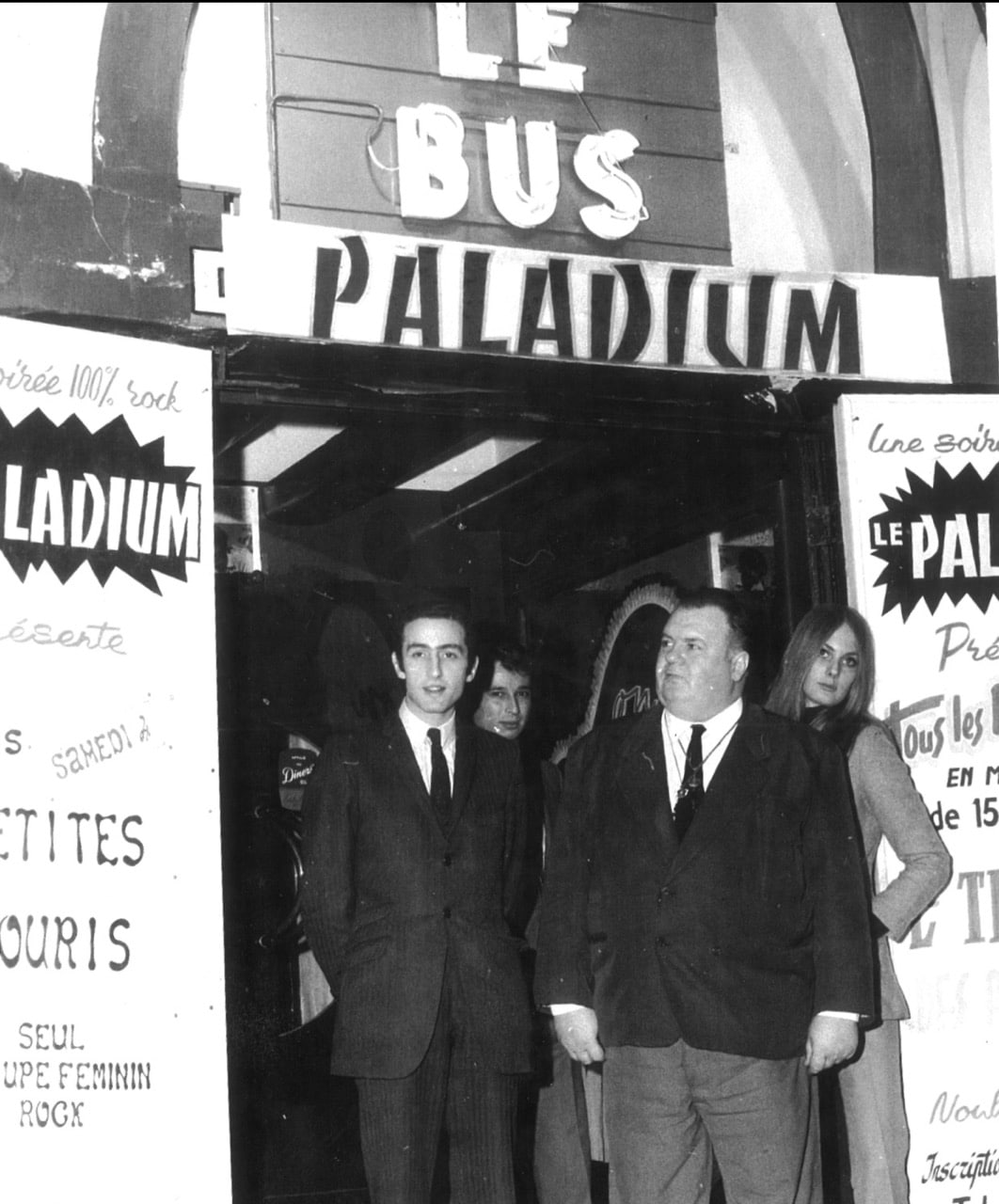
Paris in 1965 had its places: the glamorous fortresses of Régine’s and Castel’s, their velvet ropes sorting the world into those who belonged and those who did not. What Arch offered was the opposite proposition. Long-haired beatniks returning from Asia, girls in Courrèges minidresses, musicians in pointed boots, chic neighborhood regulars and suburban teenagers danced the jerk and the moonkiss under the pulse of DJs and live orchestras, and no one was checking credentials at the door. Serge Gainsbourg came almost every night, wreathed in Gitanes smoke at a corner table, and wrote the lyrics to Qui est in? Qui est out? right there, the Bus itself as the song’s central character. Brian Jones played harmonica on the small stage until dawn. Jimmy Cliff performed there. Gloria Gaynor. Jane Birkin, who understood these things intuitively, called it “a mental laboratory. One of those places where an artist immediately feels inspired without knowing exactly why.”
It lasted six months. Maurice Papon, then prefect of Paris, shut it down in March 1966 for noise complaints. A brevity that, in retrospect, feels almost characteristic: the most luminous things often are. But the dream proved harder to extinguish than the neon. The Bus was revived in 1974, the year of Bowie’s Rebel Rebel, and passed through the hands of successive stewards who understood that the room had a soul worth preserving. Sam Bernett, journalist and impresario, kept the rock spirit alive. Jean-Charles Dupuy spun records there from 1979, threading rock and funk and soul and jazz into nights where Al Pacino and Robert De Niro and Yannick Noah might be seen on the dance floor. He would later write a book about it, La nuit va nous perdre, because some experiences demand that kind of accounting. Alain Bashung played there. Indochine, Mano Negra, Rita Mitsouko, Noir Désir, The Strokes. In 2024, Pete Doherty said plainly that the Bus Palladium was one of the reasons he had wanted to move to Paris.
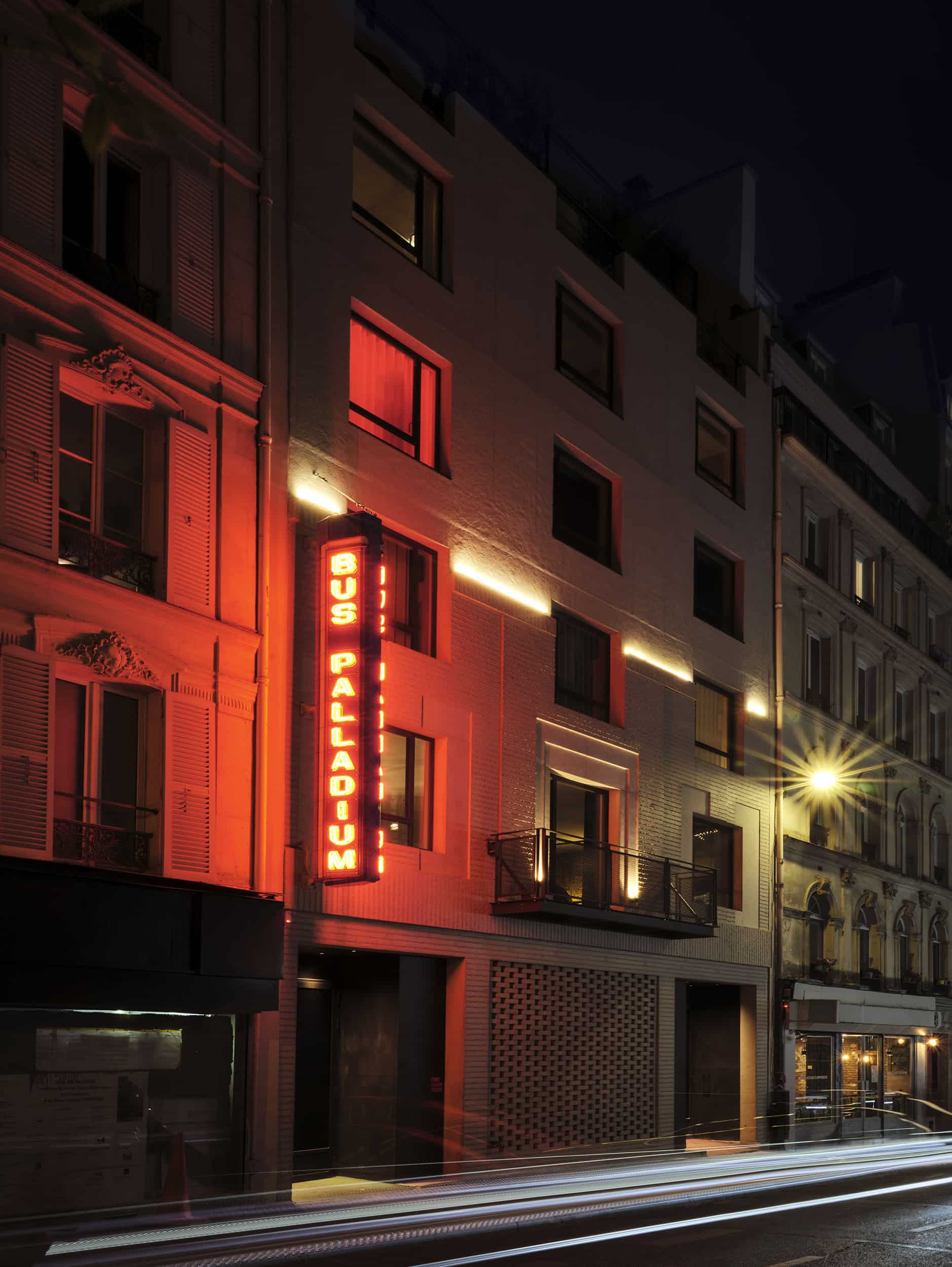
In July 2022, the doors closed for the last time. Fifty-seven years of consecutive nights.
The origin of what comes next begins, appropriately, with a game of backgammon. In 2019, Christian Casmèze, whose family has owned the building since his grandfather purchased it at the Foire du Trône fairground in 1924, sat down across from Nicolas Saltiel, founder of the hotel group Chapitre Six. What Saltiel proposed was not a renovation or a rebranding but something more genuinely ambitious: a five-star hotel that felt nothing like one. He had a specific reference in mind, not from Paris but from New York, the Chelsea Hotel at its most mythologized, that particular atmosphere of creative promiscuity where artists and musicians and writers and insomniacs and ordinary people drawn to beauty all wanted to be in the same building at the same time.
Saltiel knew the Bus from the inside, having worked there during the MOMA Group years alongside Benjamin Patou. He had since built a quiet portfolio of historically resonant addresses: La Ponche in Saint-Tropez, once the haunt of Boris Vian and Brigitte Bardot; the Cap d’Antibes Beach Hotel, where Picasso and Bonnard and Nicolas de Staël had once been regulars. His instinct, honed across these projects, is that the worst thing you can do to a place with genuine history is to museumize it, to treat the past as décor rather than inheritance.
The architecture was given to Karl Fournier and Olivier Marty of Studio KO, whose previous work includes the Yves Saint Laurent Museum in Marrakech and the restoration of the Château Marmont in Los Angeles. The structural undertaking alone was considerable: they dug 14 meters underground to construct 12 levels, four of them below grade, layering present onto past with the care of archaeologists who also happened to be building something new. The façade they designed is minimalist and sandblasted, engraved with discreet geometric motifs drawn from the original building’s vocabulary, restrained in a way that invites looking closer rather than announcing itself.
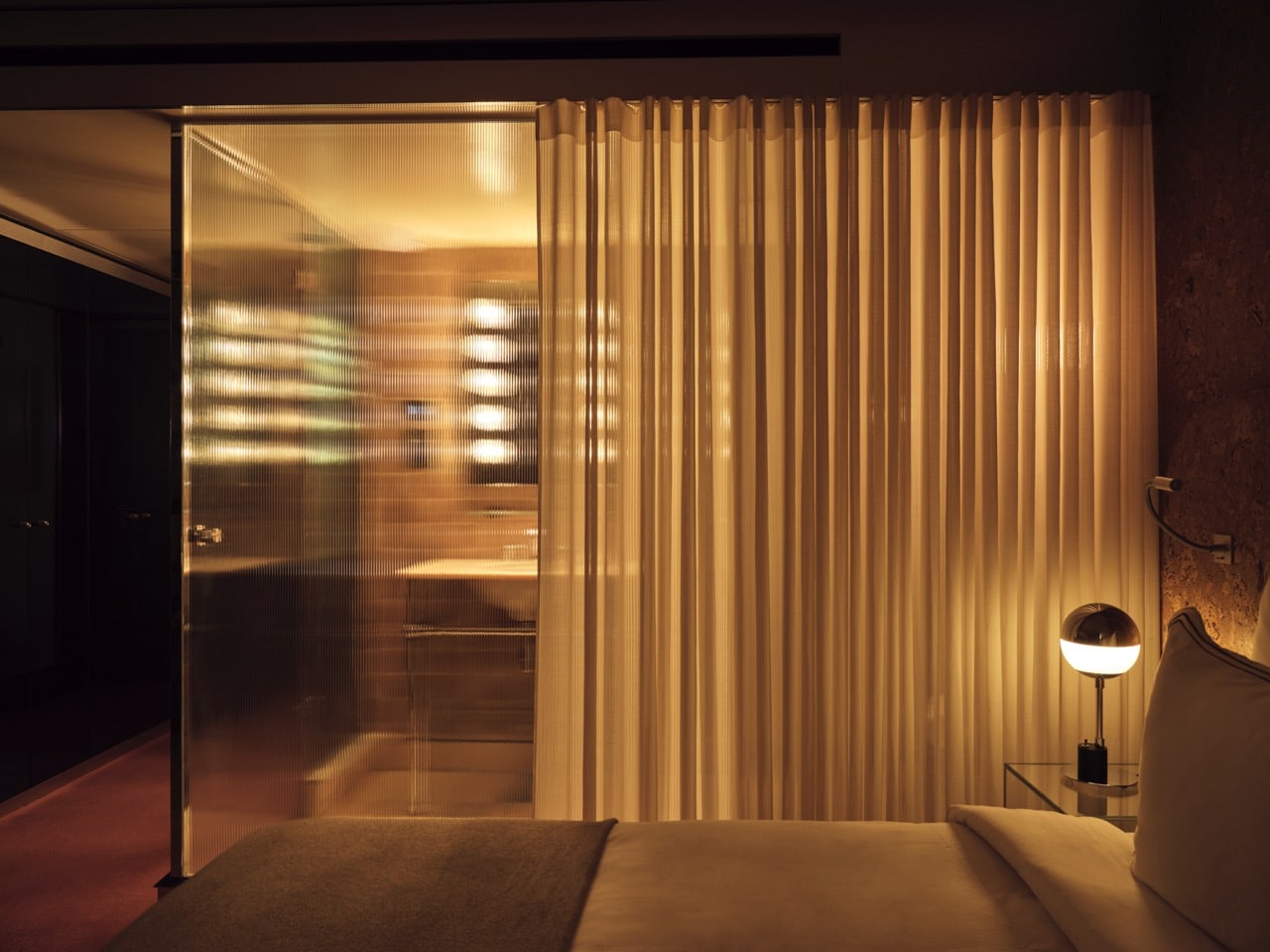
Inside, the aesthetic is cinematic, shaped by the 1960s and 1970s in the way that a certain kind of memory is shaped by a specific quality of afternoon light. Raw concrete ceilings. Cork walls that envelop rather than merely cover. Powder-pink carpeting. Bathrooms tiled entirely in Klein blue or dusty rose, revealed behind semi-transparent curtains that feel less like a privacy measure than a kind of reveal. The switches resemble vintage amplifiers. The door handles are perforated like microphone grilles. These are not decorative gestures so much as arguments, a sustained insistence that every surface in the building has something to say about the same subject.
No two rooms are alike, which is the kind of claim hotels make routinely and mean rarely. Here it reflects a genuine curatorial intention. The bedside tables are transparent cubes containing works by contemporary artists and found objects: stacks of audio cassettes, collections of books, miniature vintage buses. The objects were chosen by Ballade Sonores, the independent record store that anchors this neighborhood spiritually as much as commercially, alongside the decorative arts gallery L’Oeil de KO and collector Antoine Billore, whose eye moves instinctively between vintage pieces, curiosities, and the kind of unexpected finds that reveal a sensibility rather than just a budget. In the Dalí Suite, a vintage modular DS-600 De Sede sofa bends toward full seventies exuberance, while a Murphy bed concealed in a mirrored alcove and an original balcony looking directly onto the neon sign outside achieve something rarer than luxury: they achieve atmosphere.
Caroline de Maigret, who serves as artistic director and curator, understands that a hotel’s sensory life extends well beyond what its guests can see. She has created four exclusive playlists, played on wooden Ojas speakers in every room, each one a mood rather than a genre: intimate and sensual, drawing on Fleetwood Mac and Bill Withers and Marvin Gaye; a getting-ready playlist that moves through Prince and Grace Jones and Run DMC; a collection devoted to French music across the decades, from Jacqueline Taïeb to La Femme; and a late-night selection built for darkness and open ears, Miles Davis and Alice Coltrane and Julie London. The staff uniforms were designed in collaboration with Husbands: corduroy velvet, sharp tailoring, slightly flared high-waisted trousers, slim ties, lacquer-red belts. That particular red appears throughout the hotel like a recurring note, the sign outside, the belts, the thread of continuity running through sixty years of nights.
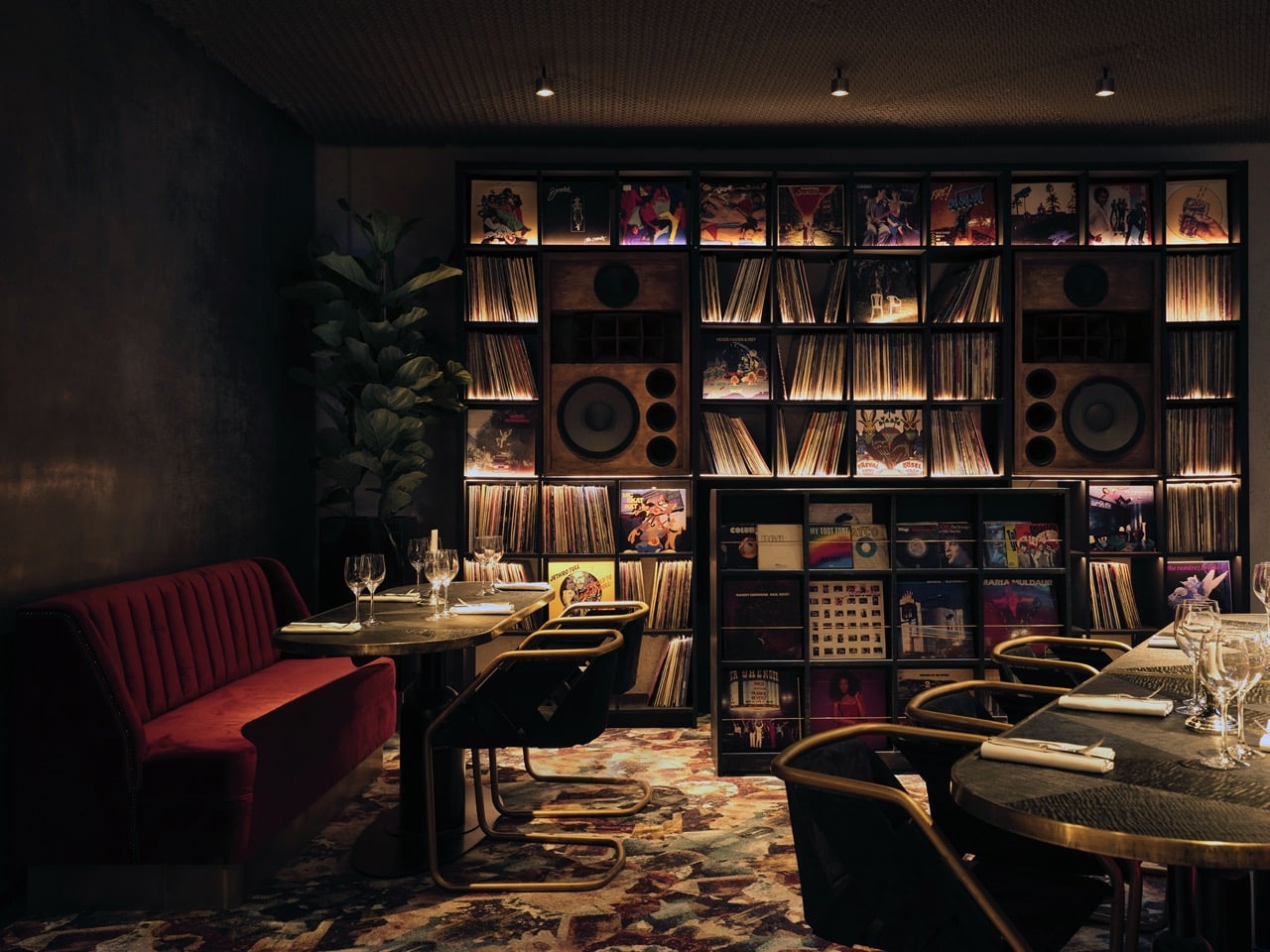
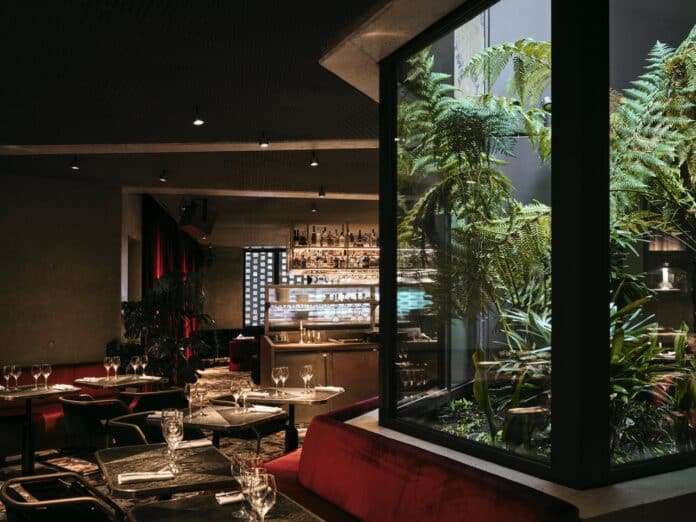
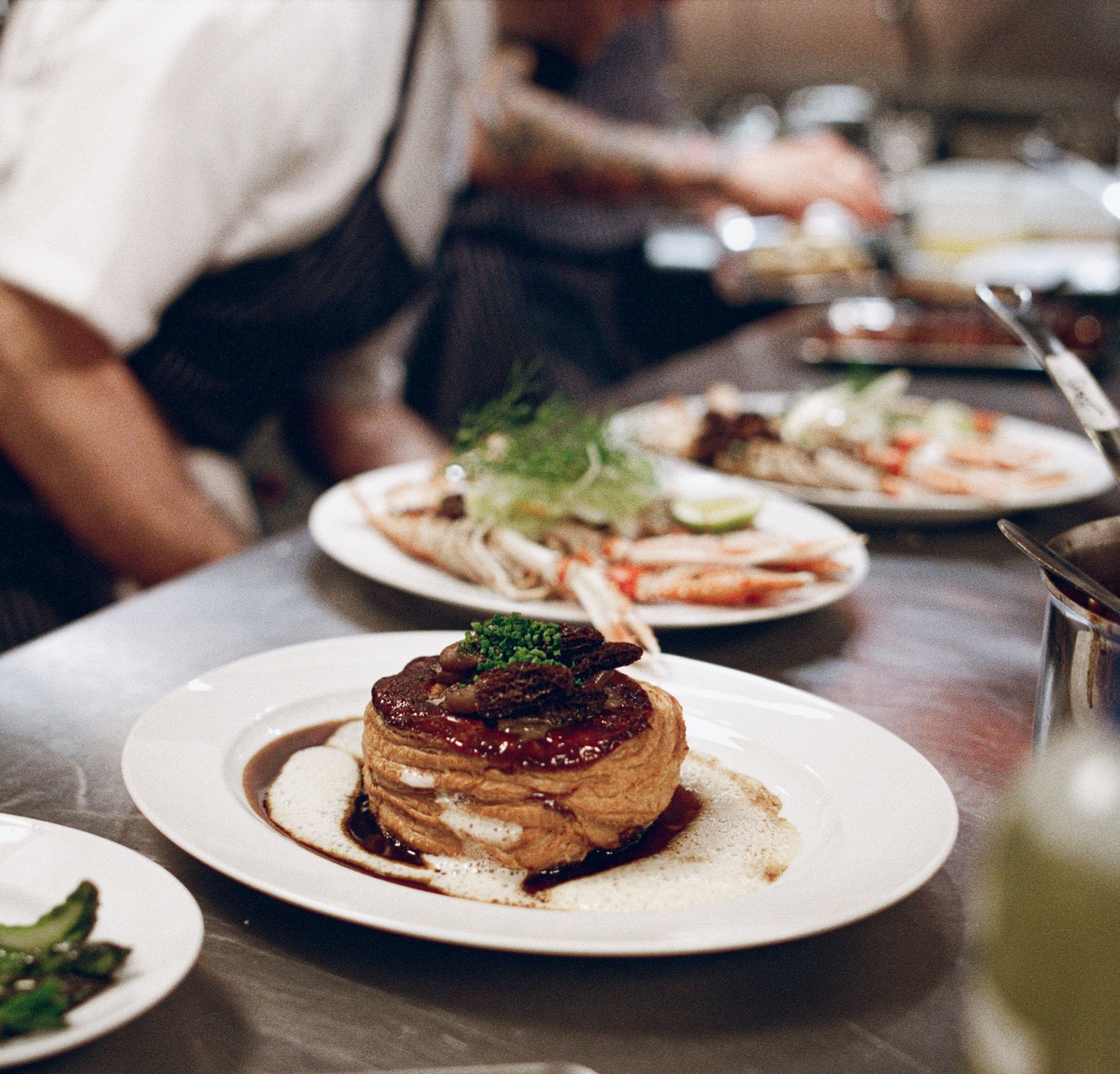
The restaurant belongs to Valentin Raffali, a young chef whose cooking carries a quality that serious food often shares with serious music: the sense that restraint and freedom are not opposites but counterparts. His menu is concise and readable, built around suppliers chosen with the same care the architects brought to materials, Viot Fish Market, Andrès Butchery, Ferme de Terroirs d’Avenir, Vessières citrus orchards. Smoked white asparagus with sweet vernal grass. Amberjack with sorrel. Barbecued red mullet with tartar sauce. Saddle of Lozère lamb. Morel mushroom vol-au-vent. An entire wall of vinyl records, including collections assembled by James Arch and Jean-Charles Dupuy across decades of listening, keeps time. The restaurant is open Monday through Saturday from 7pm to 10:30pm, staying on through the late hours when guests return from the club below.
Underground, the club beats on. Lionel Bensemoun, who shaped a generation of Paris nights through Le Baron and Petit Palace, directs the programming alongside Gary Gillet, Michael Kimmoun, and Eddie Megraoui. The intention is neither too commercial nor too niche, a refusal of formula in favor of something older and less articulable: music that makes people dance, in a room designed to let that happen. Once or twice a week, before midnight, the space transforms into a stage for discovery concerts, international musicians, cabaret evenings that blend dance and performance and something approaching theater. Then the turntables take over. The L-Acoustics sound system is among the finest in Paris. The hours are Thursday through Saturday, midnight to five in the morning, and hotel guests move through it all with the ease of people who have nowhere else they are supposed to be.
What the Bus Palladium is proposing in 2026 is not a hotel that happens to have a club, nor a club that has found a way to charge for rooms. It is something less easily categorized and more genuinely interesting: a building conceived as a single continuous experience, in which sleeping and eating and dancing and listening and being awake at four in the morning in a city that has always rewarded those who stay up late are not separate activities but aspects of the same one. You can sleep directly above the dance floor. You can come downstairs in the middle of the night and go back up at dawn while Paris is still quiet. The music is not ambiance. It is the reason for being here.
There is a word in French, une ambiance, that carries more weight than its English translation allows. It describes not just an atmosphere but a particular quality of presence, the feeling that something alive is happening in a room and that you are part of it. Rue Fontaine has known this feeling for over a century, in the café-concerts of the Belle Époque, in the surrealist arguments at No. 42, in the nights when Gainsbourg wrote at his corner table and the dance floor moved around him like a current.
The red neon is lit. The bus is running again.
