



There is a particular quality of light that settles over Hanoi in the late afternoon, when the heat of the day begins to loosen its grip and the city’s endless motion softens into something more contemplative. It falls, too, over the corner of what was once the boulevard Henri Rivière, onto a pale yellow façade with green shutters and wrought iron balconies, where for one hundred and twenty five years a hotel has stood as both witness and participant in the unfolding story of a city. This is Sofitel Legend Metropole Hanoi, and in 2026 it is pausing, as grand old buildings occasionally do, to consider its own reflection.
The anniversary carries a name, “125 Years of a Legend,” though the phrase feels almost too tidy for what the hotel actually represents: a living palimpsest, layered with the residue of empires, wars, honeymoons, secret bunkers and quiet mornings, all held within the same set of walls. The hotel has chosen to mark the milestone not with spectacle but with a slower kind of storytelling, a season long invitation it calls “Live the Legend,” built from curated stays, sensory rituals and gastronomic gestures meant to draw guests into its particular atmosphere rather than simply house them within it.
George Koumendakos, the General Manager, speaks of the anniversary less as a marketing moment than as an act of custodianship. He describes the hotel as the beating heart of Hanoi, a place that has spent a century and a quarter absorbing history rather than merely observing it, and he speaks of this year as an opportunity to honour that inheritance while writing something new into it. It is a sentiment that suits the building itself, which has always seemed to understand that true elegance ages rather than fades.
A Hotel Built From Swamp and Ambition
To understand the Metropole is to understand a particular kind of colonial ambition, equal parts opportunism and aesthetic conviction. In 1899, a French scholar and entrepreneur named Gustave Émile Dumoutier petitioned Hanoi’s colonial administration for permission to transform a plot of land at the edge of the city into a hotel worthy of French Indochina’s capital. The considerable sum required, some five hundred thousand francs, came from his business partner André Ducamp. Together the two men spent months willing an elegant, neoclassical structure into being on ground that, by most accounts, had begun its life as little more than marshland.
When the Grand Métropole Hotel finally opened its doors in August of 1901, it announced itself immediately as the social nucleus of the city, becoming, among other things, the very first venue in Hanoi to project a motion picture onto a screen. One imagines the scene: colonial society gathered in their evening best, the flicker of early cinema catching against high ceilings, the hotel already performing the role it would play for the next century, that of stage and salon at once.
The early years were not without their sorrows. Dumoutier died in 1904, and the hotel passed into the stewardship of a professional French manager, Édouard Lion, under whose direction it earned a reputation among travelers as luxurious, if unapologetically expensive. By 1916 it had become the first venue in all of French Indochina to screen motion pictures, a small but telling marker of its role as a place where modernity first touched the region. Through the economic tremors of the early 1930s and the seismic political shifts that followed, the hotel persisted, its rooms absorbing the anxieties and aspirations of an empire in its final decades.
What came after independence reads less like hotel history than like a novel. Between 1954 and 1988, as private and foreign ownership became impossible under the new government, the Metropole was pressed into service as the primary residence for visiting dignitaries, its rooms doubling at various points as makeshift embassies and consular offices during the long years of conflict. Beneath its gardens, unbeknownst to most who passed through, lay a secret. During the fiercest bombing campaigns of the war, an underground shelter sheltered guests and staff alike, among them the singer Joan Baez and the actress Jane Fonda, whose presence in the bunker during the bombings of the early 1970s has become one of the hotel’s most haunting footnotes. The shelter was sealed and, over time, simply forgotten, swallowed by decades of renovation and memory. It was not until 2011, during work on the Bamboo Bar, that engineers struck an unyielding slab of concrete and began the slow work of excavation, cutting through more than two metres of earth and a ceiling nearly thirty centimetres thick to reveal a warren of flooded corridors and interconnected chambers. The bunker reopened to guests in 2012, and today it forms the emotional centrepiece of the hotel’s Path of History tour, a walk through memory as much as architecture.
The hotel’s reinvention as a modern luxury address began in the late 1980s, when Vietnam itself was beginning to open outward. In 1987, Jacques Herbert of Pullman International Hotels, married into a family with ties to Ho Chi Minh’s own government, arrived in Hanoi and saw in the aging property something worth restoring, entering into a joint venture with its owner, Hanoi Tourism, that became the country’s first successful partnership between a domestic company and a foreign investor. The building was carefully brought back to life and reopened under the Pullman name, before Accor’s deeper investment introduced the Opera Wing and expanded the original structure with new rooms. The Sofitel name arrived in 1992, and in 2009 the hotel became the very first property in the world to be granted the Sofitel Legend designation, a distinction it still shares with only a handful of addresses on earth.
Across its long life, the hotel has kept curious company. Charlie Chaplin spent part of his honeymoon within its walls. Graham Greene wrote from its rooms. Somerset Maugham passed through, as did countless diplomats, artists and heads of state, each leaving some faint impression on a building that seems built to hold them. More recently, its name entered the news cycle once again as a setting connected to the 2019 summit between American and North Korean leaders, a reminder that history has never quite finished with this address.
A Season of Remembering
The anniversary program unfolds less like a checklist of amenities than like a series of invitations to slow down and notice. The Live the Legend stay, available through the end of September with a minimum of two nights, gathers together a breakfast for two, an elevated Vietnamese lunch at Spice Garden, and the guided Path of History tour into the bunker, alongside the quieter comforts of early check in, late check out and a complimentary room upgrade where availability allows. It is less a package than a suggestion, an itinerary for those who wish to feel the hotel rather than simply pass through it.
At Le Spa du Metropole, the ninety minute ritual known as Sensations Orientales borrows from both Eastern rite and French refinement, opening with a full body exfoliation before moving into Sothys’ Digi Esthétique techniques, an interplay of acupressure and modelling drawn from traditions East and West. Amber and myrrh linger in the air as the treatment unfolds, a small gift sent home with each guest to extend the sensation past the hotel’s walls. It runs through the close of the year, a quiet counterpoint to the more theatrical gestures elsewhere on the property.
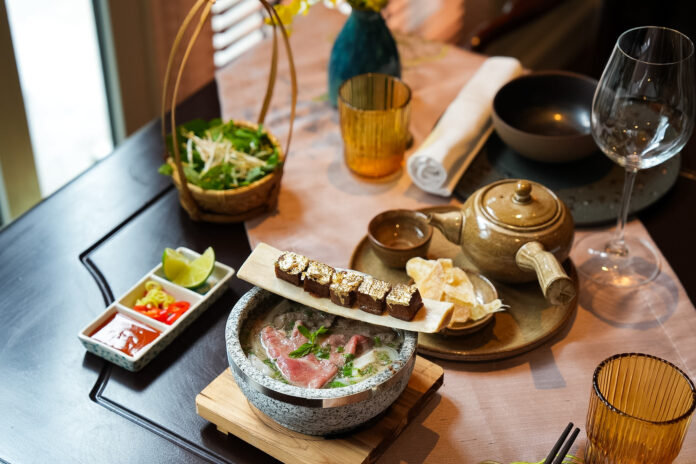
The bars and restaurants, naturally, tell their own version of the story. At Bamboo Bar, the Carnet de Voyage cocktail collection traces an imagined 1920s itinerary once envisioned by co founder André Ducamp, poolside sips that carry the faint perfume of a more romantic, less hurried era of travel. At Le Beaulieu, which has occupied its current room since 1901 and claims the distinction of being the oldest continuously operating restaurant in Vietnam, a three course menu revives century old recipes such as lobster bisque and crêpe suzette, the latter still finished tableside with the theatrical flourish of guéridon service. At Le Club Bar, a new cocktail called The Last Telegram joins a menu already steeped in the memory of Chaplin and Greene, served alongside the aptly named 1901 Burger. Spice Garden, meanwhile, has taken on something closer to devotion, simmering a pho broth for a full one hundred and twenty five hours according to a recipe rooted in the 1920s, finished with Wagyu beef, gold leaf short rib and a tableside pour that turns a bowl of soup into something closer to ceremony. At angelina, the cocktail lounge and whisky bar, the Metropole Liquid Chapters menu marks the hotel’s own timeline in liquid form: 1901 for its founding, 1968 for the bunker beneath its gardens, 2026 for the Hanoi of tonight.
For those who wish to carry something of the hotel home, La Boutique and the patisserie L’Epicerie have introduced a 125th Anniversary Collection of branded keepsakes, while the hotel’s e vouchers offer a way of extending the experience as a gift to others. And for those drawn to the fuller narrative, the hotel publishes Le Petit Journal, a bi monthly dispatch of moments and milestones, alongside a dedicated Metropole History Book that gathers the untold stories of both the property and the city that surrounds it, available through La Boutique or online.
The anniversary’s most contemplative offering may be its exhibition series, the first instalment of which, A Journey through Time Since 1901, opened in June across the Heritage Wing, set within the hotel’s original 1901 structure, and the Opera Wing. Through rare photographs the exhibition traces a visual arc from colonial Indochina through the years of conflict and into the present, a reminder that the hotel’s real achievement has never simply been survival, but attention, the quiet discipline of remembering. Further exhibitions are planned across the year, drawing on painting, mixed media and photography to explore the artistic inheritance of the Indochine era and the enduring texture of Vietnamese life.
What lingers, after all the tastings and treatments and tours, is something harder to name than luxury. It is the sense of standing inside a building that has never stopped listening to the city around it, that has absorbed war and peace, occupation and independence, cinema’s first flicker and a summit between presidents, without ever losing the particular grace of its original façade. One hundred and twenty five years on, Sofitel Legend Metropole Hanoi remains less a hotel than a long, unfinished sentence about Hanoi itself, one that guests are simply invited, for a few nights, to help write.