

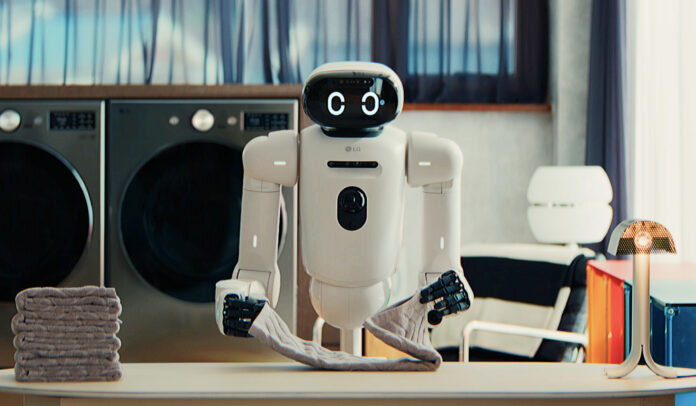

The future LG wants to sell is one where making breakfast, doing laundry, and managing a home quietly happen in the background. At CES 2026, the company plans to put a physical version of that idea on display with LG CLOiD, an AI native home robot designed to take over everyday chores and coordinate the growing web of connected appliances inside modern homes.
LG CLOiD will be shown publicly for the first time at CES, not as a concept locked behind glass but as an active participant in a simulated home. In LG’s vision, CLOiD grabs milk from the fridge, slides a croissant into the oven, and gets breakfast started before anyone asks. Once the house empties out, it shifts gears, running laundry cycles and folding clothes after they finish drying. The point is not spectacle. It is routine. LG is pitching CLOiD as a system that understands how people live and quietly adapts to those rhythms.
That ambition sits at the intersection of robotics and the smart home ecosystem LG has been building for years. CLOiD builds on the company’s Self Driving AI Home Hub, known as LG Q9, and plugs directly into the ThinQ platform. Rather than acting like a standalone gadget, the robot is meant to function as a mobile interface for the entire home, coordinating appliances instead of just reacting to voice commands.
Physically, CLOiD looks like it belongs in a living space rather than a lab. The robot combines a head unit, a tilting torso, two articulated arms, and a wheeled base designed for autonomous navigation. The adjustable torso lets it reach from knee level to higher surfaces, a small but important detail for homes that were never designed around robots.
Each arm has seven degrees of freedom, mirroring the range of motion in a human arm. Shoulders, elbows, and wrists move forward, backward, laterally, and rotationally, while five independently controlled fingers allow for fine manipulation. That design is what enables CLOiD to handle everything from kitchenware to laundry baskets across kitchens, laundry rooms, and living areas.
The wheeled base borrows heavily from LG’s experience with robot vacuums and autonomous home navigation. LG says the low center of gravity improves safety, especially around kids and pets, and helps keep costs down compared to legged robots that still feel experimental and fragile.
CLOiD’s head is where most of the intelligence lives. It houses the main chipset, cameras, sensors, a display, speakers, and voice based generative AI. Together, those elements allow the robot to speak, listen, observe, and learn. LG frames the head as a mobile AI home hub, one that can express simple facial cues, map the home over time, recognize routines, and make decisions about when and how to operate connected appliances.
Under the hood, CLOiD runs on what LG calls Physical AI. That system combines a Vision Language Model that translates images and video into structured language understanding with a Vision Language Action model that turns visual and verbal input into physical movement. Trained on tens of thousands of hours of household task data, these models allow CLOiD to recognize appliances, interpret intent, and perform actions like opening doors or moving objects without explicit step by step instructions.
The robot becomes significantly more capable once it is tied into LG’s broader ecosystem. Through ThinQ and the ThinQ ON hub, CLOiD can orchestrate tasks across multiple appliances, acting less like a robot assistant and more like a roaming control layer for the smart home. It is an example of LG leaning into an ecosystem first strategy, where the value comes from how devices work together rather than what any single product can do on its own.
LG is also using CES to highlight the less visible parts of its robotics push. Alongside CLOiD, the company is introducing LG Actuator AXIUM, a new line of robotic actuators designed for service robots. Actuators function as robotic joints, combining motors, drives, and reducers to control movement, speed, and torque. They are among the most expensive and strategically important components in modern robotics.
LG believes its background in appliance components gives it an edge here, especially in making actuators that are compact, efficient, and powerful. Modular design plays a key role as well, since advanced robots often require dozens of different actuator types. It is a reminder that the future of home robotics is as much about supply chains and components as it is about AI demos.
Zooming out, CLOiD fits into a longer roadmap toward what LG calls the AI Home. The company plans to keep expanding both dedicated home robots and robotized appliances, from smarter robot vacuums to refrigerators that open automatically when someone approaches. The end goal is a home where routine labor is delegated to AI driven systems, freeing up time and attention for things that feel more human.
“The LG CLOiD home robot is designed to naturally engage with and understand the humans it serves, providing an optimized level of household help,” said Steve Baek, president of the LG Home Appliance Solution Company. “We will continue our relentless efforts to achieve our Zero Labor Home vision, making housework a thing of the past so customers can spend more time on the things that really matter.”
For now, CLOiD is still a preview of what LG thinks domestic life could look like next. But at CES 2026, visitors will be able to see that future play out in real time at LG’s booth, one chore at a time.
