

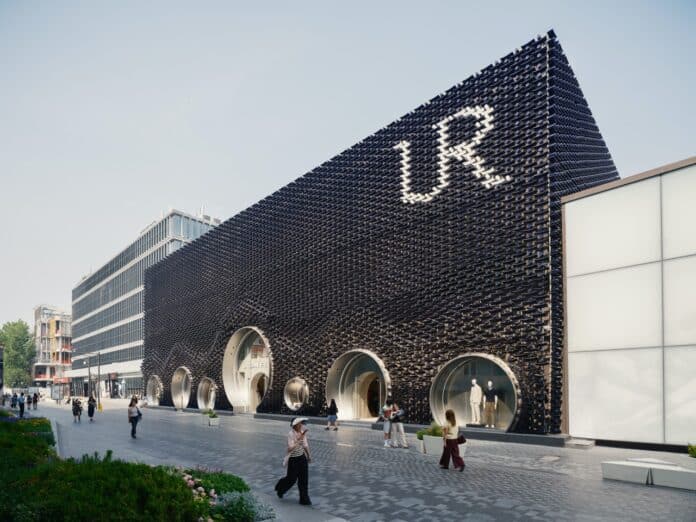

In Beijing’s Sanlitun district, MVRDV has completed a flagship store for Chinese fashion retailer Urban Revivo that reads less like a retail unit and more like an urban artifact, a building that negotiates between two identities without flattening either one. The Rotterdam based studio was tasked with something deceptively simple: give a brand with global ambitions a home that still feels like it belongs to Beijing. The result is a facade and interior sequence that treat heritage not as decoration but as material logic.
Urban Revivo, founded in 2006, now operates more than 380 stores worldwide, and this location sits on Sanlitun West Street, the pedestrian spine linking the youthful, accessible energy of Taikoo Li’s South Village with the North Village’s parade of luxury facades, among them a nearby Tiffany & Co. storefront also designed by MVRDV. In a district where every brand is shouting for attention through spectacle, the studio’s answer was to slow things down and let craft do the talking.
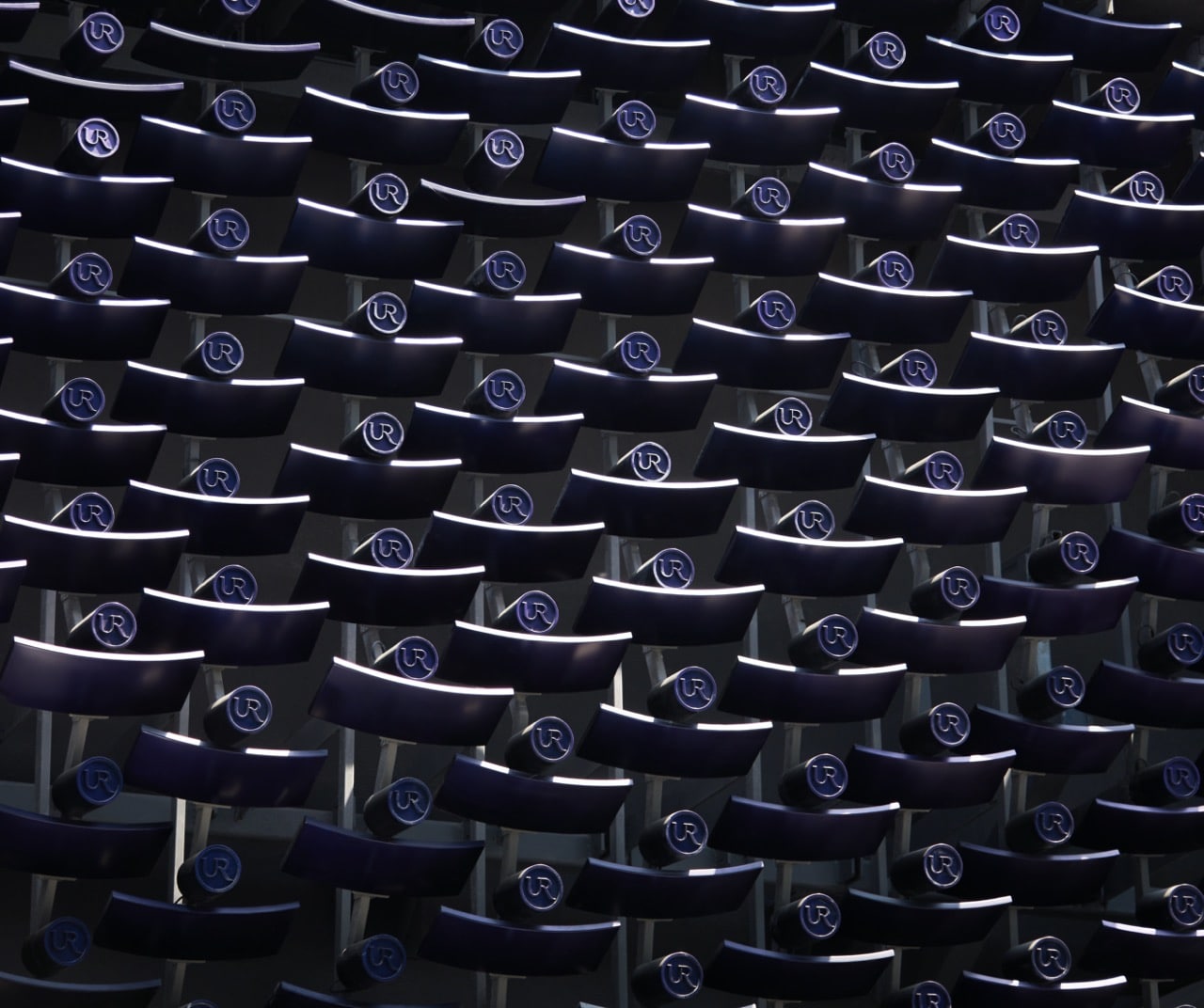
The exterior is where the concept crystallizes. MVRDV suspended an array of aluminum tiles and tubes across the facade, finished in Urban Revivo’s signature blue and coated with a dichroic finish that shifts from purple to blue depending on where you stand. It is a facade built to be experienced in motion, changing character as pedestrians move past it, echoing the layered, overlapping geometry of traditional Beijing roof tiles while behaving like something entirely contemporary. In select zones the tile array swells outward into a soft, wave like volume, giving the otherwise flat plane a sculptural depth defined by shifting shadow and highlight rather than applied ornament.
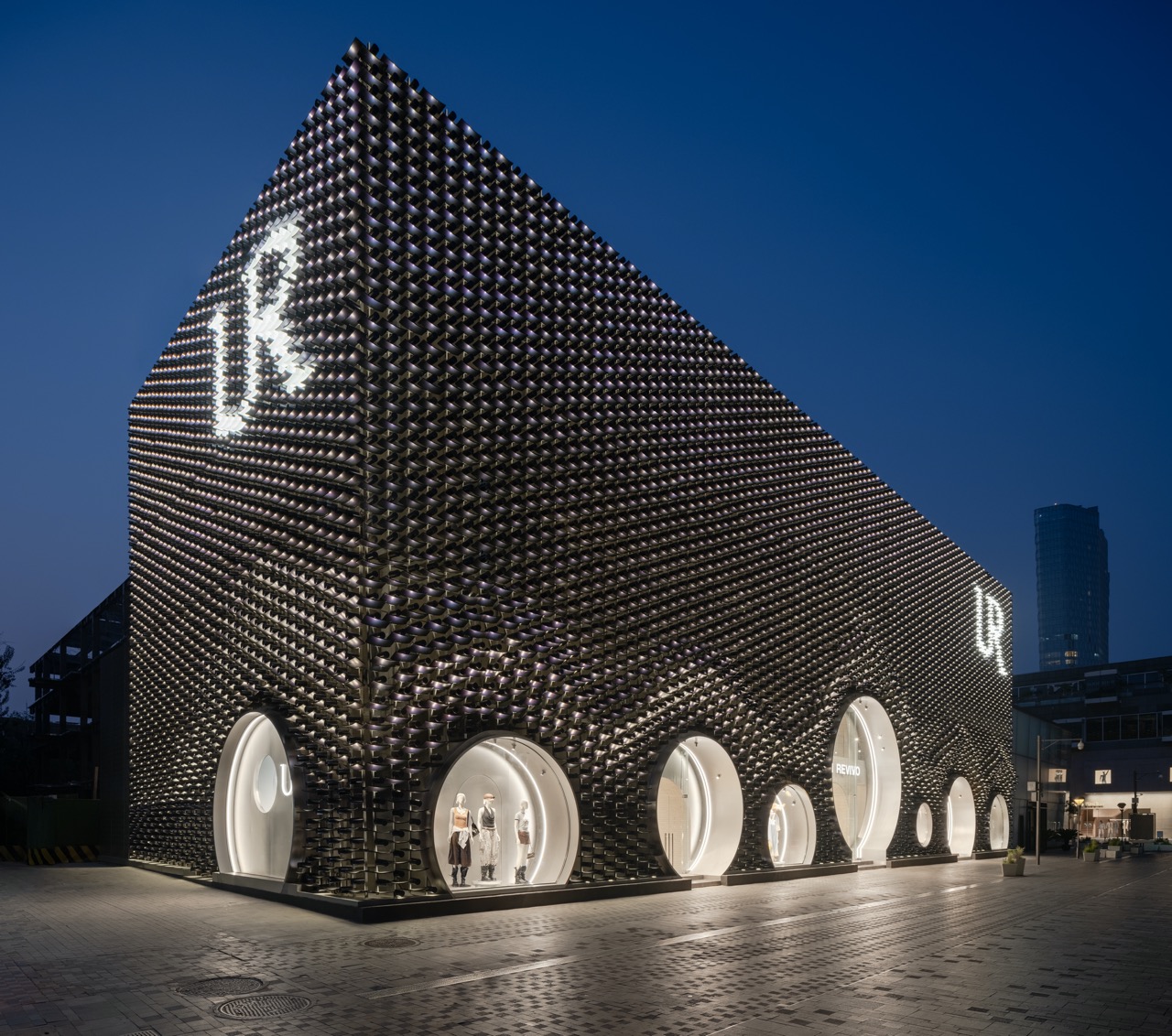
Punctuating this surface are seven circular portals, direct references to Beijing’s traditional moon gates, repurposed here as window displays that hint at what lies inside before a visitor ever steps through the door. The largest sits at the center, forming the main entrance and setting up the transition from street facade to interior world.
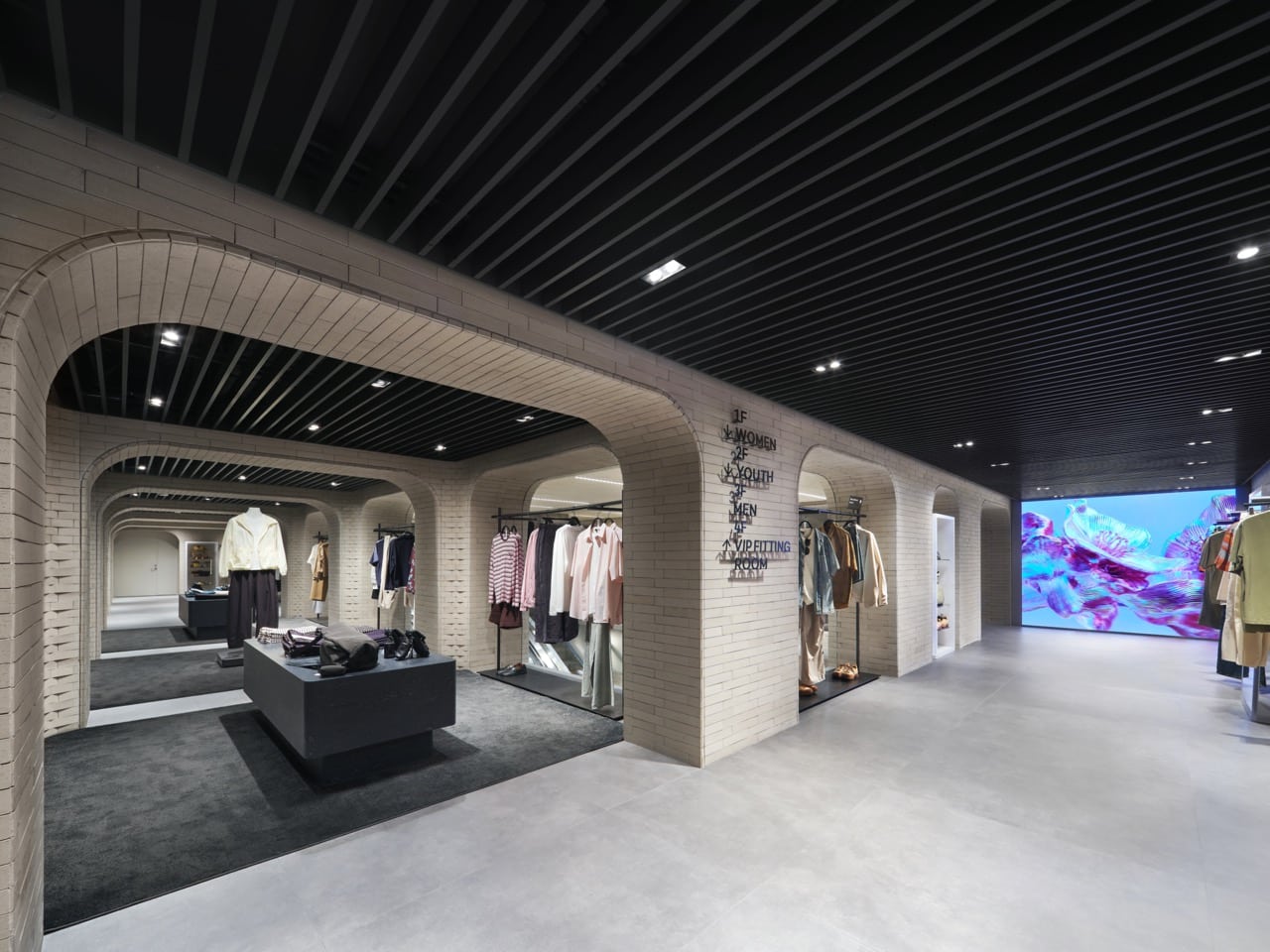
Inside, the material language shifts to grey brick, a deliberate nod to the hutong courtyards that define so much of old Beijing. It functions as a neutral, textured backdrop, letting the clothing and the architectural details around it hold visual weight without competition.
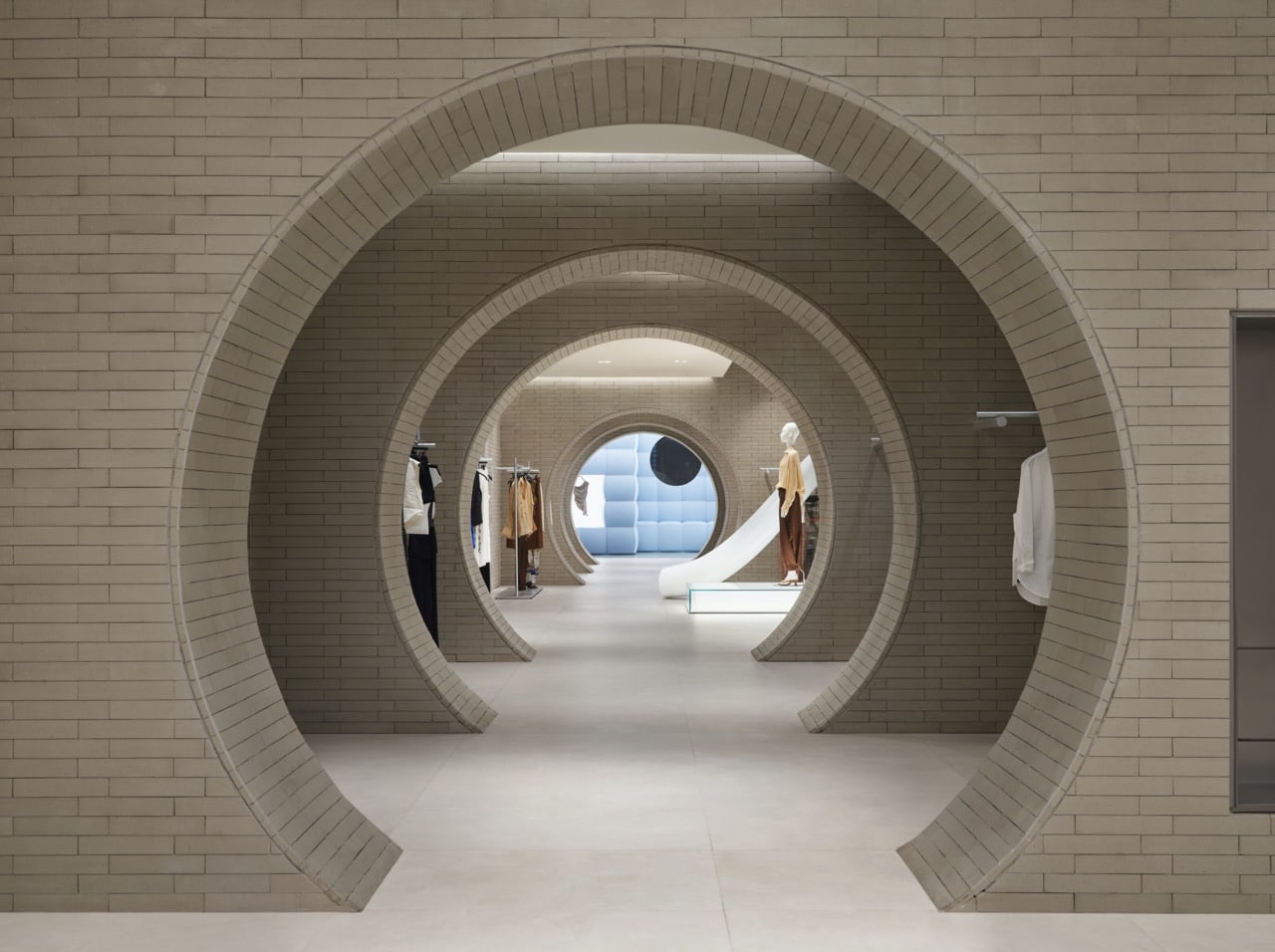
MVRDV’s real sleight of hand is in how the store evolves as visitors climb through it. Each level carries its own geometric vocabulary. The ground floor opens with the traditional moon gate form. The first floor shifts to arched openings and pairs them with reflective surfaces and bright blue furniture for a younger, more energetic mood. The second floor rounds the arches into rectangles with softened corners and introduces darker, more refined materials. By the top floor, the shapes resolve into an elegant inverted curve, and the atmosphere turns intimate, dressed in velvet and cobalt blue upholstery for a private shopping experience. It is architecture used as a timeline, tracing a path from historic reference to modern abstraction one floor at a time.
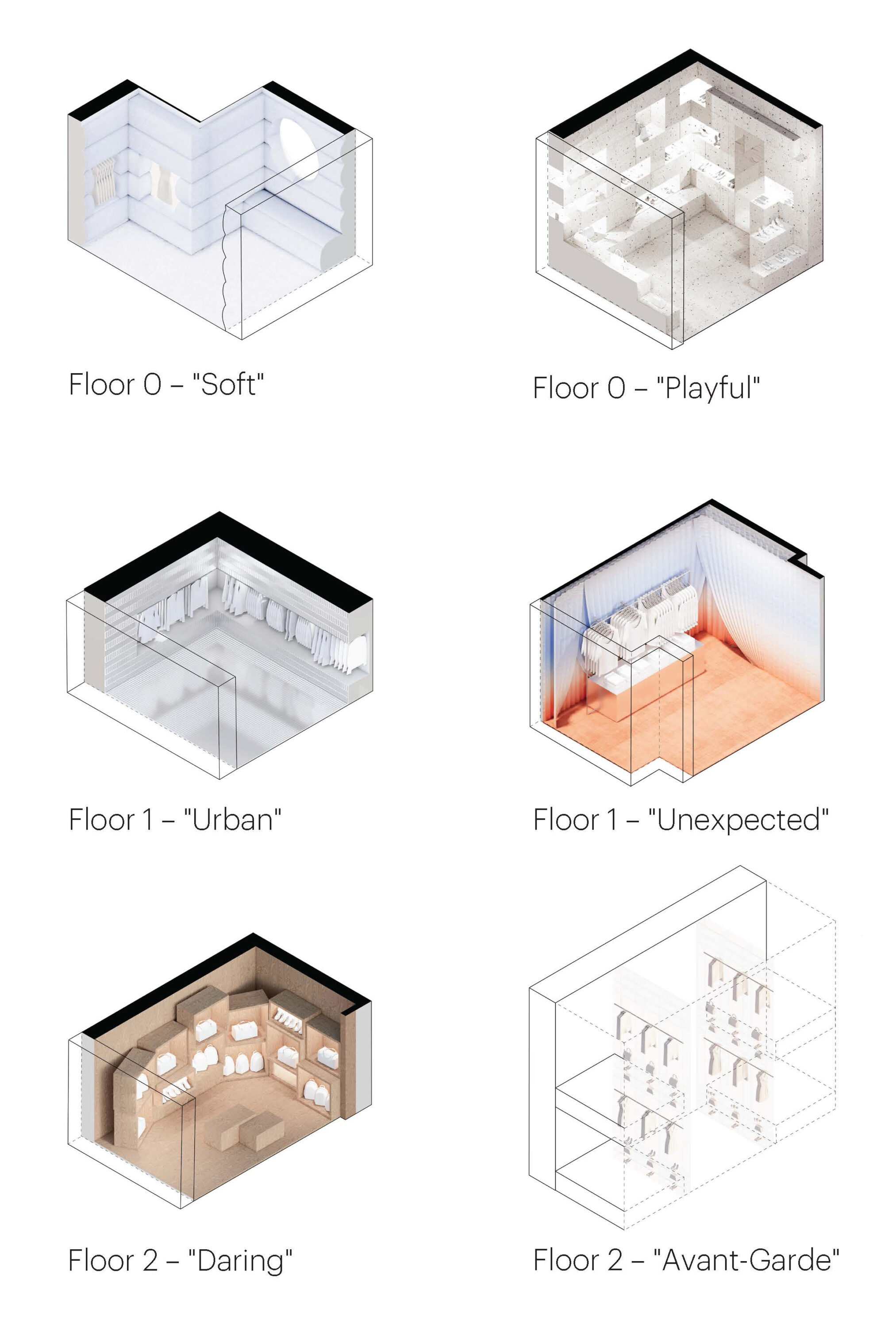
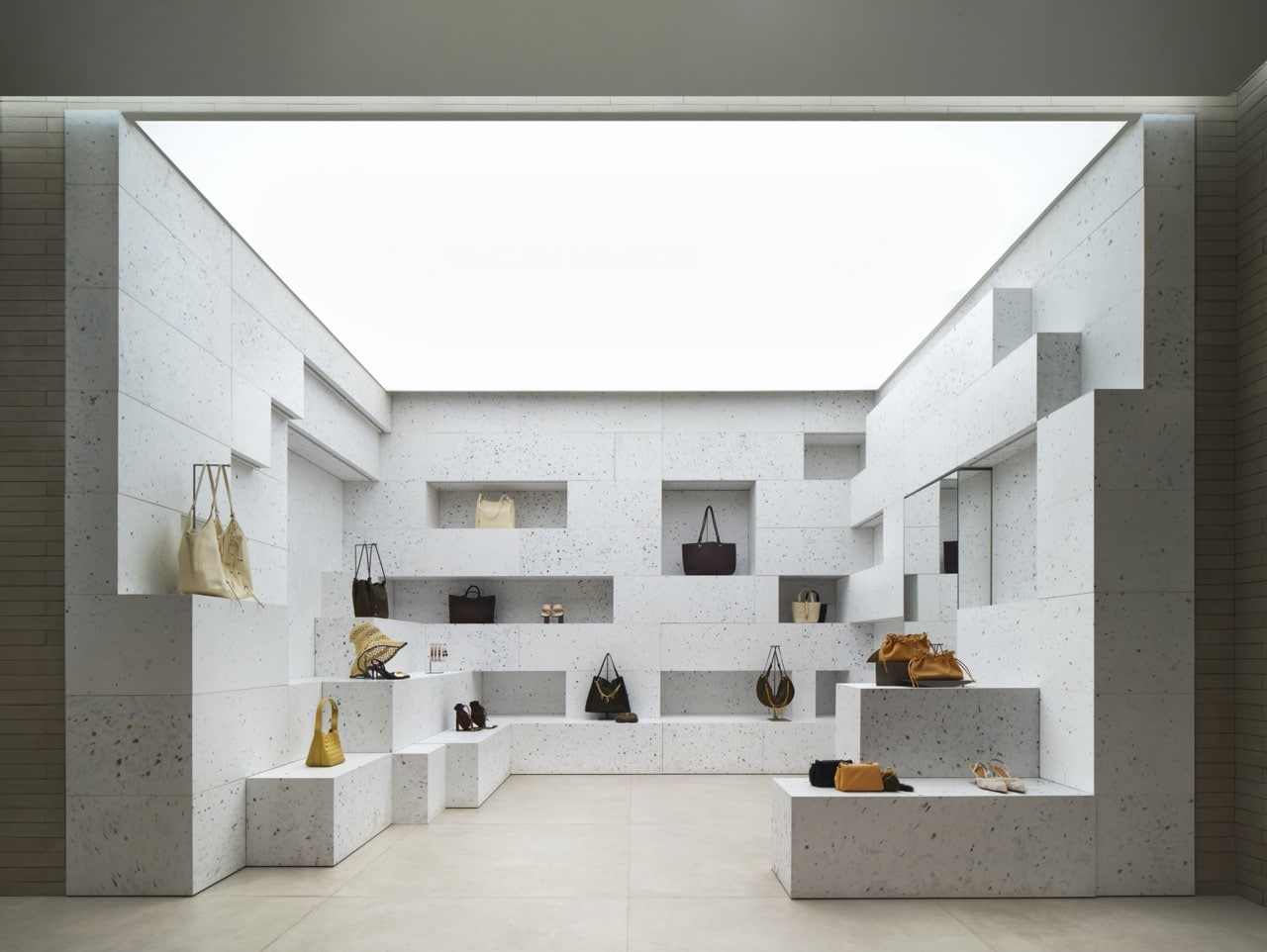
Scattered through the building are six so called Bold Rooms, thematic pockets tucked into corners and designed to showcase special collections with distinct sensory identities. The soft room wraps its walls in upholstered cushions. The playful room is built from blocks of recycled fabric. The urban room leans into reflection, with mirrored walls and floors. The daring room displays garments inside sculptural wooden boxes. The unexpected room is lined in fabric curtains that can be swapped to suit a new collection or to spotlight work by local artists. And a pair of avant garde rooms use glass display cases to frame merchandise along two internal atriums.
“The challenge of this project was to create a space that feels grounded in its surroundings while also reflecting the global aspirations of Urban Revivo,” says MVRDV founding partner Jacob van Rijs. “So we used local references, like Beijing’s roof tiles, but combined them with modern techniques to create spaces that evolve with the visitor’s experience, from the colour changing facade to the smallest design details inside.”
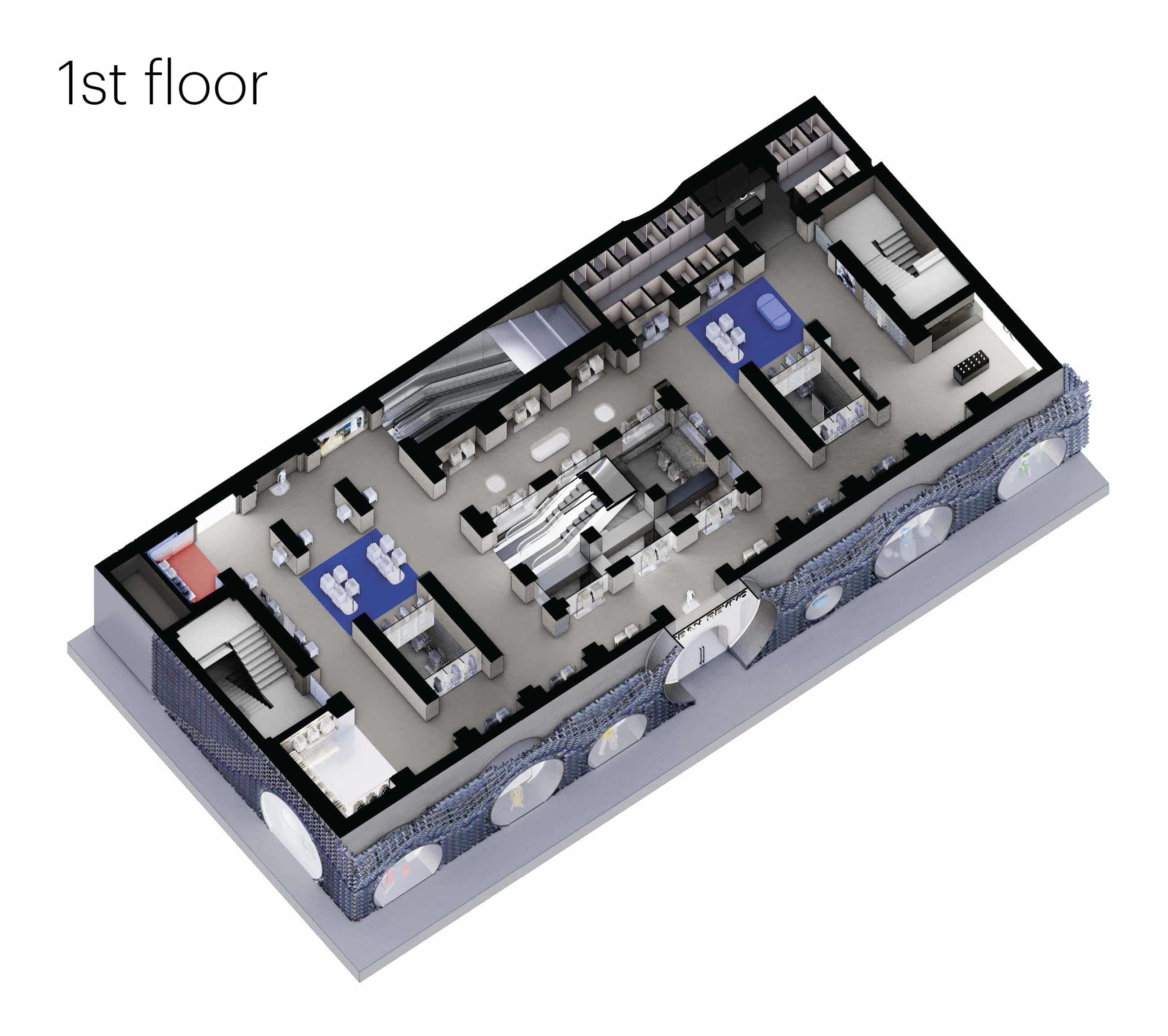
That evolution extends down to the smallest fixtures. MVRDV designed everything in the store, from the signage to the clothing racks, treating the entire environment as a single authored composition rather than a shell filled with generic retail furniture. For Urban Revivo, a brand still expanding its global footprint, the Beijing flagship functions as a statement of intent: proof that a store can be unmistakably local and unmistakably contemporary in the very same breath.
Project Credits
Year: 2025 to 2026
Client: Urban Revivo
Size and Programme: 4,120 square meters, retail
Architect: MVRDV
Founding Partner in charge: Jacob van Rijs
Director: Aser Giménez Ortega
Design Team: Elien Deceuninck, Thiago Maso, Egle Jacinaviciute, Amanda Galiana Ortega, Samuel Delgado, Gabriel Perucchi, Nicolas Odriozola, Sofia Gkegka, Maja Stankowska, Hyunjin Park, Esteban Ruiz, Matilde Rasella, Carmen Xu, Esther Qian, Jiameng Li, Kevin Zhao, Monica di Salvo, Turker Naci Saylan, Chantal Besteman, Daria Rosh, Emilia Benarroch, Robert Busko, Ciprian Buzdugan
Business Development: Hannah Yan
Copyright: MVRDV, Winy Maas, Jacob van Rijs, Nathalie de Vries
