

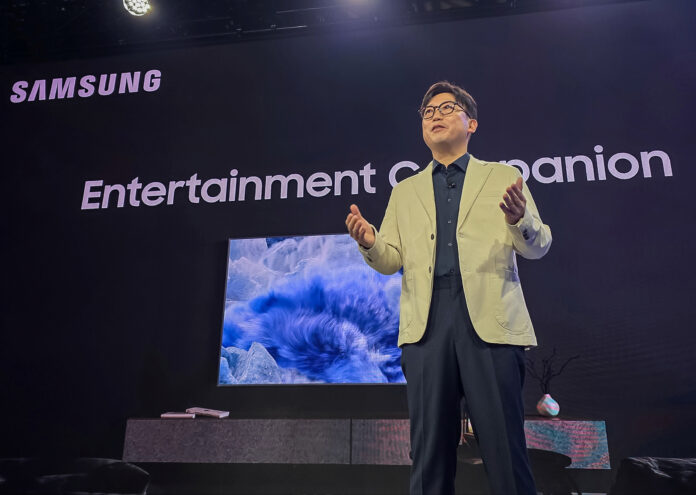

Samsung Electronics used its CES 2026 showcase, The First Look, to outline a future where AI is not just a feature but a constant companion woven into everyday life. Held at the Wynn Las Vegas, the event framed Samsung’s vision of “Companion to AI Living” as a shift in philosophy, positioning AI as the connective tissue across research, product development, operations and user experience.
TM Roh, CEO and Head of Samsung’s Device eXperience Division, set the tone by emphasizing how Samsung’s scale and deeply connected, AI enabled ecosystem gives it a unique advantage. Rather than focusing on isolated devices, the company is leaning into an AI native approach that allows technology to feel more intuitive, more personal and ultimately more useful. The goal is not to overwhelm users with automation, but to help technology quietly elevate everyday moments.
Samsung’s broader strategy centers on creating a unified experience across mobile devices, displays, home appliances and services. By embedding AI across categories and tying everything together through a global ecosystem, the company is positioning itself to deliver everyday AI experiences that feel meaningful rather than mechanical.
Entertainment Companion Rethinking the Role of the TV
Samsung’s display leaders framed the television not as a passive screen, but as an active entertainment companion. Drawing on decades of TV industry leadership, Samsung introduced a fully realized AI TV lineup designed to change how people interact with what’s on screen.
At the center of this lineup is the 130 inch Micro RGB display, a statement piece that pushes both scale and image fidelity forward. With individually controlled microscopic red, green and blue light sources, the display delivers color with exceptional precision and realism. Its minimalist Timeless Frame design keeps the focus on the content, signaling Samsung’s intent to blend advanced technology with refined aesthetics.
Powering this experience is Vision AI Companion, which reframes the TV as a contextual guide rather than just a display. Instead of simply playing content, it can suggest what to watch, what to eat or what music fits the moment, extending its role into lifestyle territory. The idea is to make entertainment feel more responsive to mood, time and environment.
Personalization plays a major role here. Features like AI Soccer Mode Pro enhance live sports with stadium level picture and sound tuning, while AI Sound Controller Pro lets users fine tune audio elements such as crowd noise or commentary through simple voice commands. Vision AI Companion supports a wide range of Samsung TVs, ensuring these interactions scale across the lineup.
Beyond viewing, Samsung is using the TV as a bridge to the rest of the home. Vision AI Companion can identify meals seen on screen and recommend recipes aligned with health goals, then send those recipes to other devices across the ecosystem. This multi device continuity underscores Samsung’s broader ambition to make AI feel cohesive rather than fragmented.
Audio also received a thoughtful upgrade. With two new WiFi speakers, Music Studio 5 and 7, Samsung is expanding its sound ecosystem in ways that prioritize both performance and design. Created in collaboration with designer Erwan Bouroullec, the speakers reflect Samsung’s belief that technology should feel at home in living spaces, not just function within them.
Samsung’s 2026 lineup continues this blend of form and function. From the ultra thin OLED S95H with its gallery like presence to The Freestyle Plus projector that adapts to walls, ceilings and unconventional surfaces, the company is clearly exploring how screens fit into modern lifestyles.
Under the hood, the lineup introduces HDR10 Plus Advanced, Eclipsa Audio spatial sound and Samsung’s most advanced Tizen OS yet, with a notable promise of seven years of software upgrades. That long term support signals a shift toward treating TVs more like evolving platforms than static hardware.
Home Companion Making the Smart Home Feel Supportive
In the home, Samsung’s focus is on reducing friction. With SmartThings now serving more than 430 million users, the company is leveraging its scale to turn everyday appliances into proactive helpers rather than reactive tools.
The Family Hub refrigerator sits at the center of this approach. Enhanced with AI Vision built on Google Gemini, it improves food recognition and tracking, simplifying meal planning and reducing waste. Features like What’s for Today add a light, gamified layer to cooking decisions, while SmartThings Food and Video to Recipe streamline the journey from inspiration to execution.
Weekly insights through FoodNote, personalized widgets via Now Brief and family recognition through Voice ID all reinforce the idea that appliances can adapt to the people using them, not the other way around.
Laundry and garment care also benefit from this philosophy. The Bespoke AI Laundry Combo removes the need to transfer loads, while the Bespoke AI AirDresser tackles wrinkles with minimal effort, addressing small but meaningful pain points in daily routines.
Samsung’s approach extends to maintenance and peace of mind as well. The Bespoke AI Jet Bot Steam Ultra combines advanced sensing with home monitoring capabilities, turning a robot vacuum into a multi purpose household assistant. Voice interaction through a smarter Bixby further lowers the barrier to use.
A standout moment came with the announcement of Samsung’s partnership with Hartford Steam Boiler, which explores how connected appliances can contribute to lower insurance premiums. By linking smart home data with real world financial benefits, Samsung is making a strong case for AI as a source of tangible value, not just convenience.
Care Companion A More Proactive Model of Health
Samsung closed The First Look by looking beyond the home and into long term wellbeing. The company outlined a vision of proactive care, where AI powered phones, wearables and appliances work together to surface insights before health issues escalate.
This includes personalized exercise and sleep coaching, nutrition suggestions tied directly to what’s available in connected refrigerators and alerts when unusual patterns emerge. Integration with platforms like Xealth enables users to share data with healthcare providers and access virtual consultations, bridging consumer technology and professional care.
Samsung is also investing in preventative research, including efforts to detect early signs of cognitive decline through subtle changes in mobility, speech and engagement captured by wearable devices.
Underlying all of this is Samsung Knox and Knox Matrix, which serve as the security backbone for the ecosystem. As AI capabilities expand, Samsung is emphasizing adaptive security measures designed to protect user data throughout AI training and deployment.
Taken together, Samsung’s CES 2026 vision paints a future where AI fades into the background, not because it is less powerful, but because it is better integrated. The company’s Companion to AI Living strategy is less about chasing specs and more about shaping how technology fits into everyday life, quietly guiding, supporting and adapting along the way.
