

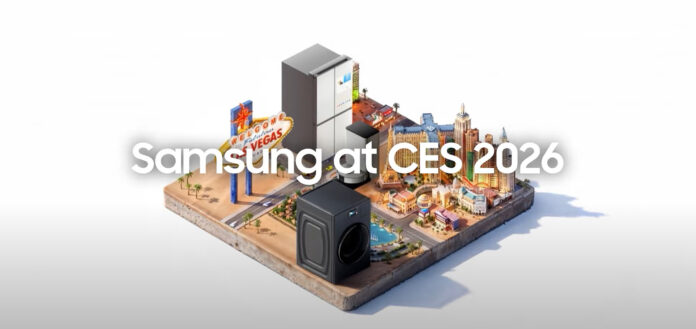

For decades, CES has rewarded scale. Bigger booths. Brighter lights. Louder demos. The unspoken rule has always been simple: if you want to matter in Las Vegas, you need to dominate the floor of the Las Vegas Convention Center.
In 2026, Samsung Electronics is walking away from that rule entirely.
Rather than taking over another cavernous corner of the LVCC, Samsung is staging “The First Look” as a standalone exhibition at the Wynn Las Vegas, running January 6–9. The decision isn’t just logistical. It’s philosophical — a statement about how the company wants its technology to be seen, understood and remembered.
CES, in Samsung’s view, has become less effective as a place to tell a coherent story. Too much noise. Too many half-heard demos. Too many products fighting for attention in the same visual plane. The Wynn exhibition is Samsung’s attempt to fix that — not by doing more, but by doing it differently.
Replacing the Booth With a Point of View
Samsung’s new Exhibition Zone is designed as a single, continuous environment. Product showcases, keynote-style presentations, technology forums, partner meetings and client consultations all live in one integrated space. Instead of fragmented booths and competing soundtracks, visitors move through curated sequences that unfold intentionally.
The design borrows from museums and galleries rather than trade shows. Space matters. Pacing matters. Congestion is minimized not just for comfort, but for comprehension. Samsung isn’t trying to win CES by volume — it’s trying to win it by clarity.
That shift mirrors a broader tension across the tech industry. As products converge and features blur together, differentiation increasingly comes down to ecosystems and experience. Samsung’s wager is that those ideas are better communicated through immersion than exposition.
AI as the Unifying Logic
At the center of Samsung’s CES 2026 narrative is a unified AI strategy spanning its Device eXperience (DX) division. Framed under the theme “Your Companion to AI Living,” the company is positioning artificial intelligence not as a breakthrough moment, but as a background condition — something persistent, adaptive and quietly useful.
Rather than showcasing AI as a collection of isolated features, Samsung is emphasizing how intelligence flows across devices: phones talking to appliances, displays coordinating with services, software anticipating needs without demanding attention. It’s a vision of AI as infrastructure, not spectacle.
That framing is deliberate. As consumer fatigue around AI buzzwords grows, Samsung is betting that reassurance — not amazement — is what resonates. The promise isn’t that AI will change your life overnight. It’s that it will reduce friction in small, compounding ways.
The Freestyle+ and the Future of Screens
The global launch of The Freestyle+ offers a clear example of how Samsung wants that philosophy to feel in practice. On paper, it’s a portable projector with more brightness and smarter features. In use, it’s meant to dissolve the rituals that usually surround projection.
AI OptiScreen handles keystone correction, focus, screen fitting and color calibration automatically, even on uneven or unconventional surfaces. The device rotates freely, projects at nearly any angle, and adjusts in real time as it moves. Vision AI Companion adds a conversational layer, integrating enhanced Bixby with partner AI services to make interaction feel less mechanical.
The implication is subtle but important: screens shouldn’t ask for preparation. They should simply work. In a world where viewing happens everywhere — not just in living rooms — Samsung is designing displays that adapt to environments rather than imposing constraints on them.
When Appliances Start Paying Attention
That same logic extends into Samsung’s kitchen lineup, where vision-based AI continues to evolve beyond novelty. The latest Bespoke AI refrigerators expand food recognition capabilities using Google Gemini and Google Cloud, moving past rigid pre-registration systems toward more flexible, automatic identification.
Processed foods, user-labeled items and personal containers become part of the system. Inventory tracking becomes clearer. Suggestions become more relevant. The refrigerator shifts from passive storage to something closer to a contextual assistant — aware of what’s inside and capable of supporting decisions without overwhelming the user.
The new Bespoke AI Wine Cellar follows the same path. Cameras recognize labels as bottles are stored or removed, track placement by shelf and compartment, and sync with SmartThings to surface information and pairing suggestions. It’s a niche use case, but a revealing one: Samsung sees AI not as a replacement for taste or judgment, but as a way to reduce cognitive overhead.
Sound as an Ecosystem, Not a Component
Samsung’s 2026 audio lineup reinforces its ecosystem-first thinking. The company’s latest Q-Series soundbars and Music Studio Wi-Fi speakers are less about individual performance metrics and more about how sound behaves across spaces.
Enhanced Q-Symphony allows TVs, soundbars and speakers to function as a single adaptive system, analyzing room layout and device placement to optimize channel distribution in real time. The result is audio that feels spatial and coherent, rather than layered or overpowered.
Design plays a larger role here, too. The Music Studio speakers, created in collaboration with designer Erwan Bouroullec, are meant to exist comfortably in living spaces — objects that feel intentional, not purely technical. It’s another signal that Samsung sees lifestyle integration as a competitive advantage.
C-Lab and the Long View
Beyond its own products, Samsung is using CES 2026 to highlight the broader innovation ecosystem it’s cultivating through C-Lab. Fifteen startups will appear in Eureka Park, spanning AI, robotics, digital health and creator-focused tools. A record number come from regional hubs outside Seoul, reflecting Samsung’s effort to decentralize innovation.
C-Lab startups have collectively earned 17 CES 2026 Innovation Awards, including two Best of Innovation honors — a validation not just of individual projects, but of Samsung’s role as an incubator. The message is clear: the company doesn’t just ship products; it seeds ideas.
What Samsung’s CES Shift Really Signals
Samsung’s Wynn takeover isn’t about rejecting CES — it’s about redefining what participation looks like when the industry matures. As hardware differences narrow and AI becomes ubiquitous, storytelling becomes strategy.
By slowing the experience down, curating space and emphasizing cohesion over spectacle, Samsung is making a quiet argument about the future of consumer tech. The next phase isn’t louder, flashier or more overloaded. It’s calmer, more integrated and more aware of how people actually live.
If CES has always been about tomorrow, Samsung is suggesting that tomorrow won’t arrive as a dramatic reveal — but as a seamless continuation of everyday life, powered by intelligence that knows when to step forward and when to stay out of the way.
