


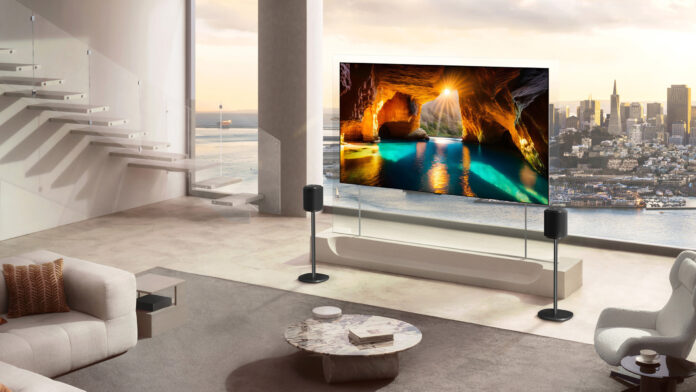

At CES 2026, LG Electronics announced its 2026 OLED evo lineup with a familiar name carrying entirely new technical weight. The OLED evo W6 marks the return of LG’s Wallpaper TV, now rebuilt around true wireless connectivity, higher peak brightness, and an upgraded AI processing pipeline. Positioned as the most advanced expression of LG’s OLED platform to date, the W6 anchors a lineup that reflects the company’s thirteen-year leadership in OLED while signaling a shift toward displays designed as architectural, software-driven systems rather than conventional televisions.
Rather than positioning the W6 as a nostalgic return to an earlier design, LG is framing it as a structural rethink of ultra-thin displays. The original Wallpaper OLED introduced in 2017 focused on visual minimalism. The 2026 version builds on that idea with architectural engineering, lossless wireless transmission, and LG’s most advanced OLED imaging stack to date. It also arrives as LG marks its thirteenth consecutive year leading the global OLED TV market, a milestone the company is clearly using as a platform to push OLED forward rather than simply iterate.
Designing around the absence of hardware
The defining characteristic of the OLED evo W6 is not just its thinness but how that thinness is achieved. The panel falls into a nine-millimeter class thickness, made possible by compressing and redistributing internal components rather than stripping capability. LG redesigned the internal structure to maintain rigidity while reducing mass, allowing the display to mount completely flush against the wall with no visible offset.
What makes that design viable at scale is LG’s True Wireless architecture. All physical connections are relocated to the Zero Connect Box, which can be placed up to ten meters away from the screen. Video and audio are transmitted wirelessly at visually lossless 4K quality, eliminating the need for ports, cables, or visible hardware on the display itself. LG positions the W6 as the thinnest True Wireless OLED TV in the world, but the more significant shift is conceptual. The screen is no longer treated as a device that hosts inputs, but as a pure output surface.
A new ceiling for OLED brightness and clarity
Across the entire 2026 OLED evo lineup, LG is introducing Hyper Radiant Color Technology, which focuses on pushing brightness and color precision while reducing environmental interference. On the W6, this translates into the brightest OLED presentation LG has shipped to date. Using Brightness Booster Ultra, the panel reaches luminance levels up to 3.9 times higher than conventional OLED displays.
Higher brightness often brings trade-offs, particularly with reflections and black level consistency. LG addresses this with a newly engineered low-reflectance screen that has earned Reflection Free Premium certification from Intertek. The goal is to preserve OLED’s defining strengths, deep blacks and accurate color, even in brightly lit rooms where OLED has traditionally struggled.
Image processing is handled by the Alpha 11 AI Processor Gen3, which introduces a significantly more powerful neural processing unit. The processor’s Dual AI Engine runs parallel analysis paths, one focused on noise reduction and the other on texture preservation. Instead of choosing between clarity and smoothness, the system balances both in real time, reducing the artificial look that can accompany aggressive processing.
OLED as a programmable surface
LG is also expanding how the display functions when it is not actively playing content. Gallery Plus reframes the OLED panel as a programmable visual element, capable of displaying curated artwork, cinematic visuals, personal photo libraries, and AI-generated imagery. Paired with ambient audio, the screen becomes a dynamic part of the room’s atmosphere rather than a dormant black rectangle.
This feature is available across LG’s TV lineup, reinforcing a broader strategy where displays are treated as adaptable surfaces that respond to context, time, and user preference.
Performance without compromise
Despite its extreme thinness and wireless design, the OLED evo W6 remains a performance-focused display. Alongside the rest of the 2026 OLED evo series, it supports 4K resolution at up to 165Hz, NVIDIA G-SYNC compatibility, and AMD FreeSync Premium. With a 0.1 millisecond pixel response time and Auto Low Latency Mode, the display is engineered to meet the demands of high-end gaming without sacrificing image integrity.
Software personalization is driven by LG’s webOS platform. Voice ID enables automatic profile recognition, allowing the interface to shift based on who is speaking. Multi-AI integration brings Google Gemini and Microsoft Copilot into the TV experience, enabling conversational search and contextual assistance. Features like In This Scene provide real-time access to cast details and related content, while generative AI tools add a creative layer to discovery.
Security underpins this personalization through LG Shield, which uses advanced encryption and system-level protections to safeguard user data. The platform has been recognized with a CES 2026 Innovation Award, underscoring LG’s emphasis on trust alongside intelligence.
Park Hyoung-sei, president of LG’s Media Entertainment Solution Company, described the OLED evo W6 as the convergence of wireless delivery, form factor engineering, and more than a decade of OLED development. That convergence defines LG’s broader message at CES 2026. OLED is no longer being refined only as a panel technology, but as a flexible, intelligent display system designed to disappear physically while becoming more capable digitally.
The OLED evo W6 and the full 2026 OLED evo lineup are on display at LG’s booth during CES 2026 in Las Vegas from January 6 through 9.