


LG Innotek is heading to CES 2026 with a clear goal: show how the building blocks of tomorrow’s cars are coming together into something smarter, safer, and easier to live with. As vehicles continue to evolve into software driven platforms packed with sensors and connectivity, the company is positioning itself as a behind the scenes force shaping how those systems work together. CES 2026, which runs for four days starting January 6 in Las Vegas, offers a high profile stage to make that case.
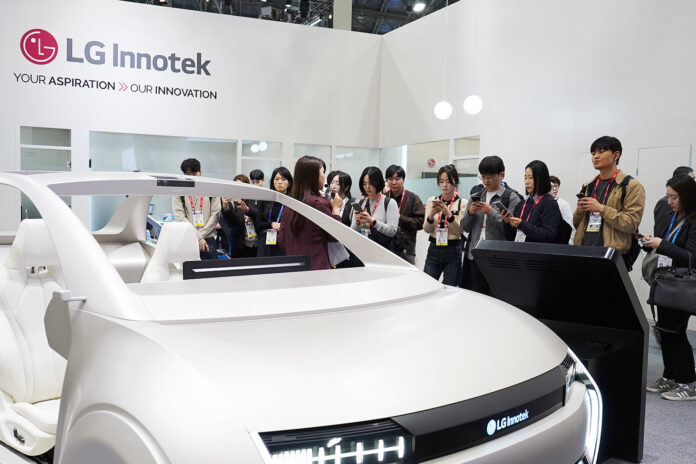
The company previewed its CES presence for domestic media on December 5, offering an early look at its mobility focused booth at the Las Vegas Convention Center’s West Hall. Measuring roughly 330.58 square meters and located near the hall’s entrance, the space once again adopts an all mobility theme, building on the approach LG Innotek introduced last year. The layout emphasizes integration over individual parts, reflecting how modern vehicles are increasingly designed as unified systems rather than collections of components.
Front and center is an autonomous concept vehicle mock up that anchors the entire exhibit. The vehicle is outfitted with 16 autonomous driving and advanced driver assistance products, all presented as part of a cohesive solution rather than isolated technologies. LG Innotek organizes these offerings by function and use case, highlighting how software ties everything together as cars move toward the era of AI defined vehicles.
The mock up showcases sensing technologies both inside and outside the vehicle, with a particular focus on LG Innotek’s autonomous driving convergence sensing solutions. Vehicle camera modules play a central role, working in concert with LiDAR and radar to improve perception and reliability. This layered sensing approach is designed to address real world challenges like weather, visibility, and distance.
Some of the most attention grabbing features are practical ones. The Heated Camera Module quickly clears snow and frost, while the Active Cleaning Camera Module removes water and debris from the lens in about one second. Both modules are smaller than conventional designs and rely on LG Innotek’s proprietary software to deliver faster and more consistent performance.
A key debut at CES 2026 is LG Innotek’s ultra compact LiDAR developed with US based company Aeva. The sensor is capable of detecting objects up to 650 feet or 200 meters away, extending the range beyond what cameras alone can reliably handle. It is positioned as an important step toward safer autonomous driving, especially at higher speeds and in complex environments.
Visitors can step inside the autonomous vehicle mock up and take part in a simulated drive experience. From the driver’s seat, an LED display powered by front mounted sensors offers a window into how LG Innotek’s autonomous driving technologies perceive and respond to the road. The goal is to make the technology feel tangible rather than abstract.
Inside the cabin, LG Innotek highlights a range of sensing and interface technologies designed to improve safety and convenience. One of the telltale examples is the Next Generation Under Display Camera Module, making its debut at CES 2026. Hidden behind the dashboard, the camera uses LG Innotek’s in house AI image restoration software to enable accurate facial recognition without sacrificing image quality. The module also supports dual recording, opening up possibilities for in car content creation.
Ultra wideband radar adds another layer of intelligence inside the vehicle. Demonstrations include child presence detection and a kick sensor that enables hands free trunk access, features aimed at solving everyday problems in a simple, intuitive way.
Lighting plays a major role in the exhibit as well. LG Innotek is showcasing interior and exterior vehicle lighting solutions, including its CES 2026 Innovation Award winning Ultra Thin Pixel Lighting Modules. Integrated into daytime running lights, turn signals, and the front of the vehicle, these modules use high resolution pixels to display letters and patterns with precision. Also on display is Nexlide Air, debuting at CES, which appears in the protruding lights flanking the headlamps. Both lighting solutions use silicon materials to allow greater design flexibility while helping reduce the risk of pedestrian injury from collision fragments.
Connectivity rounds out the picture. LG Innotek is showing a 5G non terrestrial network module designed for satellite based blind spot communication, a vehicular access point module that serves as the central processing hub for AI defined vehicles, and a UWB digital key that enables ultra precise short range communication for improved security and convenience.
The company also features a dedicated electric vehicle mock up that brings together 15 integrated EV technologies. Highlights include what LG Innotek describes as the world’s first 800 volt wireless battery management system, developed with B Link. The B Link solution integrates the battery and battery junction box into a single unit, helping reduce weight and improve efficiency. The EV display emphasizes LG Innotek’s strengths in miniaturization, wireless systems, and precision motor control, all aimed at simplifying EV architecture.
For LG Innotek, CES 2026 is about showing how these technologies fit into the bigger picture. CEO Moon Hyuksoo said the event is an important opportunity to secure new business in autonomous driving and electric vehicles, and to move forward as a mobility innovation company. The message throughout the booth is consistent: as cars become more connected and intelligent, the technology behind them needs to be smarter, smaller, and better integrated to meet the demands of real world driving.
