

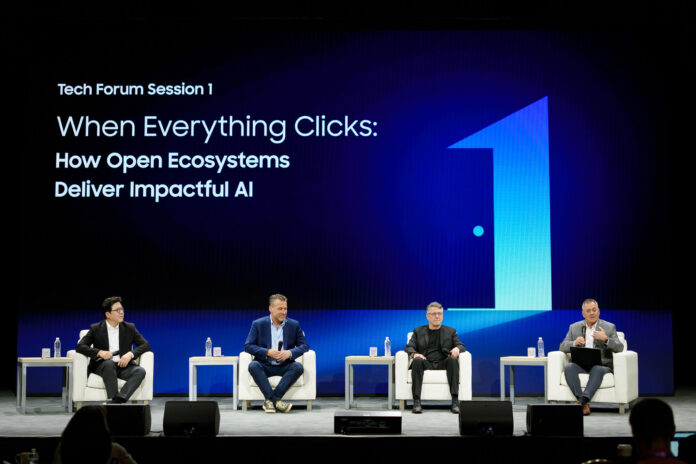

Samsung Electronics Co., Ltd. set the tone for the smart home conversation at CES 2026 by bringing together industry leaders for the opening session of its Tech Forum at The Wynn in Las Vegas. The panel, titled “When Everything Clicks: How Open Ecosystems Deliver Impactful AI,” focused on a question increasingly relevant to everyday life: how connected homes can move beyond isolated smart devices to become intelligent environments that genuinely support the people living in them.
As smart home adoption accelerates, most households now rely on technology from multiple brands and categories. The discussion made it clear that the real opportunity lies not in adding more devices, but in helping them work together. When interoperability becomes the norm, the home starts to feel less like a collection of gadgets and more like a system that understands routines, adapts to needs and quietly delivers value in the background.
Why openness matters for home AI
Panelists consistently returned to one core idea: the next phase of home AI depends on openness, not closed ecosystems. In practical terms, this means devices, platforms and services sharing information responsibly so they can act in concert. Without that collaboration, even the most advanced AI remains limited in what it can do for real people in real homes.
Samsung emphasized that open connectivity is what allows appliances, energy management systems, safety solutions and services from outside the traditional consumer electronics space to align around everyday outcomes. When systems are designed to communicate, AI can move from issuing commands to anticipating needs, whether that is optimizing energy use, preventing damage or simplifying daily routines.
Yoonho Choi, President and Chair of the Board of the Home Connectivity Alliance and Head of Strategic Alliances at Samsung Electronics, framed the challenge in human terms. Home is the most personal environment people have, and any AI operating there must earn trust. That trust comes from being unobtrusive, transparent and clearly useful. Interoperability across brands, he noted, allows the home to function as one cohesive system rather than a set of disconnected features, turning cooperation into safer homes, simpler living and measurable savings.
Scale that shapes smarter experiences
Samsung also pointed to the scale of its connected ecosystem as a critical advantage. With more than 500 million users globally already connected through SmartThings, the company has spent over a decade learning how people actually live with smart technology. That experience informs how AI in the home is evolving, from individual smart products toward intelligence that spans the entire household.
Rather than feeling technical or overwhelming, system wide intelligence allows AI to fade into the background. Appliances and services can coordinate with one another in ways that feel natural, responding to context instead of requiring constant input.
Michael Wolf, founder and editor in chief of The Spoon, highlighted the connected kitchen as a clear example of where this approach becomes tangible. When refrigerators, water systems and heating networks share information, the result is not just convenience, but a more complete understanding of what is happening in the home. That holistic view opens the door to preventative actions that save time, reduce waste and improve everyday decision making.
Turning collaboration into real benefits
The panel also explored how open ecosystems translate into direct consumer value when industries collaborate. Samsung’s partnership with Hartford Steam Boiler served as a practical case study. By using smart home data responsibly and with user consent, the collaboration demonstrates how insights from connected devices can extend beyond convenience into areas like safety and insurance.
Jed Usich, Senior Vice President of Strategic Growth Solutions at Hartford Steam Boiler, explained that seamless integration is key to building trust in smart home technology. When systems fit naturally into daily life, consumers are more willing to rely on them. That trust, in turn, enables simple data points to be transformed into concrete benefits, including potential cost savings, by connecting the smart home with the insurance ecosystem.
Making AI feel human at home
Beyond technology and partnerships, the conversation repeatedly came back to design and experience. For home AI to succeed, it must feel emotionally intelligent and aligned with how people actually live. Cooking, relaxing, entertaining guests and caring for family members all require technology that supports rather than interrupts.
Panelists stressed that thoughtful design, clear storytelling and a deep understanding of human behavior are essential to making AI feel like a calm, reliable presence instead of an intrusive one. The goal is not to showcase intelligence for its own sake, but to create systems that people trust and appreciate without having to think about them.
By the end of the session, there was clear agreement that the future of home AI will be defined by interoperability, responsible data use and collaboration across industries. As AI becomes more ambient and system wide, Samsung’s focus remains on open ecosystems that make connected living simpler, safer and more meaningful. When everything truly works together, the promise of home AI shifts from novelty to something that quietly improves everyday life.
