


At CES 2026, AMD laid out its clearest vision yet for the AI PC era, unveiling a sweeping lineup of mobile and desktop processors alongside new software and developer platforms designed to make on device AI practical, powerful, and mainstream. The announcements span consumer laptops, enterprise systems, ultra thin notebooks, compact desktops, and high end gaming rigs, all anchored by a growing belief inside AMD that artificial intelligence is no longer a feature add on but a defining part of how modern PCs are built and used.
The centerpiece of AMD’s announcement is the new Ryzen AI 400 Series and Ryzen AI PRO 400 Series processors, created specifically for Copilot+ PCs and the next generation of AI accelerated Windows systems. Built on the Zen 5 CPU architecture and powered by second generation XDNA 2 neural processing units, these chips deliver up to 60 TOPS of dedicated NPU performance. Every processor in the lineup exceeds Microsoft’s Copilot+ requirements, positioning AMD’s hardware to run AI features locally without leaning heavily on the cloud.
AMD is clearly betting that AI workloads will live alongside everyday computing, not replace it. The Ryzen AI 400 Series combines up to 12 high performance CPU cores with integrated Radeon 800M graphics and faster memory, targeting a balance of responsiveness, multi day battery life, and on device intelligence across a wide range of laptop designs. The PRO variants extend that platform into the enterprise, layering in AMD PRO Technologies for security, manageability, and long term stability. The goal is consistency: the same AI experiences for business users that consumers get, without forcing IT teams to compromise on control or reliability.
AMD says adoption is already accelerating. OEM partners are launching more Ryzen AI powered systems across consumer, commercial, and gaming segments, with momentum expected to build throughout 2026. Systems featuring Ryzen AI 400 and Ryzen AI PRO 400 processors are scheduled to arrive from major manufacturers including Acer, ASUS, Dell, HP, GIGABYTE, and Lenovo starting in the first quarter of 2026, with desktop versions following in the second quarter.
While the Ryzen AI 400 Series targets the mainstream, AMD is also pushing aggressively at the high end with expanded Ryzen AI Max+ processors. New SKUs extend the Max+ lineup into premium ultra thin notebooks, workstations, and compact mini PCs, bringing together Zen 5 CPU cores, Radeon 8060S class integrated graphics, and XDNA based NPUs in a single unified memory architecture. The pitch is simple: desktop class AI compute and graphics performance without the size, heat, or power draw traditionally associated with high end systems.
These processors are designed to handle demanding creative workloads, large language models, and modern games without sacrificing portability. AMD sees this category as a natural fit for creators, developers, and power users who want one machine that can edit high resolution media, run AI models locally, and still play AAA games at high settings. Systems built around the new Ryzen AI Max+ processors are expected to ship starting in the first quarter of 2026, with additional designs rolling out over the course of the year.
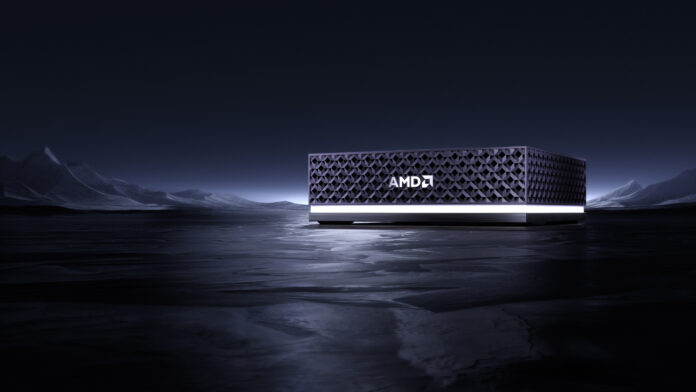
AMD’s ambitions around AI extend beyond silicon. The company also introduced Ryzen AI Halo, its first AMD branded AI developer platform. Halo is a compact mini PC built around Ryzen AI Max+ processors and designed to give developers a turnkey, out of the box environment for AI work at the edge. Despite its small footprint, Ryzen AI Halo is capable of running models with up to 200 billion parameters locally, supported by as much as 128GB of unified memory and up to 60 TFLOPS of RDNA 3.5 graphics performance.
Halo ships fully optimized for AMD’s ROCm software stack and supports both Windows and Linux, with preinstalled tools and workflows aimed at reducing setup friction. AMD positions the device as a way to democratize AI development, giving researchers and engineers a powerful local platform without the complexity of building custom systems or relying entirely on cloud resources. The Ryzen AI Halo platform is planned for introduction in the second quarter of 2026, with pricing details to come closer to launch.
Gaming remains a critical pillar of AMD’s strategy, and the company used CES to reclaim bragging rights at the high end of desktop performance. The new Ryzen 7 9850X3D processor builds on the success of its predecessor with higher boost clocks and second generation 3D V Cache technology. With eight cores, 16 threads, boost speeds up to 5.6 GHz, and 104MB of total cache, AMD says the chip delivers up to 27 percent better gaming performance than Intel’s Core Ultra 9 285K in today’s most demanding titles.
The focus is squarely on latency and frame rates, with AMD framing the 9850X3D as the fastest gaming processor it has ever shipped. Systems powered by the new chip are expected to be available from OEMs, system integrators, and retail partners starting in the first quarter of 2026.
Software is the connective tissue tying all of this hardware together, and AMD spent nearly as much time talking about its platform stack as it did about silicon. The company announced ROCm 7.2, extending its open software platform to support Ryzen AI 400 Series processors across both Windows and Linux. Integration with tools like ComfyUI and simplified access to PyTorch builds on Windows are meant to lower the barrier to entry for AI developers, particularly those working outside traditional data center environments.
AMD says ROCm performance has improved dramatically over the past year, with up to five times gains in AI workloads and a sharp increase in platform support across Ryzen and Radeon products. Downloads have surged as well, reflecting growing interest in local AI development on consumer and prosumer hardware.
For end users, AMD is also rolling out a new AI Bundle within its Adrenalin Edition software. The optional feature packages essential AI tools into a single streamlined installation, making it easier to experiment with local image generation, large language models, and machine learning frameworks without wrestling with complex configurations. It is a subtle but important move that reflects AMD’s broader push to make AI feel approachable rather than intimidating.
On the gaming side, AMD continues to evolve its FidelityFX Super Resolution technology. The latest FSR Redstone update introduces machine learning based upscaling and frame generation, delivering sharper visuals and smoother performance in modern games. AMD also previewed FSR Radiance Caching, a ray tracing optimization that predicts light behavior to reduce rendering overhead while maintaining visual fidelity.
Taken together, AMD’s CES 2026 announcements paint a picture of a company leaning hard into a full stack strategy. From CPUs and GPUs to NPUs, software frameworks, developer tools, and ready to use systems, AMD wants AI to feel native at every level of the PC experience. The message is consistent across consumer laptops, business machines, creator systems, and gaming rigs: intelligence is built in, performance scales efficiently, and form factors no longer dictate capability.
As AI reshapes expectations for what a personal computer can do, AMD is positioning itself not just as a chip supplier, but as a platform builder aiming to define how those experiences come together, today and well into the future.
