



There is a particular kind of house that exists only in fiction, and then, occasionally, someone finds it standing in the world, waiting. This is what happened to the team behind “Verity,” Michael Showalter’s seductive adaptation of Colleen Hoover’s bestselling novel, when location manager Elizabeth Krekel stumbled upon a multimillion dollar property in upstate New York designed decades earlier by the Danish sculptor Jens Quistgaard. She had been searching for something modern and ominous, grays and blacks pressed against dense nature, and what she found instead felt less like a location scout and more like a premonition.
The story of how “Verity” came to be begins, as these things often do, with an act of recognition. Producer Alex Hedlund read Hoover’s self published novel in the spring of 2019 and understood, almost instantly, that he was holding something rare. Provocative, sexy, shocking, and layered with flavors he could not yet name, the book arrived before Hedlund fully grasped the scale of devotion Hoover commanded among readers who seemed to intuit exactly what she understood about longing and darkness. His producing partner Nick Antosca, who would go on to write the screenplay, found in the novel an inheritance from an older tradition of suspense, something that recalled Daphne du Maurier’s Rebecca in its juicy, unsettling pleasures. It leaves you with questions, he has said, and perhaps that is the truest compliment a thriller can receive.
Hoover herself came to the genre almost by accident, or perhaps by refusal. Sixteen books into a career built on contemporary romance, she found herself disappointed by a horror film’s unearned twist and wondered what she might do differently. I have a dark sense of humor, she has said, and I am definitely not as romantic or emotional as the characters in some of my books. What emerged was a fascination with isolation, with characters cut off from the world and left to face what waits for them alone. That instinct toward confinement, toward houses that swallow their inhabitants, would become the beating heart of the film.
To direct, the producers turned to Showalter, fresh from the intimacy and warmth of The Idea of You, and asked him to pivot toward something more dangerous. He did not hesitate. A longtime devotee of psychological and erotic thrillers alongside his producing partner Jordana Mollick, Showalter found in the script an invitation to commune with Hitchcock, with Brian De Palma, with Adrian Lyne, filmmakers who understood that suspense and sensuality were never separate languages. It is very escapist, he has said of the genre. It combines all these different cinematic elements and allows for humor, visual storytelling. This was his chance to join that lineage, to tell a story that unsettles even as it seduces.
And then there was the house itself, which Showalter and production designer Amy Williams built into something closer to a psychological landscape than a set. Williams, who had worked with both Showalter and Hathaway on The Idea of You, recalled Showalter’s request simply enough, that she make something beautiful, glamorous, a popcorn thriller elevated by daring design. What she delivered was architecture as metaphor, sunken living rooms, stone intruding into walls as though the house had grown out of a cliffside, ceilings that soar in one breath and close in on you the next. Long, narrow hallways twist into confusion by design. Showalter wanted the sensation of a rabbit hole, a house whose full dimensions remain perpetually just out of reach, an extension, he has said, of Verity’s own imagination. Hathaway, who plays the author at the story’s center, calls the choice a statement rather than a compromise. There is something so eerie, yet intimate about it, she has said. This is a kind of classic gothic story, so you really need the house to be a character in the movie.
Cinematographer Jim Frohna found in these rooms an embarrassment of riches, the kind of architecture that rewards the camera no matter where it is placed. Dakota Johnson, who plays the struggling writer Lowen Ashleigh, has spoken with particular admiration about how the house’s descending levels mirror the story’s own descent, each floor a step further into the belly of the beast, what waits below never quite matching what appears above. When Hoover herself visited the finished set, she found it uncanny in its accuracy. It is a million times better than my imagination, she has said, noting the subtle V shaped lines running through the architecture, as though the house had been waiting all along to be found and filmed.
If the house speaks in architecture, the costumes speak in color, and here too the film operates as a kind of visual language for its characters’ unraveling. Costume designer Jacqueline DeMeterio, working with Hathaway for the fourth time, found herself dressing two distinct women inside one character, the vivid, idealized Verity of memory and flashback, and the more fragile present day Verity, tended by her nurse and dressed with a caretaker’s quiet insistence on preserving her former glamour. Lowen, by contrast, arrives dressed in earth tones and black leather, an edge meant to resist the lush excess of the Crawford world, though that resistance erodes as the story deepens. Little by little towards the end, DeMeterio has explained, especially when she shows up in the red dress out of Verity’s closet, is when it gets a little spooky. Johnson found particular joy in a wardrobe built almost entirely of black, a color she notes is rarely permitted such prominence on screen, and in the moment her character begins, quite literally, to wear another woman’s identity.
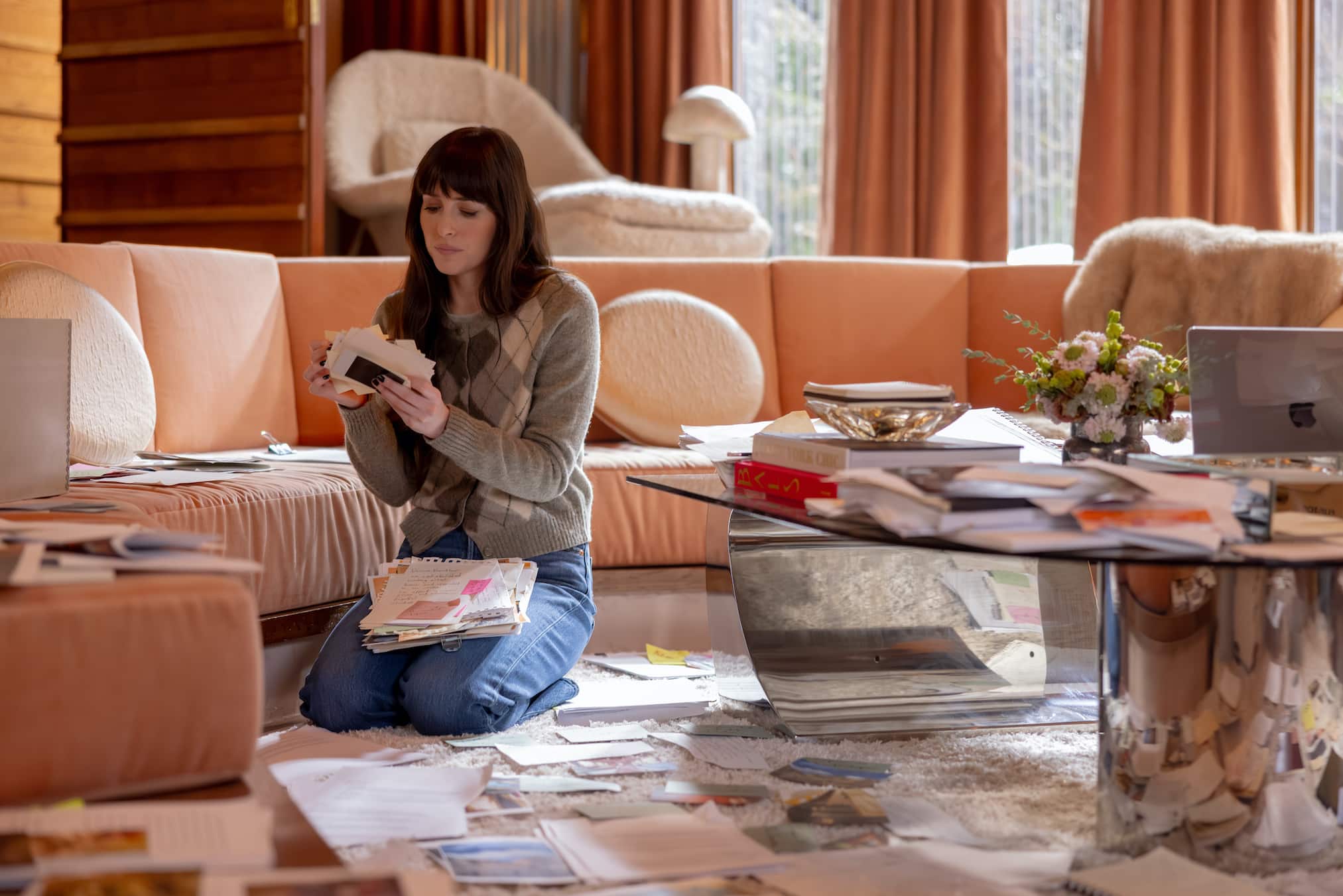
Photo credit: Alisha Wetherill
© 2026 Amazon Content Services LLC. All Rights Reserved.
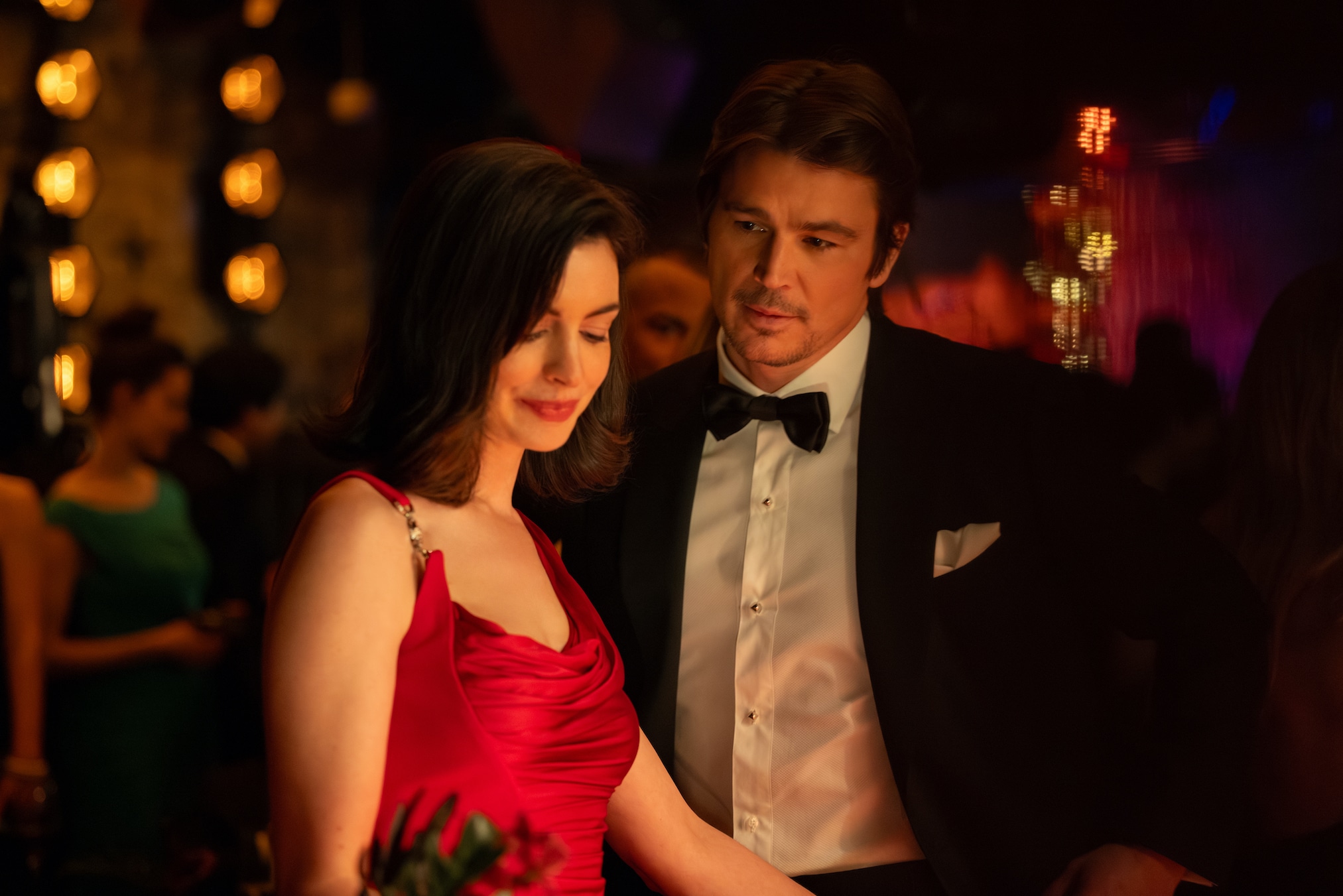
Two red dresses anchor the film’s most charged visual moments, one worn by Verity in the flashback of her first meeting with Jeremy, another worn by Lowen on a dinner date with him much later. Hathaway has described trying on what felt like every red dress in Manhattan before settling on a silk rayon Versace gown, while DeMeterio deliberately chose a different but tonally related Versace piece for Lowen’s version, a visual rhyme rather than a repetition. For Jeremy himself, played by Josh Hartnett, the design language leaned toward soft luxury, cashmere sweaters and clean lines meant to evoke a man adrift, comfortable on the surface and quietly unraveling beneath it. Looking really good while I’m depressed, Hartnett has joked, though the joke carries its own small truth about the character.
At the center of all this stands a trio of performances built on ambiguity. Hathaway plays two versions of the same woman, one silenced by catastrophic injury, the other vivid and untouchable within the pages of her own memoir, and the tension between those two Veritys becomes the film’s central question. Which version, producer Stacey Sher has asked, do you believe is the truth. Johnson’s Lowen serves as the audience’s anchor into that uncertainty, a grieving, gifted woman whose vulnerabilities leave her susceptible to the gravitational pull of the Crawford household. Hathaway has praised the musicality Johnson brings to her performance, the way thought seems to cross her face even as mystery remains fully intact beneath it. And Hartnett’s Jeremy, caught between two women and two timelines, anchors the story’s more melancholic register, a man whose comfort, DeMeterio suggests through his very wardrobe, is only ever skin deep.
What emerges from these overlapping obsessions, a house that confuses on purpose, dresses that echo across timelines, actors drawn to characters they cannot fully explain, is a film less interested in resolution than in atmosphere. “Verity” asks its audience to sit inside uncertainty, to distrust even the most beautiful rooms, and to recognize that the most seductive stories are often the ones we choose, quite willingly, not to fully believe.

