
HomeNewsTechnologyGoogle Unveils Gemini, a Cutting-Edge AI Model Redefining Multimodal Capabilities

Google Unveils Gemini, a Cutting-Edge AI Model Redefining Multimodal Capabilities

Follow the journey on Google: Follow us on Google News Preferred Source Google Discover

In a groundbreaking announcement, Google has introduced Gemini, a revolutionary generation of AI models inspired by human understanding and interaction with the world. The collaborative efforts of teams across Google, including Google Research, have culminated in the development of Gemini, designed from scratch to seamlessly comprehend and integrate various types of information such as text, code, audio, image, and video.

Gemini, now revealed as Google’s largest and most versatile AI model, boasts unprecedented flexibility, capable of efficient operation across a spectrum of devices, from data centers to mobile platforms. This state-of-the-art model is poised to reshape the landscape for developers and enterprise customers, enhancing their ability to build and scale with AI.

Gemini 1.0 comes in three optimized versions to cater to diverse needs:

– Gemini Ultra: The most advanced model tailored for highly complex tasks.

Ads

– Gemini Pro: Optimal for scaling across a wide array of tasks.

– Gemini Nano: The most efficient model designed for on-device tasks.

Rigorous testing of Gemini models across various tasks showcases their prowess. Gemini Ultra, in particular, surpasses current benchmarks, achieving a remarkable 90.0% on the Massive Multitask Language Understanding (MMLU) test, outperforming human experts. Moreover, Gemini Ultra excels in the new Multimodal Multitask Understanding (MMMU) benchmark, achieving a state-of-the-art score of 59.4%.
Google's Gemini
Google’s Gemini (Google)

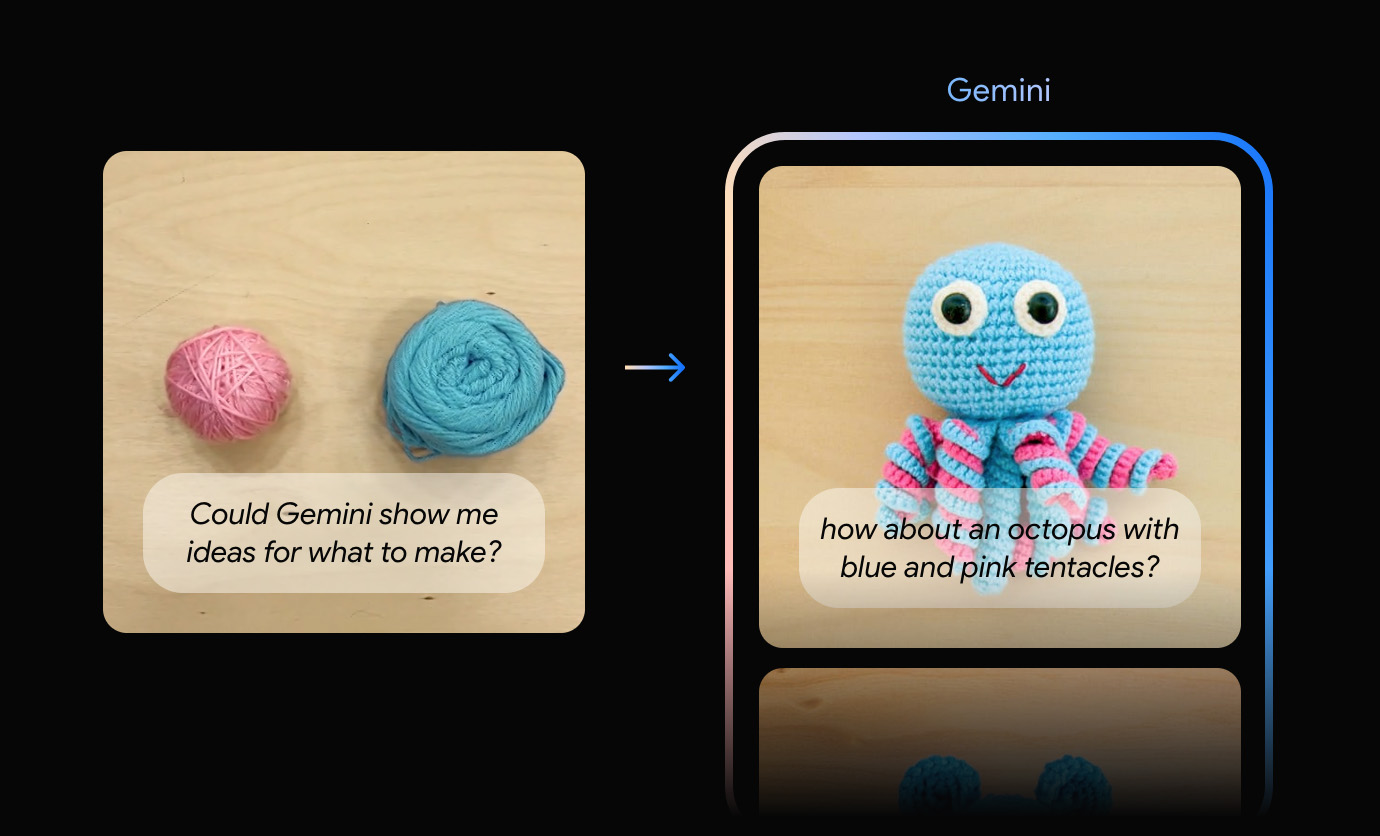
The Gemini series exhibits remarkable capabilities in image benchmarks, outperforming previous state-of-the-art models without relying on object character recognition (OCR) systems. Gemini’s native multimodality and advanced reasoning abilities shine through, especially in complex subjects like mathematics and physics.

Gemini 1.0’s proficiency extends to understanding and generating high-quality code in popular programming languages, making it a leading foundational model for coding worldwide. Its capabilities in various coding benchmarks, including HumanEval and Natural2Code, position it as a formidable tool for developers.

Google’s AI infrastructure, powered by Tensor Processing Units (TPUs) v4 and v5e, played a pivotal role in training Gemini 1.0. The introduction of Cloud TPU v5p, the most powerful TPU system to date, is expected to accelerate Gemini’s development and facilitate faster training of large-scale generative AI models.

Gemini 1.0 is already rolling out across products and platforms. Notably, Bard, a key application, will leverage a fine-tuned version of Gemini Pro for advanced reasoning and understanding. Additionally, Pixel 8 Pro becomes the first smartphone engineered to run Gemini Nano, introducing new features like Summarize and Smart Reply.

Ads

In the coming months, Gemini will be integrated into more Google products and services, including Search, Ads, Chrome, and Duet AI. Early experiments with Gemini in Search have already yielded a 40% reduction in latency in the United States, coupled with improvements in quality.

Developers and enterprise customers can access Gemini Pro via the Gemini API in Google AI Studio or Google Cloud Vertex AI starting December 13. Android developers will also harness the power of Gemini Nano via AICore in Android 14, available on Pixel 8 Pro devices. Moreover, Google plans to launch Bard Advanced, offering cutting-edge AI experiences with access to Gemini Ultra, early next year.

Want Instant Updates?

Subscribe to receive instant email whenever a new article is available!

Julie Nguyen
Julie Nguyen

Julie is the founder of SNAP TASTE and a driving force in global storytelling, innovation, and creative leadership. A respected member of the Harvard Business Review Advisory Council, she also serves as a judge for the CES Innovation Awards (2024, 2025, and 2026), bringing her perspective to the intersections of business, culture, and breakthrough technologies.

Her immersive reporting has taken audiences behind the scenes of defining world moments, from the FIFA World Cup Qatar 2022 and Expo 2020 Dubai to CES, D23 Expo, and the Milano Monza Motor Show. Through her lens, global events become intimate, human stories.

An accomplished film critic and editorial voice, Julie has built a reputation for reviews that go beyond analysis, finding the heartbeat within the frame. Her work on National Geographic documentaries and other cinematic works speaks to audiences who believe that great storytelling has the power to shift perspectives and expand the world.

At the heart of everything Julie does is a belief that art, technology, and culture are not separate conversations. She has spent her career proving they never were.

Ad

Leave a Reply

More to Explore

Googlebook Is Google’s Big Bet on Turning Your Android Phone Into a Laptop

Googlebook is Google's answer to a question nobody quite knew how to ask: what happens when a phone operating system grows up and starts...

Meta Connect 2026: Muse AI and New VR Glasses Revealed

Meta held its Connect 2026 keynote to detail a broad set of updates across artificial intelligence, smart glasses, and virtual reality hardware. CEO Mark...

iPhone Duo: Everything You Need to Know About Apple’s First Foldable iPhone

Apple has officially entered the foldable phone market. At its Cupertino event, the company introduced iPhone Duo, its first foldable iPhone and, by Apple's...

AI Won’t Replace the 3D Artist, But It Will Change How They Work

For years, 3D artists have carried the same quiet burden: the gap between an idea and the finished model is long, tedious, and full...

Inside IFA Berlin 2026: AI Moves From Feature to Foundation of the Smart Home

IFA Berlin, one of the largest events in the world for consumer electronics, home appliances, and future tech, spent its opening days making one...

Google’s Gemini 3.8 Flash arrives with a cybersecurity sibling built for autonomous patching

Google is not slowing down. On September 2, 2026, the company rolled out Gemini 3.8 Flash, a new entry in its Flash lineup that...

Closed-Loop Cooling Explained: How Meta, Google, and Microsoft Are Solving AI’s Water Problem

The rack that used to need a wall of fans now needs plumbing. That is the short version of what has happened inside Meta's...

Google Flow gets a serious upgrade with Gemini Omni 1.1 Flash

Google is giving its AI filmmaking tool another major push forward. At its I/O developer conference earlier this year, the company introduced Gemini Omni...

Apple’s New Mac Mini Gets a Major AI Upgrade With M6 and M5 Pro Chips

Apple has unveiled a refreshed Mac mini, and the headline story is a big one for anyone who cares about on device AI performance....

Mac Studio Gets M5 Ultra, Thunderbolt 5, and Up to 512GB of Memory for Local AI

Apple's latest Mac Studio refresh lands as one of the more substantial internal updates the machine has seen since it first launched, and the...

Blender 5.2 LTS Features Guide: Node Editor, Outliner, and Interface Changes Explained

Blender 5.2 LTS shipped on July 14th, 2026, and it is not the modest interface polish pass the original document made it out to...

Blender Basics: The Beginner Guide Nobody Handed You

Okay, so you downloaded Blender. Good. That already puts you ahead of most people who talk about wanting to make 3D art and then...

Handpicked for You

You Might Also Like