



There is a particular quality of light in the Alpilles, a bleached, silvering brightness that falls through olive canopies and lands on limestone the color of old bone. Van Gogh chased it here, unsuccessfully by his own account, and something of his frustration still makes sense standing in the gardens of Hameau des Baux at the hour when the cicadas begin their long argument with the afternoon. The light does not sit still. It moves the way memory does, in fragments, and the hotel, a scattering of stone cottages folded into a five hectare olive grove outside the village of Paradou, seems built entirely in service of that light rather than in spite of it.
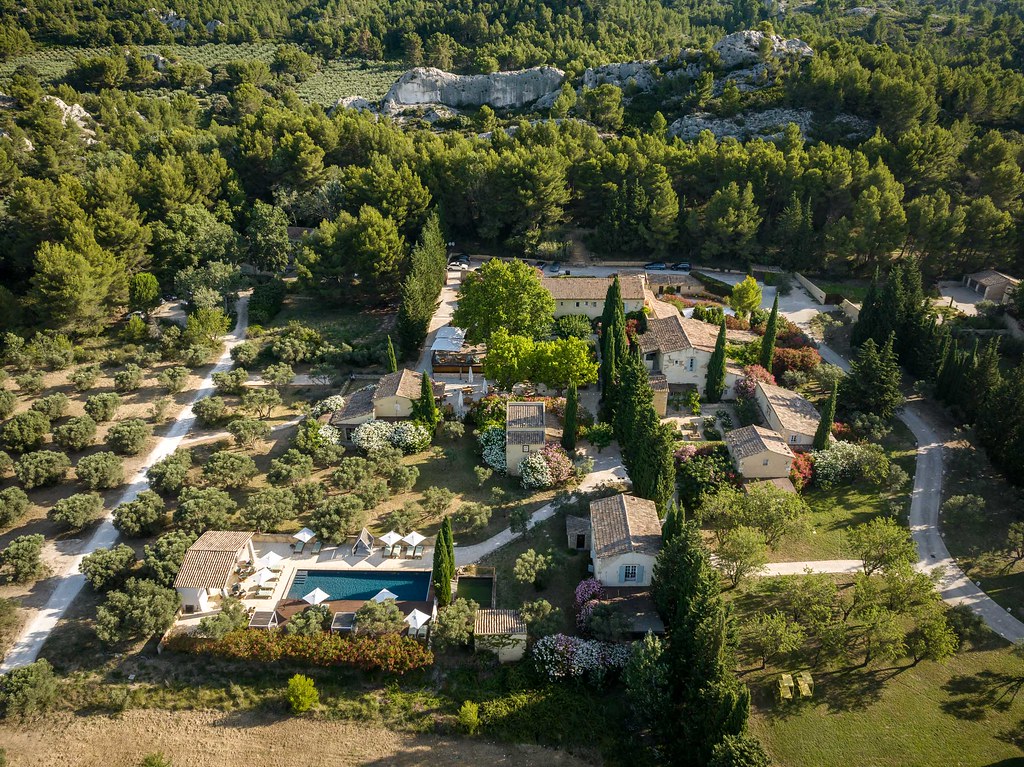
This is not a hotel so much as a proposition. Founded by Guillaume Multrier, a former digital media entrepreneur who traded platforms for pétanque pitches, and Aurélie Blanquart, whose training runs from the Pavillon Ledoyen in Paris through the mountain resorts of Chamonix, Hameau des Baux is the first property under the banner of Les Petites Maisons Hotels, a name that translates loosely to small houses and carries, in its modesty, the entire philosophy of the place. Nothing here announces itself. The grandeur, and there is a great deal of it, arrives sideways, in the way sunlight falls across a breakfast table or the way a fountain sounds at midnight when the guests have finally gone quiet.
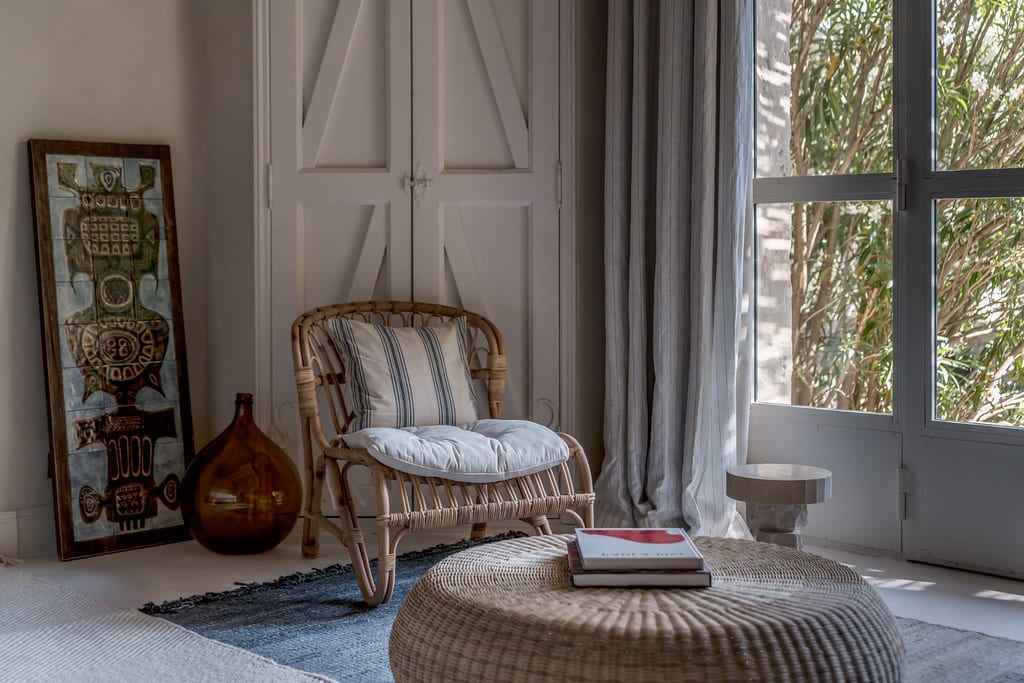
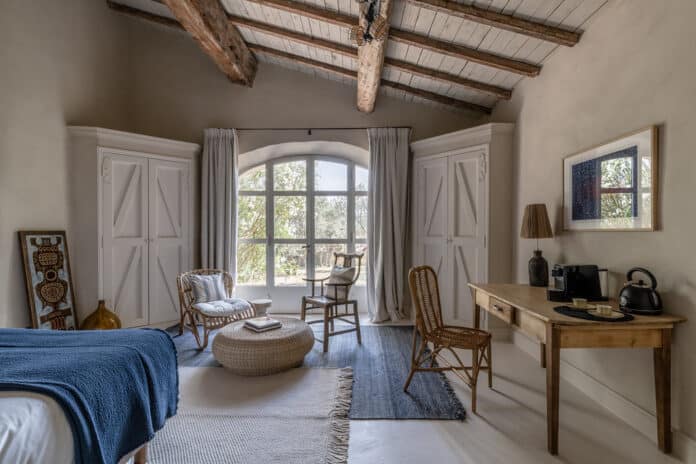
For summer 2026, the hamlet grows. A new wing called La Villa adds ten rooms and suites, each opening onto a private terrace, designed by Trésor Publik in a language of vintage furniture and unfussy materials that reads less like decoration and more like memory made tangible. The rooms do not perform luxury so much as absorb it, the way linen absorbs heat, quietly and without comment. One imagines a chair here has always been that particular chair, in that particular corner, catching that particular slant of afternoon.
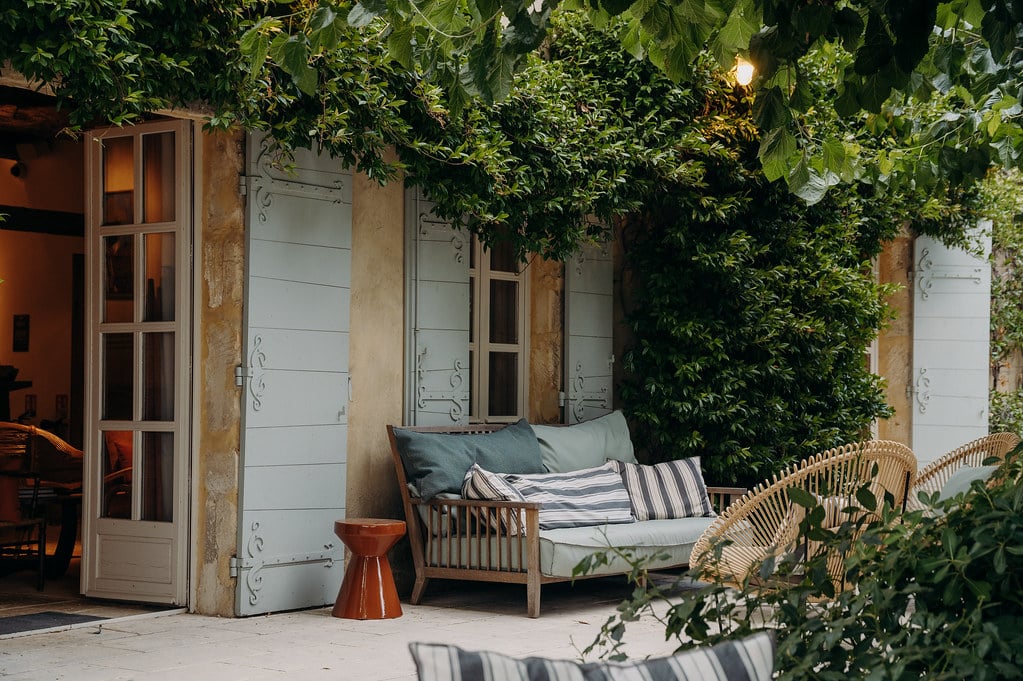
To walk the property is to move through a village rather than a lobby. There is a square, shaded by plane trees, with a fountain at its center, and cottages arranged around it the way a Provençal hamlet might have organized itself across centuries, by instinct rather than by architect. Art appears without warning, tucked between olive trunks or set against a garden wall, curated under the direction of Constance Breton, whose vision treats the grounds themselves as a rotating gallery. This summer’s exhibition emerges from the estate’s first artist residency, work born from a year spent looking closely at this particular light, this particular stone, and it shows. The pieces feel native to the place rather than imported for it. Elsewhere, a small bookshop developed with the Arles publishing house Actes Sud offers the kind of volumes one buys on impulse and finishes on a terrace by the second glass of rosé, while a soundscape composed specifically for the property by Samuel Boutruche threads through the gardens, so faint it might be mistaken for wind moving through leaves.
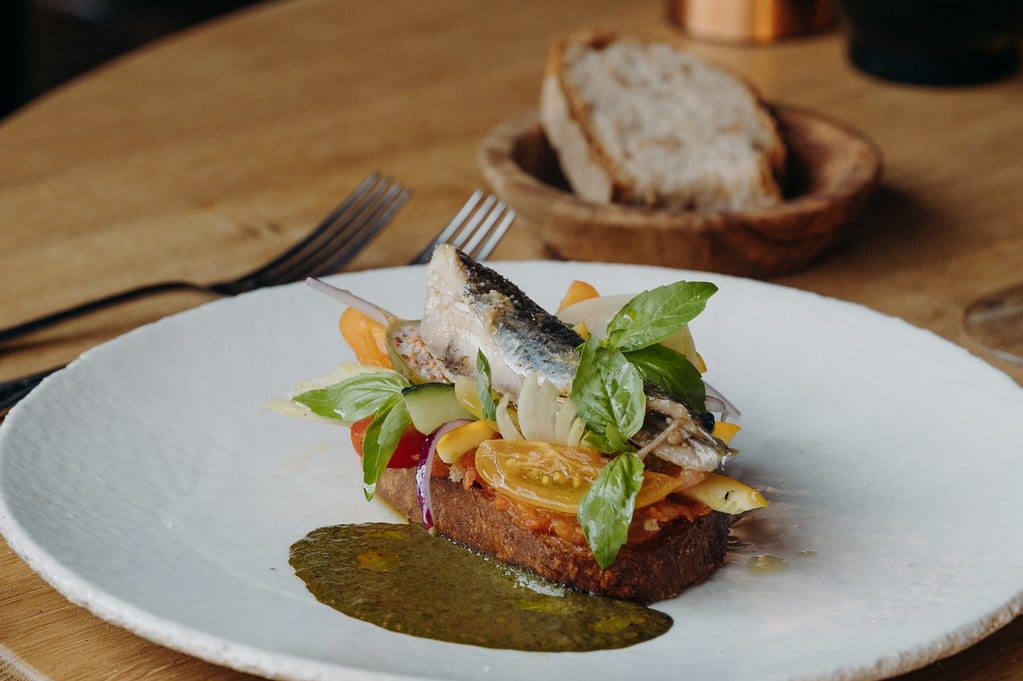
If the eye is cared for here, so is the appetite, and with considerably more seriousness than the hamlet’s gentle self-presentation might suggest. The kitchens belong to Julie Chaix, a chef whose biography reads like a pilgrimage through French gastronomy’s most exacting rooms. She trained under Anne-Sophie Pic, passed through the Alain Ducasse constellation at Le Louis XV in Monaco and in New York, and worked at La Bastide de Moustiers before a stint in Geneva. She is, notably, a daughter of this region, the child of a market gardener, and her return to Provence after years elsewhere reads less like a career move than a homecoming. Gault et Millau has awarded her two toques. The Michelin Guide speaks of a market driven menu built on the ingredients and traditions of Provence, and both are right, though neither quite captures the particular tenderness in her cooking, the sense of a woman feeding people the way her grandmother once fed her, without ceremony, but with total conviction.
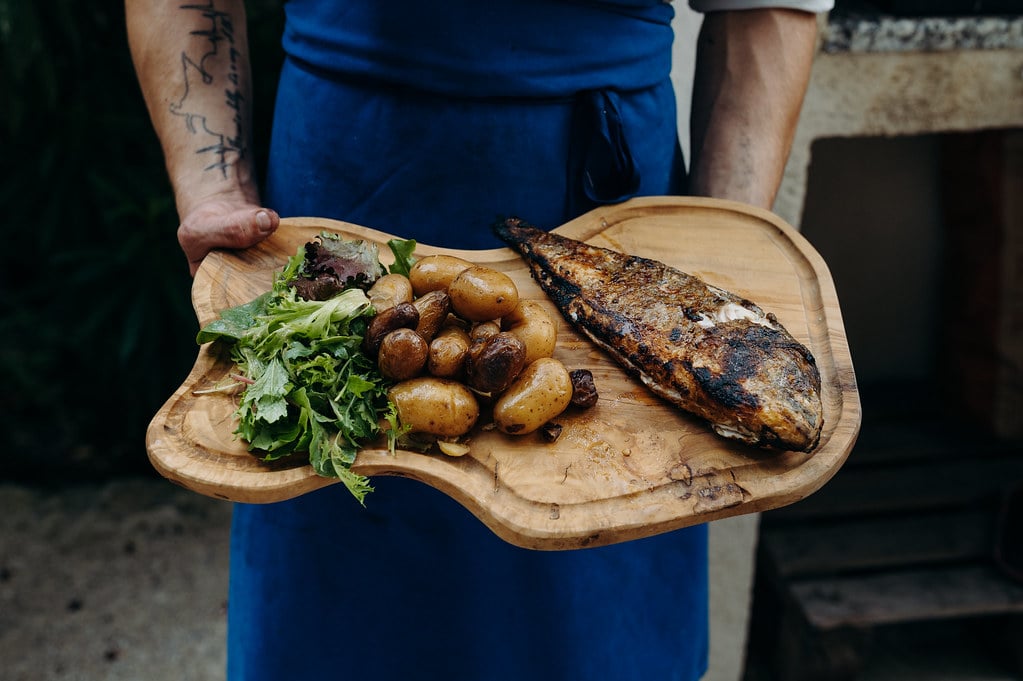
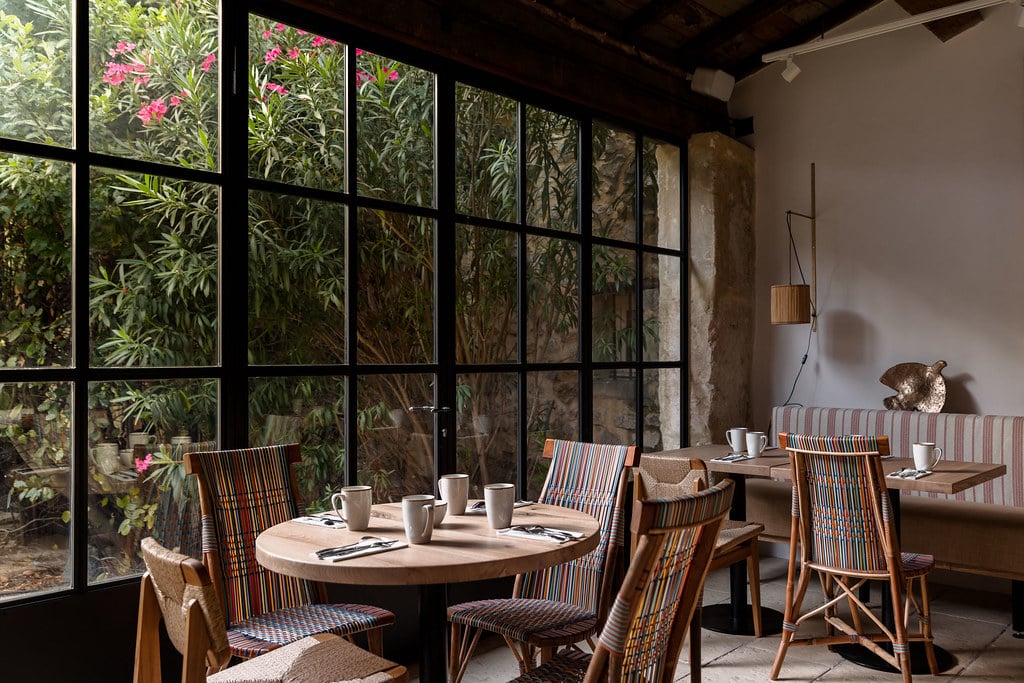
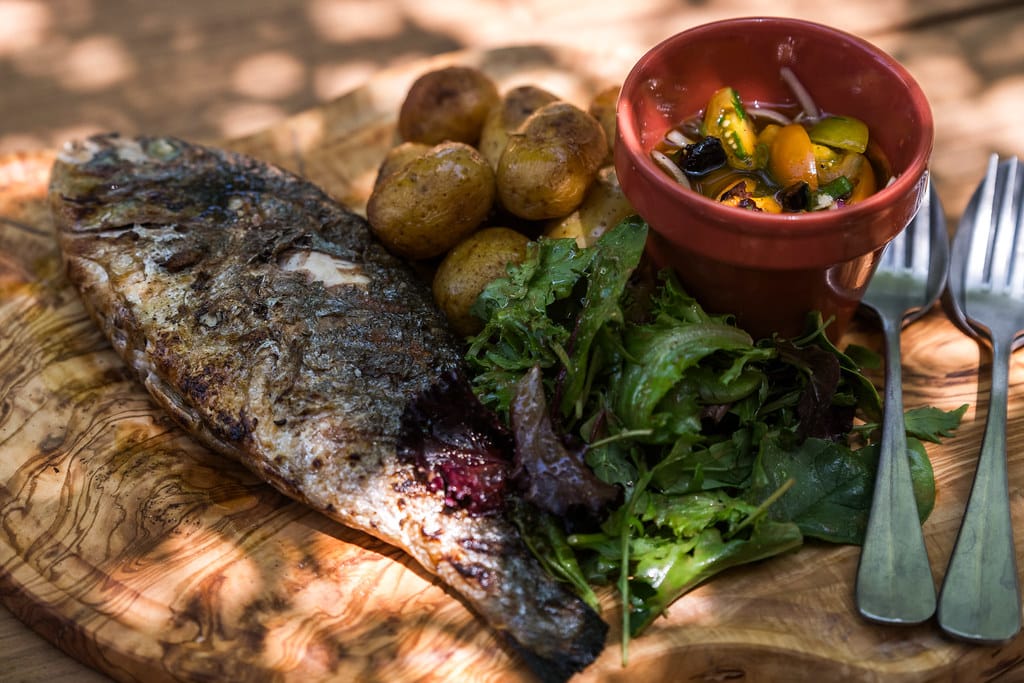
At Allegria, her restaurant within the main farmhouse, the summer table reads like a love letter to the season. A Mediterranean carpaccio arrives beside local asparagus and rhubarb steeped until it turns tender and faintly sour. White asparagus, the pale spears prized across Provence each spring, comes dressed with cured egg yolk, a pistou of arugula, and a sabayon browned in butter until it tastes faintly of hazelnut. There is a potato gnocchi set into a stew of spring peas and fresh mint that seems designed for the exact moment the mistral finally dies down. Mains carry the same conviction. Fried squid from the Mediterranean sits with fava beans and a lettuce charred just past the point of sweetness. The catch of the day comes bathed in a citrus virgin sauce among multicolored carrots. A veal rack from the Hautes Alpes is roasted simply and left to speak for itself, while a pigeon dish, its breast roasted and its leg slowly stewed, arrives with a fried artichoke and a jus reduced down to something almost syrupy in its intensity. Dessert closes on a note of pure pleasure: a chocolate mousse and caramelized peanut composition the kitchen has nicknamed, with evident affection, the Hameau’s Snickers, alongside strawberries from the Alpilles folded into mascarpone and a vacherin finished with candied rhubarb and crisp meringue. The wine list wanders the way a good conversation does, through Rolet and Mas Sainte Berthe by the glass, and onward by the bottle through the Rhône, the Luberon, the Jura, Alsace, the Loire, Bordeaux, a whole geography of France poured out beneath the plane trees.
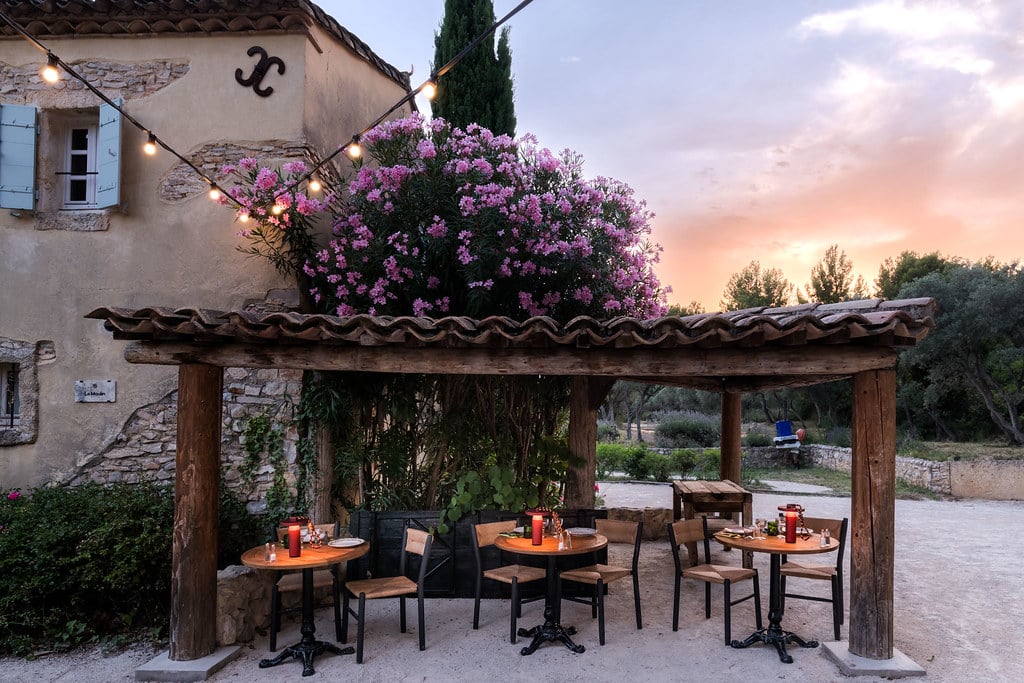
Where Allegria is composed, La Petite Guinguette, set on the square through the summer months, is looser and more communal, a wood fired evening of shared plates, grilled octopus, pissaladière, live music drifting somewhere between dinner and dessert. It is the version of the hamlet that laughs a little louder, that stays out past the hour it probably should have gone to bed.
There is, throughout, a studied resistance to hurry. The heated pool, ringed by design objects and shaded loungers, exists as much for stillness as for swimming. A clay tennis court, a small gym, a pétanque pitch, outdoor massage spaces folded into the olive rows, all of it built for a kind of movement that has nowhere urgent to be. For those who want to leave the grove, a 1960s Méhari convertible waits for picnic excursions, and electric bikes offer a quieter way to trace the canal roads through neighboring vineyards.
And then there is the landscape itself, which the hotel seems to understand it did not invent and could never improve upon, only frame. Les Baux de Provence rises on its rocky spur minutes away, a village so improbably perched it has long been counted among the most beautiful in France, its medieval château sprawling across seven hectares of ruin and reconstruction. The Regional Natural Park of the Alpilles surrounds it all, four thousand years of human presence layered into wetland and scrub, home to more than two hundred and fifty species of bird and to olive groves that still account for the great majority of the park’s cultivated land, some of it protected under designations of origin that read like small acts of regional pride.
To stay at Hameau des Baux is to accept an invitation into a particular rhythm, one measured less in itineraries than in the length of a shadow across a terrace, the arrival of a dish, the particular hour at which the cicadas finally fall silent. It does not perform hospitality so much as practice it, quietly, in a place that has clearly decided that the truest form of luxury is simply paying close enough attention to be worth remembering.