

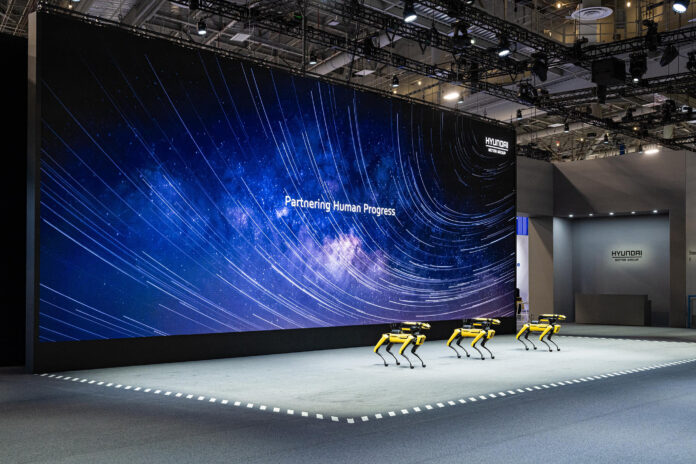

Hyundai Motor Group’s presence at CES 2026 reads less like a product launch and more like a systems briefing. Instead of pushing a single headline device, the company is laying out how it believes AI robotics will mature: not through one breakthrough robot, but through tightly coupled hardware, software, and operational workflows that scale together.
The setting reinforces that intent. In the West Hall of the Las Vegas Convention Center, Hyundai Motor Group has built a 1,836 square meter booth organized around live operation rather than static display. Robots are continuously running tasks, and hourly technical sessions focus on architecture, deployment constraints, and integration challenges. The emphasis is less on vision and more on execution.
What stands out analytically is how deliberately the Group avoids treating robotics as a single category. Instead, it presents physical AI as an ecosystem composed of humanoid manipulation, mobile perception, autonomous mobility, wearable assistance, and logistics automation. Each category addresses a different bottleneck in labor, safety, or efficiency, but they are unified by shared approaches to autonomy, sensing, and fleet management.
That strategy is most visible in the way Hyundai frames Atlas and Spot. Rather than positioning the humanoid robot as a general purpose replacement for human labor, the company is explicit about scope. Atlas is designed to operate in structured industrial environments where adaptability matters, but predictability still exists. The research prototype shown in the Tech Lab zone functions as a validation platform, testing balance, dexterity, and autonomous task execution. The production oriented Atlas model, by contrast, is presented as a manufacturing asset, optimized for repeatable tasks, heavy payloads, and continuous operation.
From a technical perspective, Atlas reflects a bet on mechanical capability paired with rapid learning. With 56 degrees of freedom, tactile sensing, and full surround vision, the robot prioritizes physical competence first, then layers autonomy on top. Features like autonomous battery replacement and operation across extreme temperatures suggest Hyundai is designing for uptime rather than novelty. The stated goal of mass production further signals that Atlas is being evaluated against cost, reliability, and maintainability benchmarks typical of industrial equipment, not experimental robotics.
Spot fills a different role in this ecosystem. Integrated with Orbit AI, it functions as a mobile sensing platform rather than a manipulator. Analytically, this highlights Hyundai’s belief that inspection, monitoring, and data collection are among the fastest paths to return on investment in robotics. Orbit AI’s focus on fleet management, anomaly detection, and data analysis positions software as the value multiplier, turning physical robots into long term operational tools rather than isolated deployments. The inclusion of historical hardware iterations reinforces a narrative of incremental, deployable progress rather than sudden leaps.
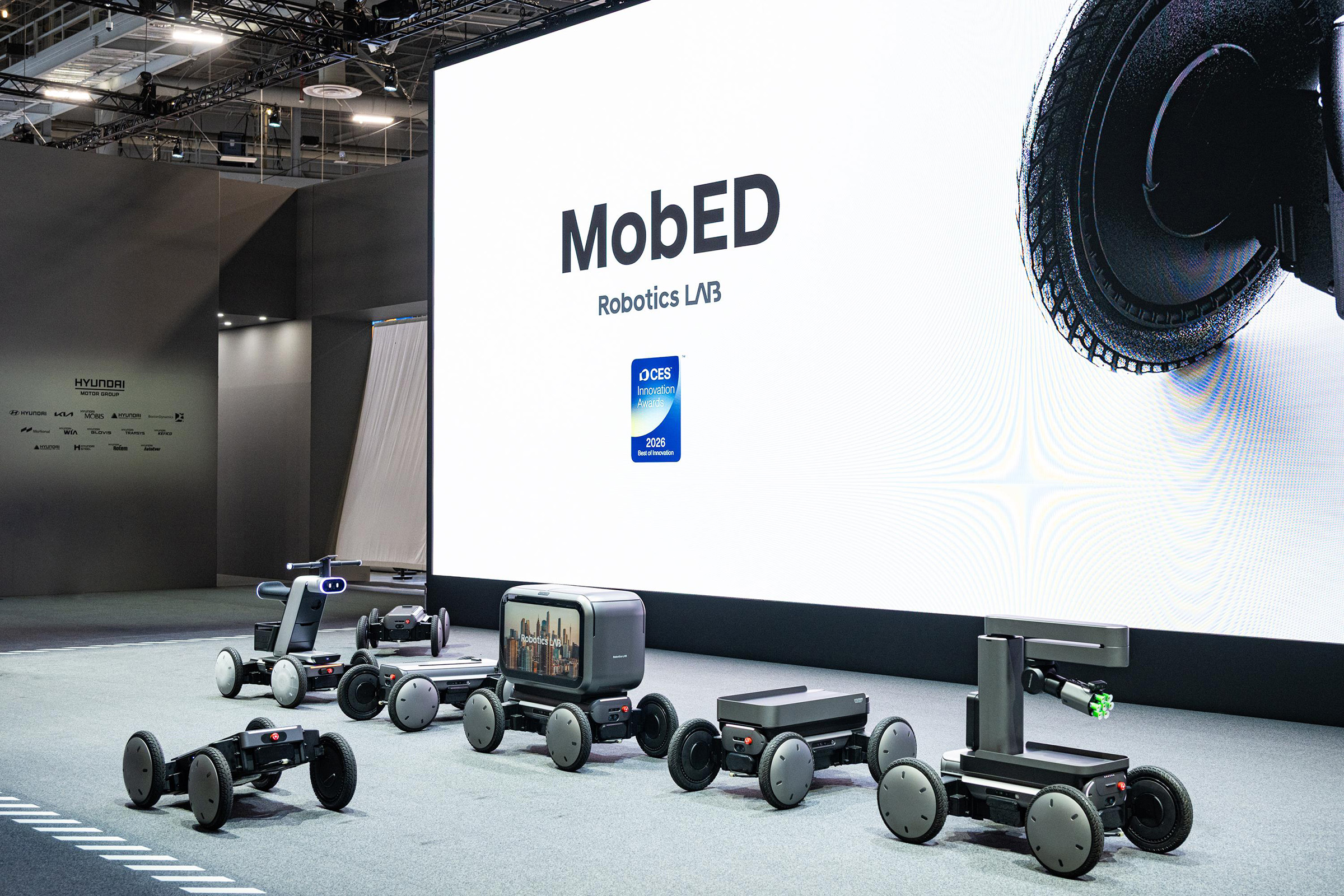
MobED introduces a separate but related thesis: that autonomy at smaller scales may prove more flexible than full size vehicles or humanoids. The platform’s Drive and Lift architecture is notable not because it is flashy, but because it solves a practical problem: maintaining stability and maneuverability in environments designed for humans, not robots. The eccentric wheel system allows MobED to handle curbs, slopes, and uneven surfaces that typically limit wheeled robots.
The split between Basic and Pro models reflects a clear market segmentation. Hyundai is simultaneously courting developers who want a hardware testbed and commercial users who want a turnkey autonomous platform. From an analytical standpoint, this mirrors strategies seen in computing platforms, where openness at the base layer accelerates ecosystem growth while integrated products drive near term revenue. The multiple concept configurations shown at CES reinforce MobED’s role as infrastructure rather than a single purpose device.
Autonomous vehicles appear in the exhibit not as the centerpiece, but as one component of a broader autonomy stack. The IONIQ 5 RoboTaxi, developed with Motional and based on the IONIQ 5, is framed as a deployment ready system operating at SAE Level 4. The analytical takeaway is less about driving capability and more about ecosystem readiness. Demonstrations of robotic charging and automated parking emphasize that autonomy depends on supporting systems that reduce human intervention at the edges.
Those supporting systems matter because they address operational friction. The Automatic Charging Robot and Hyundai WIA’s parking robot target tasks that are simple for humans but costly and error prone at scale. Parking a Kia EV6 autonomously or charging a RoboTaxi without human involvement may seem incremental, but these functions are essential if autonomous fleets are to operate continuously and profitably.
The industrial and workplace technologies on display further reinforce Hyundai’s systems level thinking. The X-ble Shoulder wearable robot is notable precisely because it is not autonomous. Its passive, non powered design reflects a recognition that not all productivity gains come from AI. Reducing physical strain through mechanical assistance addresses workforce sustainability, an issue robotics companies often overlook in favor of full automation narratives.
Similarly, the logistics demonstrations featuring Stretch, collaborative robots, and autonomous mobile robots focus on orchestration rather than replacement. Each system handles a specific segment of the workflow, from unloading to transport, operating alongside humans rather than displacing them. The use of SLAM, LiDAR, and vision systems is presented as mature technology applied to constrained problems, not speculative research.
Taken together, Hyundai Motor Group’s CES 2026 presentation suggests a measured view of robotics adoption. The company is not arguing that humanoids will replace workers or that autonomy will instantly transform cities. Instead, it is outlining a layered approach where physical AI is deployed where it is economically and operationally justified, supported by software platforms that improve over time.
From an analytical standpoint, the most important takeaway may be what Hyundai does not promise. There are no sweeping claims about general intelligence or universal robots. The focus stays on durability, integration, and scalability. In that sense, the exhibit reads less like a vision of the future and more like an operational roadmap, one that treats robotics as infrastructure that must earn its place through reliability, not imagination.
