

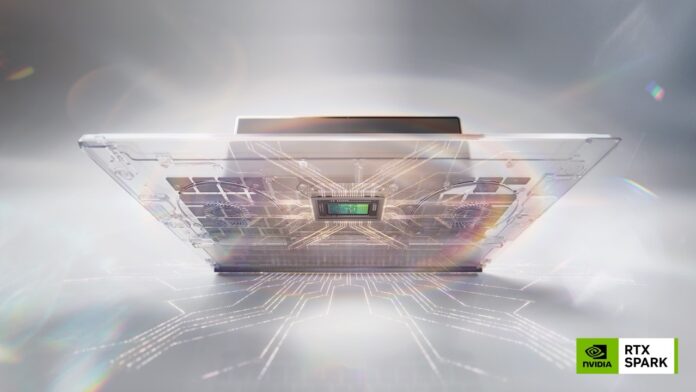

For decades, personal computers have been exactly that: tools you operate. You click an application, type a command, and wait for a result. But the unveiling of the NVIDIA RTX Spark superchip signals a fundamental shift in consumer technology. Built specifically for Windows PCs, RTX Spark aims to transform our laptops and desktops from passive tools into active, intelligent teammates, introducing a new class of personal AI computer.
At its core, this launch is about bringing thirty years of NVIDIA graphics and computing innovation directly to your desk or backpack. This is not just an iterative update. RTX Spark merges an NVIDIA Blackwell RTX GPU featuring 6,144 CUDA cores and fifth generation Tensor Cores with FP4 precision, connected via the NVIDIA NVLink C2C interconnect to a high performance 20 core NVIDIA Grace CPU. Designed in collaboration with Arm architecture leader MediaTek to ensure best in class power efficiency, the system is backed by up to 128 gigabytes of unified memory.
The result? A staggering 1 petaflop of artificial intelligence performance inside a laptop with all day battery life. As NVIDIA founder and CEO Jensen Huang noted, the era of clicking and typing is giving way to simply asking your PC to do the work.
A Secure Foundation for Local Intelligence
Artificial intelligence agents have reached a critical tipping point. Open source projects like OpenClaw and Hermes Agent are achieving record breaking adoption on developer networks such as GitHub and OpenRouter. However, letting an AI scan your personal files has rightfully raised privacy concerns, limiting broad consumer adoption.
NVIDIA and Microsoft are partnering to build a native, secure Windows experience that solves this exact problem. By introducing new Windows security primitives alongside the NVIDIA OpenShell runtime, they are creating an environment where agents run safely under your complete control.
- Total Privacy: New Windows primitives handle identity, containment, and security policy. Meanwhile, NVIDIA OpenShell intelligently routes your queries to local models based on your rules, even disguising personal data if a cloud query is necessary.
- Developer Adoption: Leaders in the space see the potential. Vincent Koc, chief architect at the OpenClaw Foundation, praised the fully integrated stack for private, on device agents. Dillon Rolnick, CEO of Nous Research, echoed this, noting that running Hermes Agent locally via OpenShell means you are buying a full fledged assistant, not just a laptop.
- The Microsoft Vision: Microsoft chairman and CEO Satya Nadella summed up the collaboration perfectly, calling RTX Spark a real breakthrough toward delivering unmetered intelligence to every home and desk.
Unprecedented Power for Creators and Gamers
Beyond intelligent agents, RTX Spark delivers the complete NVIDIA technology stack, including CUDA, RTX, DLSS, TensorRT, OptiX, Reflex, and G SYNC. For creative professionals and gamers, the raw local capabilities are staggering.
Users can now render massive 90 gigabyte 3D scenes, edit 12K 4:2:2 video natively with the Blackwell decoder, and generate 4K AI videos locally. Developers can run 120 billion parameter large language models with an incredible 1 million token context window natively. Meanwhile, gamers can run AAA titles at 1440p resolution and over 100 frames per second with ray tracing enabled.
The broader software ecosystem is moving rapidly to support the platform:
- New Technologies: DLSS 4.5 Ray Reconstruction, featuring a second generation transformer model, is coming to Blender 5.3 and dozens of games. RTX Video with 4x Frame Generation is launching on ComfyUI.
- Creative Endorsements: Grant Petty, CEO of Blackmagic Design, believes the fantastic battery life of these laptops will drive the next leap in portable production. Jules Urbach, CEO of OTOY, noted that bringing OTOY Octane with Render Network support to the chip delivers a new class of systems for creators. Yannik Marek, creator of ComfyUI, highlighted the unified memory for running highly complex multimodal workflows, while Georgi Gerganov, founder of llama dot cpp, praised the ability to multiply context processing within a portable chassis.
- Gaming Integrations: Over 100 software providers are embracing the platform. Jason Ronald, vice president of Next Generation at XBOX, expressed excitement about expanding XBOX access on these devices. Long Cheng of NetEase confirmed that players can experience NARAKA BLADEPOINT exactly as developers intended, and Mika Vehkala, chief technology officer at Remedy Entertainment, is looking forward to bringing stunning visuals to these ultra thin laptops.
Adobe Rearchitects for the AI Era
In one of the most significant software shifts of the decade, Adobe is completely rearchitecting Photoshop and Premiere Pro from the ground up for RTX Spark, promising twice the speed for AI and graphics workflows.
According to Adobe chair and CEO Shantanu Narayen, the partnership will deliver AI native experiences that match the pace of human ambition. Premiere will utilize a new video pipeline tapping into the unified memory and TensorRT software for real time color correction and faster timeline rendering. Photoshop will harness GPU accelerated compositing for live filters, high dynamic range, and modern natural brushing.
Tools like Firefly powered Generative Fill in Photoshop and Generative Extend in Premiere will see massive accelerations, and Adobe Substance 3D Painter and Stager will run natively for incredibly responsive texturing. Soon, Adobe will even allow users to design collaboratively alongside Windows agents, turning the PC into a true creative partner.
Premium Designs Without Compromise
What makes this technological leap truly consumer friendly is the hardware packaging. The industry is proving that you no longer have to buy a bulky workstation to achieve uncompromised performance.
Hardware partners are building sleek, precision machined aluminum laptops measuring just 14 millimeters thin and weighing around three pounds. Available in 14 inch to 16 inch sizes, these devices feature gorgeous, color accurate tandem OLED displays with NVIDIA G SYNC. Small, ultra efficient desktop models are also arriving for dedicated workspaces.
Major hardware makers are fully onboard, bringing their unique design languages to the new superchip:
- ASUS: Chairman Jonney Shih called RTX Spark the platform to build systems that define the future of personal computing.
- Dell: Chairman and CEO Michael Dell unveiled the XPS 16 Creator Edition, ensuring users no longer have to choose between portability and performance.
- HP: Interim CEO Bruce Broussard highlighted the upcoming HP OmniBooks as some of the thinnest RTX Spark laptops for agentic developers.
- Lenovo: Chairman and CEO Yuanqing Yang sees the platform as a way to deliver a whole new level of AI experiences across their device portfolio.
- Microsoft Surface: Brett Ostrum, corporate vice president of Surface, announced the Surface Laptop Ultra, a deeply connected device built for ambitious creators and engineers.
- MSI: CEO Jeans Huang noted the platform has allowed them to completely redefine what a compact PC can deliver.
The first wave of RTX Spark devices will be available this fall from ASUS, Dell, HP, Lenovo, Microsoft Surface, and MSI, with models from Acer and GIGABYTE following shortly after. For enterprise developers needing even more scale to build frontier agents, NVIDIA is also launching the DGX Station for Windows, putting a massive AI supercomputer right at the desk.
To learn more about the future of Windows agent capabilities, developers and enthusiasts can tune in to the keynote at Microsoft Build, running June 2 and 3. The personal AI computer is no longer a concept; it is finally here.
