

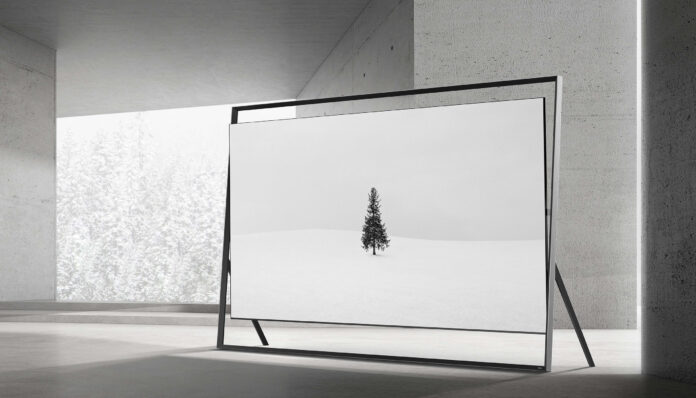

Samsung Electronics arrived at CES 2026 with a clear message about the future of ultra-premium displays: bigger screens are no longer just about size, they are about presence. The company unveiled the world’s first 130-inch Micro RGB TV, the R95H, positioning it as both a technological flagship and a design object meant to reshape the space around it.
Introduced at CES 2026, the 130-inch Micro RGB marks the largest implementation of Samsung’s Micro RGB technology to date. More importantly, it signals a shift in how Samsung wants people to think about high-end televisions. This is not a screen designed to disappear into the background. It is built to anchor a room.
Hun Lee, Executive Vice President of the Visual Display Business at Samsung Electronics, framed the launch as both a technological milestone and a return to form. The new model, he said, revives Samsung’s original premium design philosophy from more than a decade ago, reinterpreted for a generation that expects displays to feel intentional, expressive and future-facing.
When a TV starts behaving like architecture
At 130 inches, the Micro RGB TV is intentionally imposing, but Samsung has softened that scale through design. Rather than reading as an oversized gadget, the display is engineered to resemble a massive architectural opening, something closer to a window than a television.
That effect is driven by the Timeless Frame, an updated take on Samsung’s 2013 Timeless Gallery concept. The refined frame is slim and understated, allowing the screen to appear as if it is floating within its borders. The proportions are deliberate, inspired by large architectural windows, reinforcing the idea that this display is meant to shape the room rather than simply occupy wall space.
Audio is treated with the same spatial awareness. Sound is integrated directly into the frame and tuned to match the scale of the screen, creating a sense that picture and audio originate from the same physical presence. The result is a display that feels cohesive, where visuals and sound move together as a single experience.
Micro RGB pushed to its limits
Behind the design is Samsung’s most advanced Micro RGB implementation so far. The 130-inch model is powered by Micro RGB AI Engine Pro, which uses AI to refine contrast, enhance muted tones and maintain detail across both bright highlights and deep shadows. Supporting technologies like Micro RGB Color Booster Pro and Micro RGB HDR Pro further elevate dynamic range and color accuracy.
Color is a defining strength. The display delivers 100 percent of the BT.2020 wide color gamut through Micro RGB Precision Color 100, producing tightly controlled hues that remain consistent across the massive panel. The display has been certified by the Verband der Elektrotechnik for precise Micro RGB color reproduction, underscoring its technical credibility at this scale.
Samsung has also applied its proprietary Glare Free technology to the panel, reducing reflections and preserving contrast in a wide range of lighting environments. That choice reinforces the idea that this TV is meant to live in real spaces, not just darkened home theaters.
A showcase for Samsung’s AI-first TV strategy
The 130-inch Micro RGB TV is also designed to act as a platform for Samsung’s expanding AI ecosystem. It supports HDR10 Plus Advanced and Eclipsa Audio for enhanced picture and spatial sound, but the more telling addition is the integration of Samsung’s enhanced Vision AI Companion.
Vision AI Companion brings conversational search, proactive recommendations and contextual intelligence directly into the viewing experience. It also provides access to AI driven features and services such as AI Football Mode Pro, AI Sound Controller Pro, Live Translate, Generative Wallpaper, Microsoft Copilot and Perplexity. Rather than positioning AI as a headline feature, Samsung is embedding it as an always-available layer that adapts to content, environment and user behavior.
Samsung will showcase the 130-inch Micro RGB TV throughout CES 2026 at its Exhibition Zone in Las Vegas. Taken as a whole, the display feels less like a single product announcement and more like a thesis statement. Samsung is betting that the future of ultra-large TVs lies at the intersection of scale, design and intelligence, where screens stop trying to disappear and instead become intentional parts of the spaces people live in.
