


Cars, robots, and PCs are all quietly becoming computers first and machines second, and CES 2026 is where that shift feels fully locked in. At this year’s show, Qualcomm Technologies made a confident case that the future of connected technology will be defined by AI native platforms that scale across vehicles, robotics, and personal devices, all powered by intelligent compute at the edge.
Rather than focusing on a single category, Qualcomm Technologies used CES to show how its portfolio now functions as an ecosystem. From software defined vehicles to humanoid robots to Copilot plus PCs, the company positioned itself as an enabler of experiences that feel more adaptive, more personalized, and more integrated into everyday life.
Vehicles are becoming AI platforms on wheels
Automotive remains Qualcomm Technologies’ most visible proving ground, and CES 2026 highlighted how far the company has moved beyond infotainment chips. With growing global adoption of its Snapdragon Digital Chassis solutions, Qualcomm Technologies is helping automakers reimagine vehicles as continuously evolving software platforms.
A major signal came from the expanded collaboration with Google. Building on more than a decade of joint work, the two companies are deepening their partnership to combine Snapdragon Digital Chassis hardware with Google’s automotive software stack. The goal is to help carmakers bring new AI features to market faster, while simplifying development. The result is vehicles that are easier to interact with through voice, touch, and visuals, and better at adapting to individual drivers over time.
Qualcomm Technologies also highlighted growing momentum behind its Snapdragon Cockpit Elite and Snapdragon Ride Elite platforms. These flagship central compute solutions are designed to power both digital cockpit experiences and advanced driver assistance systems using accelerated AI. At CES, the company announced new and expanded design wins with automakers including Li Auto, Leapmotor, Zeekr, Great Wall Motor, NIO, and Chery, bringing the total to 10 programs.
Leapmotor introduced a high performance automotive central computer built on dual Snapdragon Elite platforms, making it the world’s first controller of its kind. Garmin also announced its selection of the Snapdragon Elite automotive platform to power its Nexus high performance computing system, underscoring the platform’s appeal beyond traditional automakers.
Another key piece of the automotive story is Snapdragon Ride Flex. As the first commercialized system on chip to unify digital cockpit and advanced driver assistance workloads, Ride Flex is accelerating the industry’s shift toward centralized compute. The platform is already deployed in mass produced vehicles across eight global programs, with Tier 1 suppliers such as Autolink, Desay SV, Hangsheng, and ZYT outlining plans to scale integrated cockpit and driver assistance solutions built on Ride Flex.
Qualcomm Technologies is also continuing to push toward end to end automated driving. Building on more than 20 design wins for the Snapdragon Ride platform, the company is working with advanced driving stack providers including DeepRoute.ai, Momenta, QCraft, WeRide, and ZYT. The open and scalable architecture of Snapdragon Ride allows partners to bring different AI approaches into production ready systems optimized for real world performance. With nearly one million Snapdragon Ride systems on chip shipped and new collaborations with suppliers such as ZF and Epec, the platform is steadily strengthening its position as a foundation for automated driving.
Inside the cabin, Qualcomm Technologies’ decade long leadership in in vehicle infotainment continues to pay off. Snapdragon Cockpit platforms now power more than 75 million vehicles worldwide, delivering increasingly intelligent digital experiences. At CES, the company announced a collaboration with Toyota, which selected the next generation Snapdragon Cockpit platform for the new RAV4. The system is designed to anticipate driver and passenger needs, adapt in real time, and provide proactive in vehicle assistance.
Connectivity and safety rounded out the automotive narrative. Qualcomm Technologies introduced its first 5G Reduced Capability modem, the Qualcomm A10 5G Modem RF, aimed at enabling low power and cost efficient connectivity for mission critical services as vehicles transition to advanced networks. Alongside Hyundai Mobis, the company demonstrated vehicle to everything technology designed to detect non line of sight hazards and provide earlier warnings and smoother braking responses, addressing real world scenarios where traditional sensors have limited visibility.
Robotics moves from prototype to deployment
Beyond cars, Qualcomm Technologies used CES 2026 to show how its edge AI expertise is shaping the next generation of physical AI. The company introduced a comprehensive robotics architecture that integrates hardware, software, and compound AI into a single stack designed to move robots from experimental prototypes into deployable machines.
At the center of this effort is the Qualcomm Dragonwing IQ10 Series, the company’s latest premium tier robotics processor for advanced autonomous mobile robots and full size humanoids. Designed as the brain of the robot, the processor emphasizes high performance and energy efficiency, enabling machines that can reason, adapt, and make decisions in dynamic environments.
The broader robotics architecture builds on Qualcomm Technologies’ strengths in scalable, low power edge computing. It supports advanced perception, motion planning, and end to end AI models including vision language architectures and vision language models, unlocking more generalized manipulation and natural human robot interaction. The Dragonwing industrial processor roadmap already powers a range of robotics form factors, including humanoid robots from companies such as Booster and VinMotion.
At CES, Qualcomm Technologies highlighted its collaboration with Figure as the two companies work to define next generation compute architectures for scaling humanoid platforms. The company is also cultivating a broad ecosystem around its robotics platforms, working with partners such as Advantech, APLUX, AutoCore, Kuka Robotics, Robotec.ai, and VinMotion to accelerate deployment ready robotics across retail, logistics, and manufacturing.
Live demonstrations at the Qualcomm booth brought this vision into focus. VinMotion’s Motion 2 humanoid, powered by the Dragonwing IQ9 Series, and Booster’s K1 Geek humanoid illustrated how edge AI can enable real time perception and interaction. Qualcomm Technologies also showcased commercially available robotics development kits, teleoperation tools, and an AI data flywheel designed to support continuous learning and skill expansion across robotic systems.
AI powered PCs continue their momentum
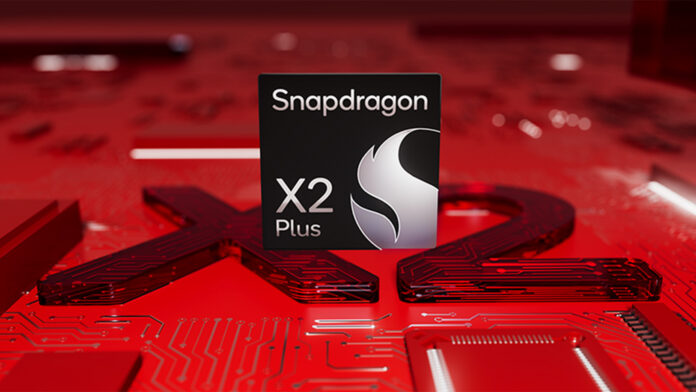
Qualcomm Technologies also extended its push into personal computing with the announcement of the Snapdragon X2 Plus platform, the newest addition to the Snapdragon X Series. Designed for modern professionals, creators, and everyday users, the platform aims to deliver fast, responsive performance in ultra portable Windows 11 Copilot plus PCs with multi day battery life.
Snapdragon X2 Plus is built to keep up with how people actually work and create today, shifting seamlessly between data heavy analysis, creative workflows, and video calls. Powered by the third generation Qualcomm Oryon CPU, the platform delivers up to 35 percent faster single core performance than the previous generation while using significantly less power. An integrated Hexagon NPU delivers up to 80 trillion operations per second of AI performance, enabling advanced agentic experiences and fluid multitasking.
With support for Wi Fi 7, optional 5G connectivity, and built in security through Snapdragon Guardian, Snapdragon X2 Plus reflects a broader strategy that connects PCs to the same AI native philosophy driving Qualcomm Technologies’ automotive and robotics platforms.
Across CES 2026, Qualcomm Technologies presented a consistent and optimistic vision. Software defined systems, powered by edge AI and scalable compute, are becoming the foundation for how people move, work, and interact with machines. Whether inside a vehicle, alongside a robot, or on a personal computer, Qualcomm Technologies is betting that the future belongs to platforms that are intelligent, efficient, and designed to quietly adapt to the world around them.
