


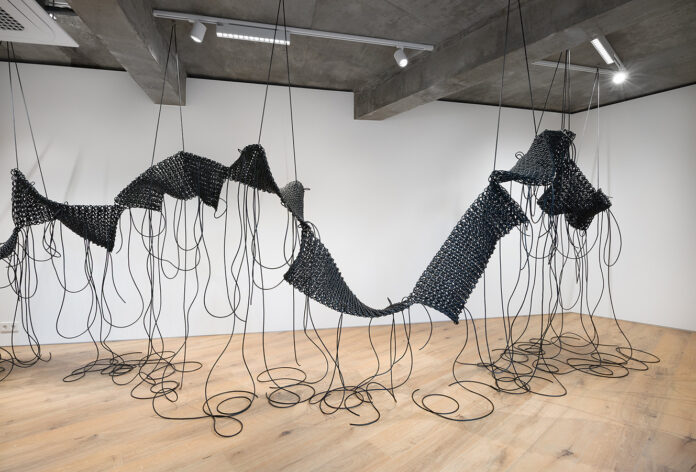

Severance, rather than continuity, is the generative premise of Kwangho Lee’s sculptural practice. In The Severance of the Serpent’s Neck, presented at Frieze House Seoul, the artist approaches birth not as an origin myth of wholeness but as a necessary rupture that makes autonomy possible. The exhibition unfolds around this proposition, using industrial materials and accumulated acts of knotting to examine how life, form, and relation emerge through interruption rather than seamless flow.
Lee’s long-standing engagement with industrial matter, particularly extension cords, resists the symbolic neutrality often assigned to utilitarian objects. These materials arrive already coded by contemporary systems of circulation, energy, and dependency. By subjecting them to prolonged, repetitive acts of knotting, Lee displaces their function while retaining their infrastructural memory. The resulting sculptures are not representations but conditions: dense, suspended bodies that hold themselves together through internal tension alone. Gravity is neither disguised nor overcome. Instead, it becomes a collaborator, activating the work’s structural precarity.
Knotting operates here as both method and epistemology. Lee works without templates, allowing form to emerge through iterative labor rather than preconceived design. Each gesture binds fragments into provisional coherence, producing sculptural bodies sustained by the force of their own interlacing. This insistence on internal structure proposes a counter-model to systems reliant on external support, whether architectural, social, or ideological. What holds these forms together is not reinforcement but relation.
The exhibition’s title gestures toward a broader cultural lineage. Drawing on Umbilical Cord Code: A Cultural History of Straw Rope, Serpents and Umbilical Cords by Kim Young-kyun and Kim Tae-eun, Lee engages with the serpent as a figure historically associated with the ouroboros and the fantasy of eternal return. Yet his position diverges sharply from this mythic continuity. For Lee, the serpent’s severed neck marks not infinity but the threshold of individuation. Life does not persist through endless looping but through the decisive act of separation that enables independent existence.
This reframing shifts the umbilical cord from a symbol of origin to one of necessary loss. Lee’s repeated processes of looping, tightening, binding, and release can be read as attempts to suture an existential wound without denying its permanence. The sculptures do not resolve rupture; they organize around it. Their serpentine energy emerges not from smooth circulation but from accumulated strain, from matter repeatedly forced into relation with itself.
Fragmentation, in Lee’s work, is neither a condition to be lamented nor an aesthetic effect to be staged. It is the material analogue of contemporary existence. Industrial components arrive discontinuous, standardized, and detached, mirroring a social reality structured by disconnection. Against this backdrop, Lee proposes what he terms an “autonomous code of life,” a system rebuilt from fragments through sustained labor. Autonomy here does not imply isolation but a form of interdependence generated from within rather than imposed from without.
The Severance of the Serpent’s Neck is presented as part of Frieze House Presents, a programme positioned less as a platform for exposure than as a site of critical articulation. Dedicated to practices across Korean creative fields, the initiative foregrounds methodologies and conceptual commitments shaping contemporary cultural production. Its emphasis lies in positioning, not promotion, and in cultivating a discourse that operates within, rather than adjacent to, global contemporary art conversations.
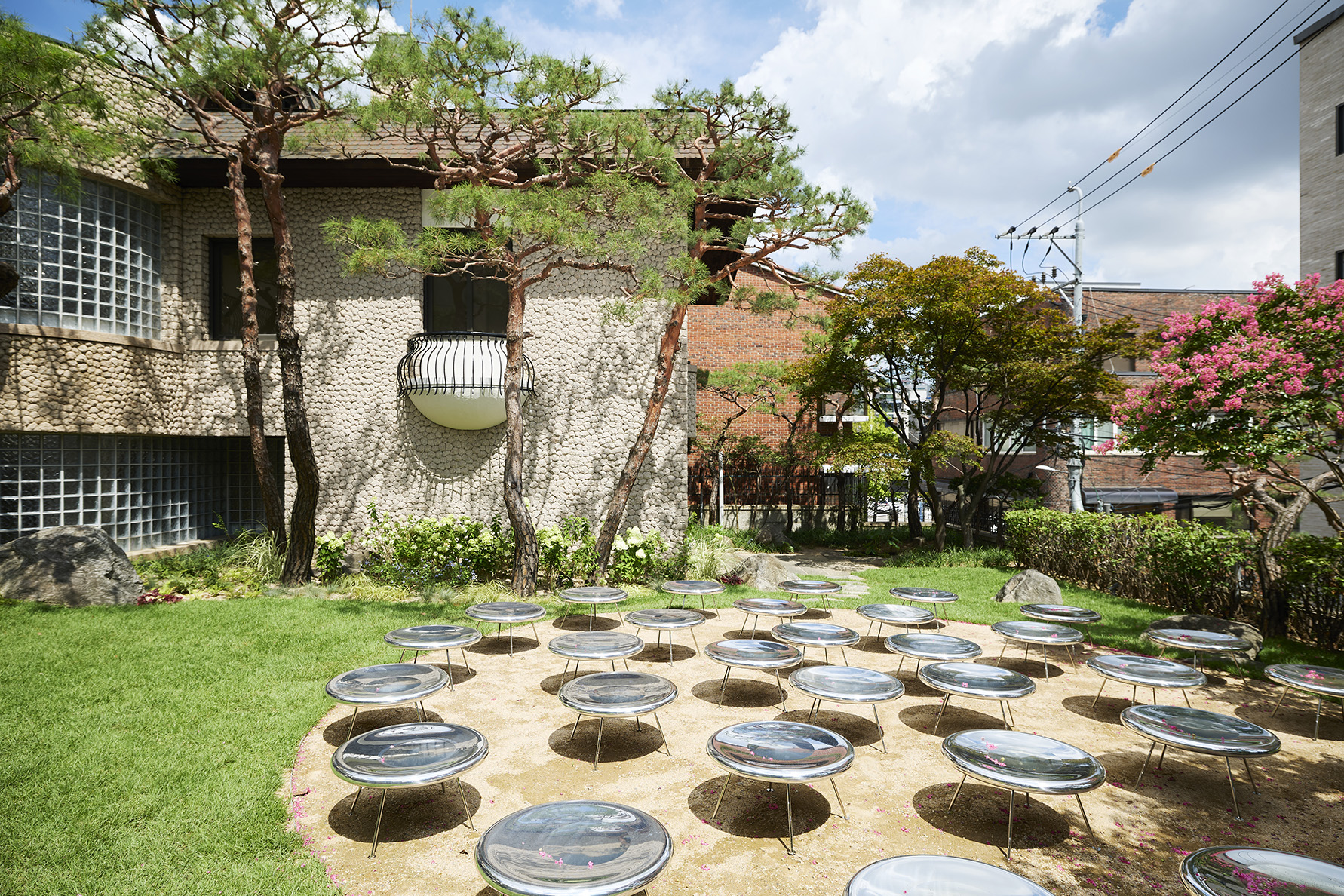
This curatorial orientation continues with the opening of Frieze House Seoul’s inaugural exhibition, UnHouse, curated by Jaeseok Kim. Set within a long-abandoned residential building, the project approaches the home as a contested structure rather than a stable site of belonging. Queerness functions here not as identity category but as analytic lens, through which domestic space is re-read as both instrument of regulation and potential site of reconfiguration.
Featuring works by Joeun Kim Aatchim, Haneyl Choi, Lee Dong-hyun, Anne Imhof, Em Kettner, Dan Kim, Dew Kim, Rebecca Ness, Catherine Opie, Grim Park, P. Staff, Kim Minhoon, Willa Wasserman, and Xiyadie, UnHouse organizes itself around four thematic axes: Body and Identity, Space and Power, Relation and Care, and Memory and Transmission. These are not compartments but overlapping vectors through which the exhibition interrogates how intimacy, authority, and inheritance are spatially produced.
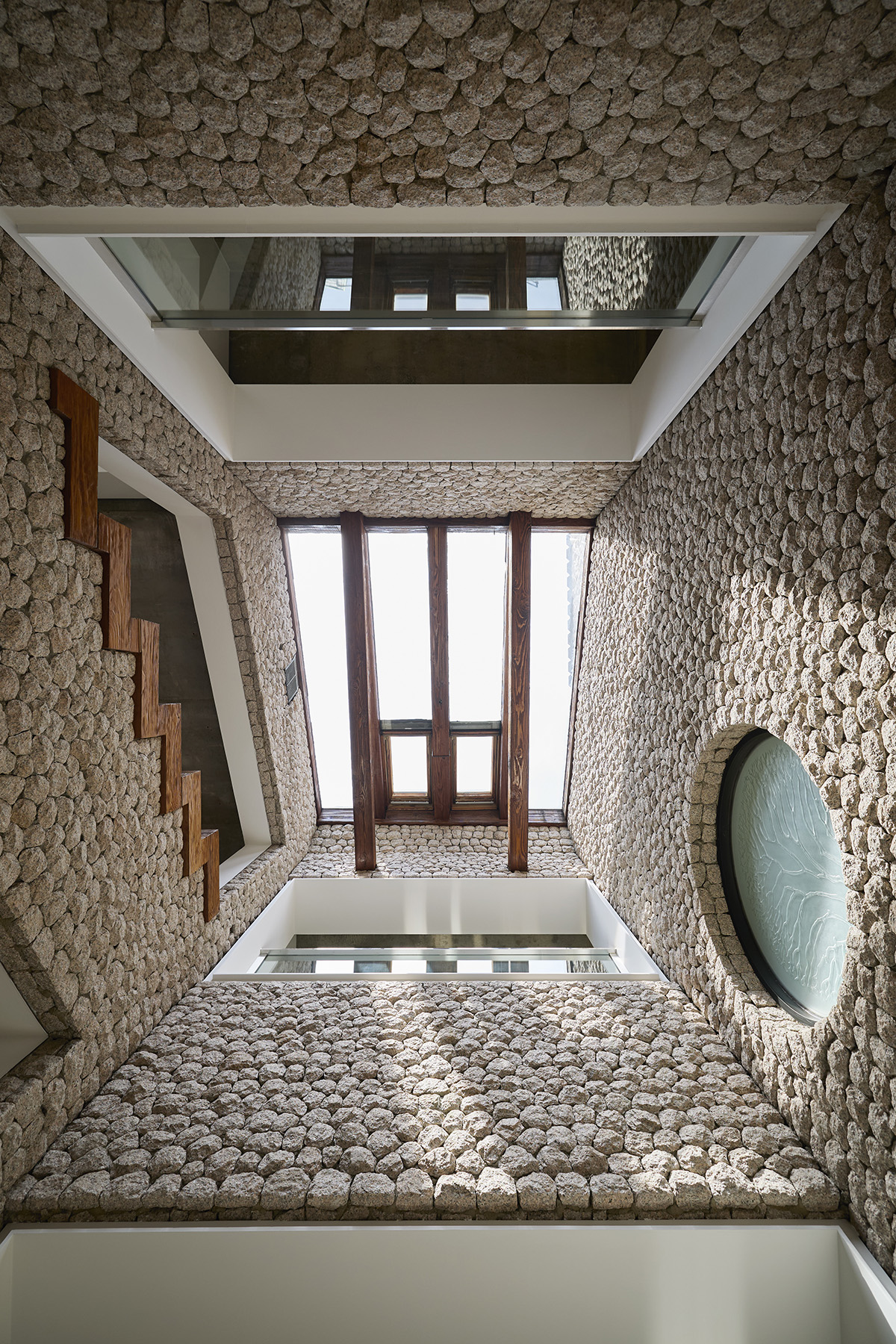
The building’s architecture is not treated as a neutral container. Staircases, corridors, tiled glass windows, and ceilings are folded into the works themselves, collapsing distinctions between artwork and site. Domestic space becomes unstable, inhabited by presences that operate as hosts, intrusions, or residues. Silence, gendered expectation, refuge, and withdrawal coexist, refusing resolution into a singular narrative of home.
Within the current Korean context, where debates around gender, sexuality, and same-sex marriage remain politically charged, the exhibition’s insistence on queerness as spatial practice carries explicit stakes. The works do not seek to rehabilitate the home but to expose its capacity for reordering. Home is neither rejected nor reclaimed; it is reconfigured as a site of experimentation, ambivalence, and potentiality.
Under the direction of Andy St. Louis, Frieze House Seoul positions itself as a space where international discourse and local specificity are not opposed but co-constitutive. Rather than functioning as an extension of the fair, it operates as a year-round platform for sustained inquiry. UnHouse marks the beginning of this trajectory, establishing Frieze House Seoul as a site where contemporary art is not explained or framed for consumption, but activated as an ongoing conversation already in motion.