

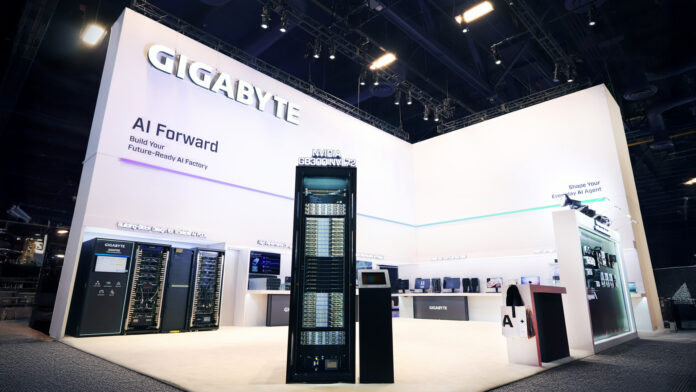

At CES 2026, GIGABYTE Technology uses its presence to make a broader point about the direction of AI computing. Rather than centering on a single product launch, the company presents a connected view of how AI infrastructure is evolving and what it takes to support it in practice. Under the theme “AI Forward,” GIGABYTE outlines a full computing ecosystem that spans data centers, edge deployments, and personal systems, all designed to help organizations move AI from experimentation to everyday operation.
The relevance of GIGABYTE’s message lies in its focus on execution. As AI models grow larger and more complex, the challenge is no longer just raw performance. It is about how quickly systems can be deployed, how efficiently they run, and how easily they can scale across different environments. GIGABYTE frames AI as a lifecycle problem, one that starts in centralized training environments and extends outward to factories, warehouses, offices, and individual workstations.
This thinking comes together most clearly in GIGAPOD, GIGABYTE’s modular AI data center solution. Built around a building block design, GIGAPOD combines high performance servers, high speed networking, and the GIGABYTE POD Manager software platform into a single, validated architecture. The goal is to reduce friction in AI infrastructure design and deployment, allowing enterprises to stand up dedicated AI environments faster and with fewer integration hurdles. In effect, GIGAPOD is positioned as a practical foundation for what many organizations now describe as AI factories.
At the hardware level, GIGAPOD relies on a new generation of direct liquid cooling servers optimized for dense AI workloads. GIGABYTE’s G4L4 and G4L3 platforms support Intel Xeon 6 processors with NVIDIA HGX B300 systems, as well as AMD EPYC 9005 and 9004 processors paired with AMD Instinct MI355X accelerators. These configurations are designed to deliver sustained performance while addressing the power and thermal demands that increasingly define modern AI infrastructure.
To manage these environments at scale, GIGABYTE introduces an in house rack management switch in a compact 1U form factor. Capable of overseeing up to eight direct liquid cooling racks, the switch supports multi vendor CDU communication protocols and precise leak detection. This kind of centralized visibility helps operators maintain reliability and simplify day to day operations, especially as data centers become more complex and densely packed.
The server portfolio extends beyond modular data centers to address a wide range of AI workloads. At the top end, the NVIDIA Grace Blackwell Ultra NVL72 is presented as a rack level compute platform built around 72 NVIDIA Grace CPUs. Combined with NVIDIA Quantum X800 InfiniBand and NVIDIA Spectrum X Ethernet networking, it is designed to deliver dramatic gains in inference performance compared with the previous NVIDIA Hopper generation, targeting large scale language models and data intensive inference tasks.
For training, simulation, and high throughput inference, GIGABYTE highlights the G894 SD3 AAX7 and XL44 SX2 AAS1 supercomputers. These systems are built around NVIDIA HGX B300 and NVIDIA RTX PRO 6000 Blackwell Server Edition GPUs respectively, paired with dual Intel Xeon 6 processors, DDR5 memory, and high speed InfiniBand and Ethernet connectivity. NVIDIA BlueField 3 DPUs are integrated to offload networking and security tasks, improving efficiency while reducing the burden on main processors. At a smaller scale, the W775 V10 L01 workstation brings server grade GPU performance and closed loop liquid cooling into an on premises form factor suited to creators and smaller AI teams.
GIGABYTE also places strong emphasis on edge computing, where AI must operate reliably and with minimal latency. At CES, this approach is illustrated through a smart warehouse scenario built on embedded systems and industrial PCs. Compact edge computers handle high TOPS inference close to the data source, while low power embedded systems coordinate automated guided vehicles and mobile robots. Industrial PCs manage robotic arms and conveyor systems, and flexible platforms with extensive I O support sensors and machine vision. The common thread is responsiveness, allowing AI systems to act in real time rather than relying on distant cloud resources.
On the client side, GIGABYTE addresses the growing interest in local and agentic AI with its AI TOP series. Systems such as the AI TOP ATOM, AI TOP 100 Z890, and AI TOP 500 TRX50 are designed to support on device large language and multimodal model inference, fine tuning, and retrieval augmented generation workflows. By running on standard electrical infrastructure, these systems lower the barrier to private and secure AI computing for individuals, studios, and small organizations.
To make these capabilities easier to use, GIGABYTE introduces the AI TOP Utility software. The emphasis here is simplicity. The software streamlines setup, model management, and deployment through an intuitive interface, allowing users to focus on applications rather than infrastructure details.
AI integration also reaches mobile users. New laptops equipped with the GiMATE AI companion provide on device assistance tailored to creators and professionals who value responsiveness and privacy. For those who need additional power, the AORUS RTX 5090 AI BOX connects via Thunderbolt 5 and delivers near desktop level AI and graphics performance using the GeForce RTX 5090 GPU.
Seen as a whole, GIGABYTE’s CES 2026 presentation reflects a shift toward integrated, practical AI infrastructure. The company is less focused on abstract promises and more on how AI systems are actually built, managed, and used across different environments. From liquid cooled data centers to warehouse floors and personal workspaces, GIGABYTE positions itself as a supplier of the tools needed to make AI work at scale today, while laying a clear foundation for what comes next.
