


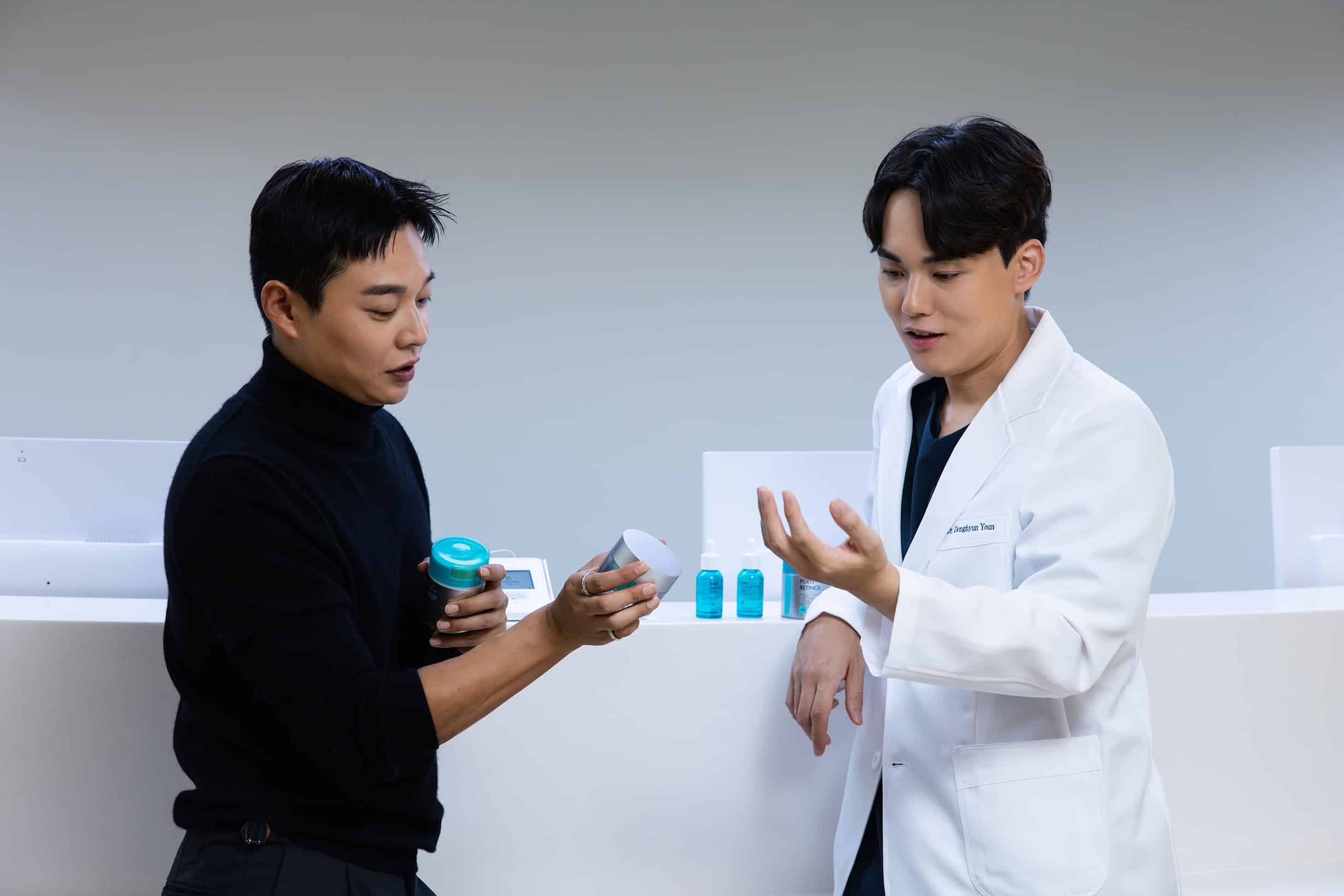

From the clinical halls of Seoul’s top dermatology centers comes a new model for skincare. It is grounded in measurable outcomes, regenerative science, and precise delivery. This is CISL Seoul. It does not belong to K-Beauty as we know it. It represents an entirely new category: K-Clinic.
Founded by Alex Lee, a former patient turned entrepreneur, and Dr. Donghyun Youn, one of South Korea’s most trusted plastic surgeons, CISL Seoul is rethinking the role of skincare through the lens of clinical logic. Their mission is to bring the efficacy and sophistication of Korea’s most advanced medical treatments into a daily ritual that requires no downtime or procedures.

From Consultation Room to Consumer Ritual
CISL did not emerge from a product development lab or a marketing boardroom. Its story began with a conversation between a patient and a surgeon. Alex Lee, in search of non-invasive solutions for facial aging, visited Dr. Youn at Edit Plastic Clinic. Over time, he observed the power of clinical treatments and also their limitations. They were transformative but not sustainable for daily care.
That experience sparked a critical question. Could the science behind aesthetic medicine, including targeted delivery, calibrated concentrations, and regenerative logic, be translated into a system for everyday use?
Lee and Youn believed the answer was yes. What followed was the creation of CISL Seoul. This was not a simplification of medical skincare. It was a translation, offering the precision of dermatology in a format designed for real-world routines.
Where Regenerative Science Meets Ritual
At the heart of CISL is a system built around three functions: renewal, reconstruction, and reinforcement. Each formula is designed to work in harmony with the skin’s natural repair cycle and is powered by actives such as botanical exosomes, multi-peptides, and PDRN, a DNA-based ingredient known for its role in wound healing and collagen synthesis.
Hero innovations include the following:
- DUAL INFUSHOT™ Serum. This breakthrough formula is activated through CISL’s proprietary DUOMIX™ and INFUSHOT™ systems, which keep two phases separated until the moment of use to preserve freshness and stability.
- ULTRA WRINKLE CORREXION™ Serum. This formula blends Matrixyl® 3000, PDRN, and exosomes to reduce fine lines while supporting collagen networks beneath the surface.
- BIOBARRIER™ Recovery Capsule Cream. This dual-phase system delivers 20,000 ppm PDRN and peptides in encapsulated form to restore hydration and long-term barrier health.
Unlike conventional layering techniques, these systems rely on engineered delivery to drive clinical-level performance. The results are verified by third-party clinical studies.
- Radiance increased by 67.3 percent after a single use of DUAL INFUSHOT™.
- Pore volume reduced by over 34 percent.
- Crow’s feet diminished by 16 percent in ten days.
- Hydration retained for up to 148 hours after application.
These are not aspirational claims. They are measurable outcomes, supported by scientific instrumentation rather than consumer surveys.
Innovation at Every Layer
CISL applies clinical thinking to every detail of product architecture. The brand’s Dual-Chamber and Disk System separates formulas until activation. This approach preserves potency and ensures precise mixing. Packaging is treated as functional hardware and an integral part of the delivery mechanism rather than a design afterthought.
Supporting technologies such as the AGELOCK™ system and Triple Peptide Capsule Complex provide extended-release capabilities and support multi-level regeneration. Every step in the routine serves a purpose. These steps focus not only on surface improvement but also on communication at the cellular level. The result is a skincare system that improves skin structure and resilience over time.

The Interview: Founder Alex Lee on Building CISL Seoul
In this exclusive conversation, CISL Founder Alex Lee shares how the brand grew from a personal consultation into a new category of skin science.
Q: CISL Seoul defines itself as “K-Clinic,” not “K-Beauty.” How does this distinction reflect a shift from cosmetic storytelling to a technology-driven, results-based model of skincare innovation?
“K-beauty” made skincare playful and global, but “K-Clinic” is where K-Medical science meets skincare innovation. Korea has become a world leader in dermatology and aesthetic medicine; people from all over the world come here for its procedures and advanced technologies. CISL Seoul was born directly from that environment, where dermatologists, scientists, and engineers collaborate daily on real patient care and device innovation.
Our goal is to translate that same level of precision and efficacy into daily skincare. Instead of following cosmetic trends, we use the same logic as medical science: diagnose, target, deliver, and measure. It’s not about adding more steps, it’s about bringing clinic-level results to home care, powered by the same world-class K-medical expertise that made Korea a global skincare destination and epicenter.
Q: The brand began not in a boardroom but in a consultation room. How has that medical foundation influenced your approach to R&D, particularly in integrating dermatological data, precision formulation, and patient-grade safety into at-home use?
The brand started where real skin transformation stories take place, inside Dr. Youn’s consultation room (Edit Plastic Clinic). We were listening to patients describe concerns like barrier damage after laser, chronic dehydration, or skin fatigue from overusing actives. That raw insight shaped how we built our R&D process.
We don’t chase trends; we translate what’s proven in the clinic into something safe and intuitive for home use. Every formula goes through dermatologist testing, irritation screening, and stability trials, but we also make sure it feels comforting, not clinical. Because skincare shouldn’t only work under fluorescent lights, it should work on your bathroom counter too.
Q: Your systems such as INFUSHOT™ and DUOMIX™ suggest a new dimension of skincare rooted in delivery engineering rather than cosmetic layering. How do you view these technologies as part of a broader evolution toward precision skincare systems?
We realized something simple: the best formulas lose their power long before they reach your skin. That’s why we created INFUSHOT™, our dual-chamber system with an activation disk. The first-of-its-kind design keeps two potent phases completely separate until you press and mix them yourself.
When you activate the formula, you’re creating a fresh dose, potent, stable, and ready to work. It turns a daily habit into a small ritual of control: you see it mix, you feel the texture change, and you know the actives are alive. It’s skincare that invites you to participate in the science, not just apply it passively.
Q: Exosomes are emerging as one of the most promising tools in regenerative science. How is CISL utilizing plant-derived exosome technology to drive cellular communication and skin repair, and what safeguards ensure consistency and efficacy in this rapidly developing field?
Exosomes are like microscopic couriers, they carry information from one cell to another, telling them when to repair or calm down. We use plant-derived exosome fractions because they’re incredibly stable and biocompatible. They help skin recover faster, strengthen the barrier, and bring back that natural vitality we often lose from stress or environment.
Each batch is lab-verified for consistency and purity, we don’t launch a product until the data looks clean. What excites me most is that this isn’t just skincare; it’s communication science. It’s teaching your skin to remember how to heal itself.
Q: PDRN has deep roots in medical aesthetics. What were the key scientific and formulation challenges in translating this clinical-grade bioactive into a stable, consumer-safe skincare ingredient without compromising its regenerative potential?
Bringing PDRN from the clinic to daily skincare was honestly one of our hardest challenges. In aesthetic medicine, it’s used in injectable form, so how do you keep that regenerative potential stable in a topical serum? We spent months testing different encapsulation methods and vehicle bases to prevent degradation. The result was a formulation that keeps PDRN active but feels light and elegant, not medicinal. It’s the same molecule that helps tissue regeneration in clinics, now adapted for consistent, at-home renewal, like bringing a bit of post-procedure care into your routine.
Q: CISL emphasizes measurable transformation, from radiance gains to wrinkle reduction, backed by third-party validation. How do you maintain scientific credibility and transparency in an industry where “clinical results” are often used loosely?
In beauty, the phrase “clinically proven” has become almost meaningless, so we decided to make it matter again. Every claim we publish comes from third-party dermatological testing, using real instrumentation, not just surveys.
For example, when we say “+67% radiance”, that number comes from measurable luminance analysis, not Photoshop. Transparency builds trust, and trust is everything. If the results aren’t strong enough to publish, we go back to the lab instead of adding another buzzword to the label.
Q: The Dual-Chamber and Disk System functions almost like a micro-device that separates actives until activation. What inspired this design, and how do you see advanced packaging evolving as a form of delivery technology in high-performance skincare?
This design is one of those rare cases where engineering meets emotion. It came from a simple observation: some of the most powerful actives lose potency just by sitting together in one bottle. So we separated them, and made the activation part of the experience.
You press, you mix, you apply, it’s interactive, it’s satisfying, and it ensures the ingredients are at their freshest moment when they touch your skin. For us, packaging isn’t decoration; it’s a delivery system. It’s where science meets functional design.
Q: Dr. Youn’s background in structural aging and tissue science informs much of CISL’s philosophy. How do you redefine anti-aging, a term often associated with surface correction, into a regenerative process grounded in cellular repair and structural renewal?
For us, “anti-aging” isn’t about freezing time, it’s about restoring communication within the skin. When we age, cells start to miscommunicate; collagen fibers loosen, the barrier weakens, and repair takes longer. Dr. Youn’s background in structural aging taught us to look beneath the surface, to focus on the architecture that keeps skin resilient.
We design our products to reactivate those internal pathways: encouraging collagen synthesis, strengthening the barrier, and supporting cellular turnover in a way that feels natural, not forced. The result isn’t a quick lift or temporary glow, it’s skin that functions better day after day. We want skin that behaves younger, not skin that simply pretends to be.
Q: CISL’s approach of renewal, reconstruction, and reinforcement suggests a systems-level logic to skin health. How does this cyclical model influence formulation design and long-term efficacy across the brand’s product architecture?
We see skin health as a living cycle, not a one-time fix. That’s why our approach follows 3 steps: renew the surface, reconstruct the structure, and reinforce the barrier. Each product in our line fits into that rhythm, supporting what comes next in the process.
It’s like training your skin to stay in balance long-term, more hydrated, more responsive, less reactive. The goal isn’t constant stimulation; it’s stability. That’s when results stop fading and start compounding.
Q: K-Clinic Skincare is positioned as a new global category. How do you envision its evolution from clinical logic and biotechnology today to future integrations such as smart diagnostics, adaptive formulations, or personalized regeneration platforms?
The next frontier is personalization, smart diagnostics, adaptive formulas, even AI-guided routines that respond to your real-time skin data. We’re already experimenting with delivery systems that sense humidity or barrier conditions and adjust performance accordingly.
“K-Clinic” is really about this evolution, merging clinical precision with human experience. We want skincare to feel like a dialogue with your skin: intelligent, responsive, and designed for results you can actually feel.
CISL Seoul is not a trend. It is a clinical blueprint for what skincare can become. With a foundation in dermatological expertise and a focus on systems-level science, CISL is redefining what innovation looks like in the beauty and health tech space.

