


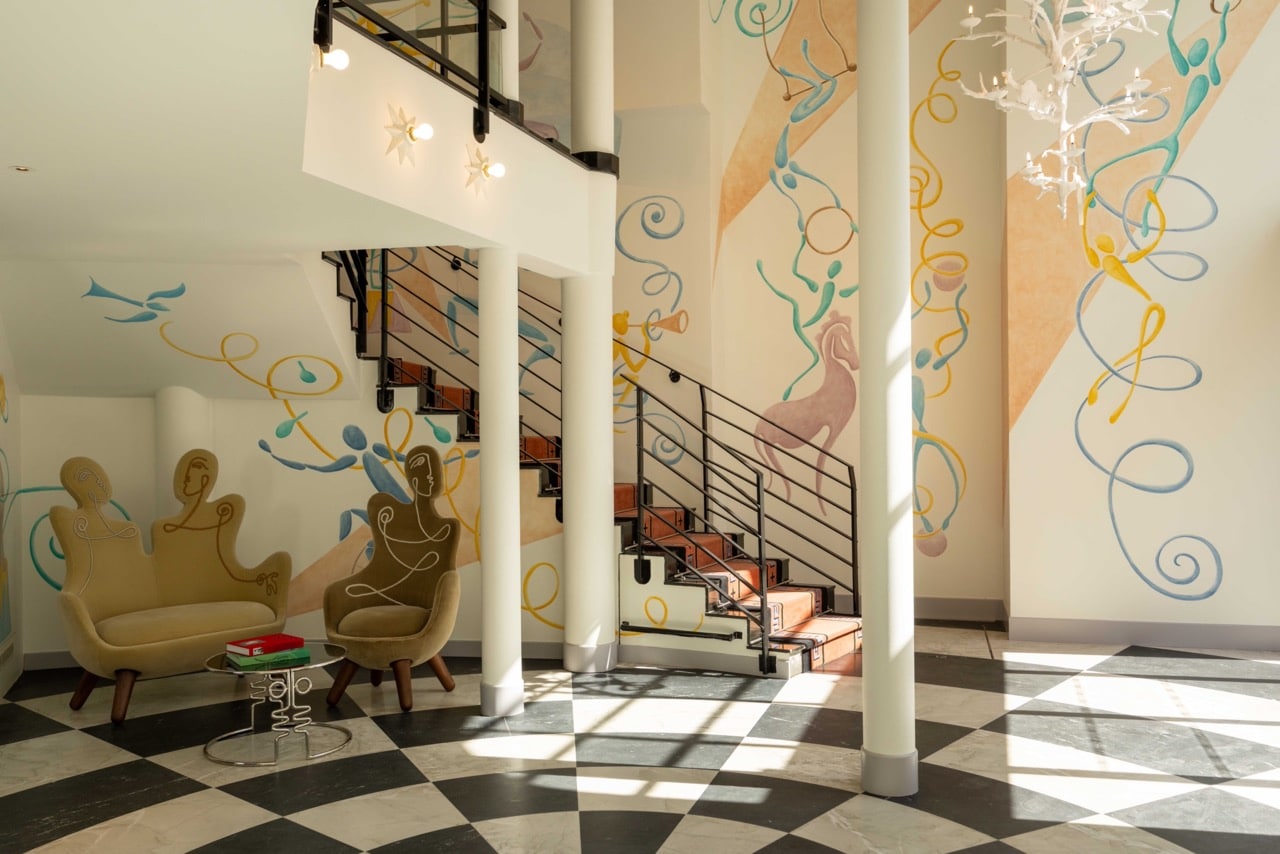
The floor arrives first. Black and white marble turns in a wide circle beneath the columns, its wedges of light and shadow shifting as the afternoon leans through the windows, so that the lobby seems to have been set gently spinning. Above it, a chandelier of white plaster branches like a winter tree, each limb holding a candle, and beyond it a fresco climbs the wall in ribbons of teal, ochre and dusty rose. A dancer bends. A horse rears in soft pink. Someone, somewhere in the paint, is blowing a trumpet.
This is the entrance to Hôtel Le Magnifique, at 20 bis rue de la Gaîté in Paris’s 14th arrondissement, and it does not behave like a lobby. It behaves like an overture.
The building was once a theater, Les Mille Colonnes, raised at the beginning of the 19th century on a street that would later fill with stages and supper crowds. Its curved façade, all tall windows and patient classical lines, still carries something of that first utopian ambition. In the 1930s, 1940s and 1950s the quarter belonged to artists, until Parisian life drifted across the river to the Right Bank and left the neighborhood half forgotten. The hotel, conceived in 2024 by the restaurateur and hotel owner Jacques Blanc, sets out to coax that spirit back. Blanc, who also owns Bellechasse, the house dressed in Christian Lacroix’s couture manner, wanted this one to run in the opposite direction from every convention of hospitality. He found the right accomplice in the designer Vincent Darré, and by Blanc’s own telling it was love at first sight. Darré’s ideas soon outran the original brief. The swimming pool, for one, appeared in that surge of enthusiasm, an idea that grew from a sketch into a Greek palace.
Darré was born in the 14th and has lived on the Left Bank all his life, and the hotel reads like a childhood remembered and then enlarged. The columns of the old theater have been painted by hand in homage to those of La Coupole, the great brasserie a few streets away. They also recall the vanished Saint-Germain-des-Prés drugstore, whose façade was once crowned with enormous, whimsical hands. Both places haunted the designer’s early years, and here they return as echoes, familiar and slightly dreamlike, as memory tends to be.
The fresco, made by artisans, celebrates art and the circus and leads the eye to reception, where white plaster birds keep watch overhead. The desk itself is hung with antique keys gathered over time, the kind that once weighed down the counters of old hotels. Darré’s idea was paradise: a guest might lift one from its hook and set off toward Saint Peter. The staircase railings, black and precise, are drawn as musical scores, so that the climb upward becomes a phrase of music, and the terracotta steps beneath them glow like a warm note held.
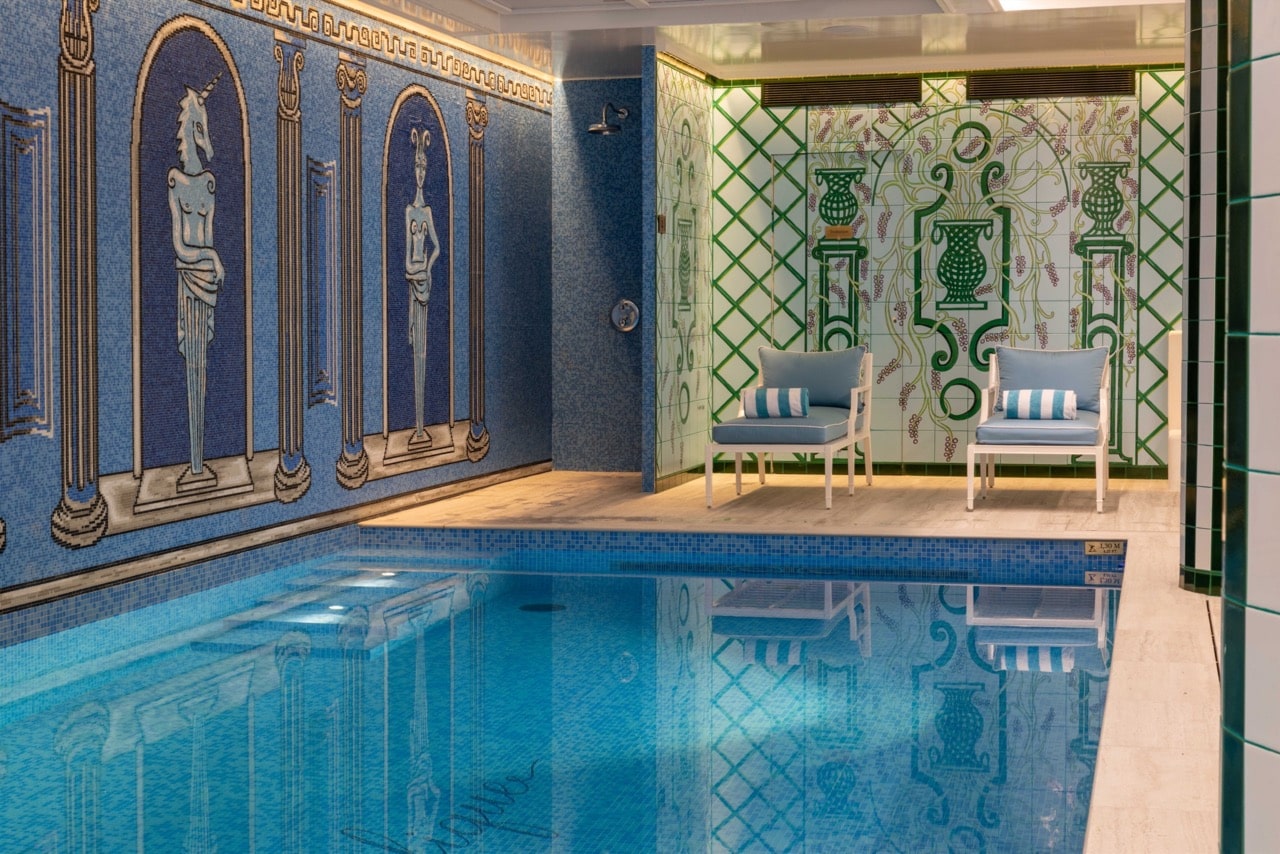
Beyond the desk, the light changes. The swimming pool appears first as a glimpse, a cool blue rectangle of water reflecting mosaics of mythical figures. They stand in arched niches between columns, their outlines picked out in fine gold, some with the heads of horses, some with horns, all serene in their small tesserae of sapphire and cobalt. Green and cream tiles wrap the columns in stripes, and trellis patterns climb the walls in the pale green of an old orangery. The pool opens onto a patio where latticework arches frame a table, two chairs and a single bright cocktail, and the whole space feels like a Greek palace suspended between sea and garden. Even the fitness room refuses to be ordinary. Along its walls, terracotta figures in the manner of Greek vase painting play pipes and chase one another, and a centaur strides above the treadmills as if the exercise were a rite.
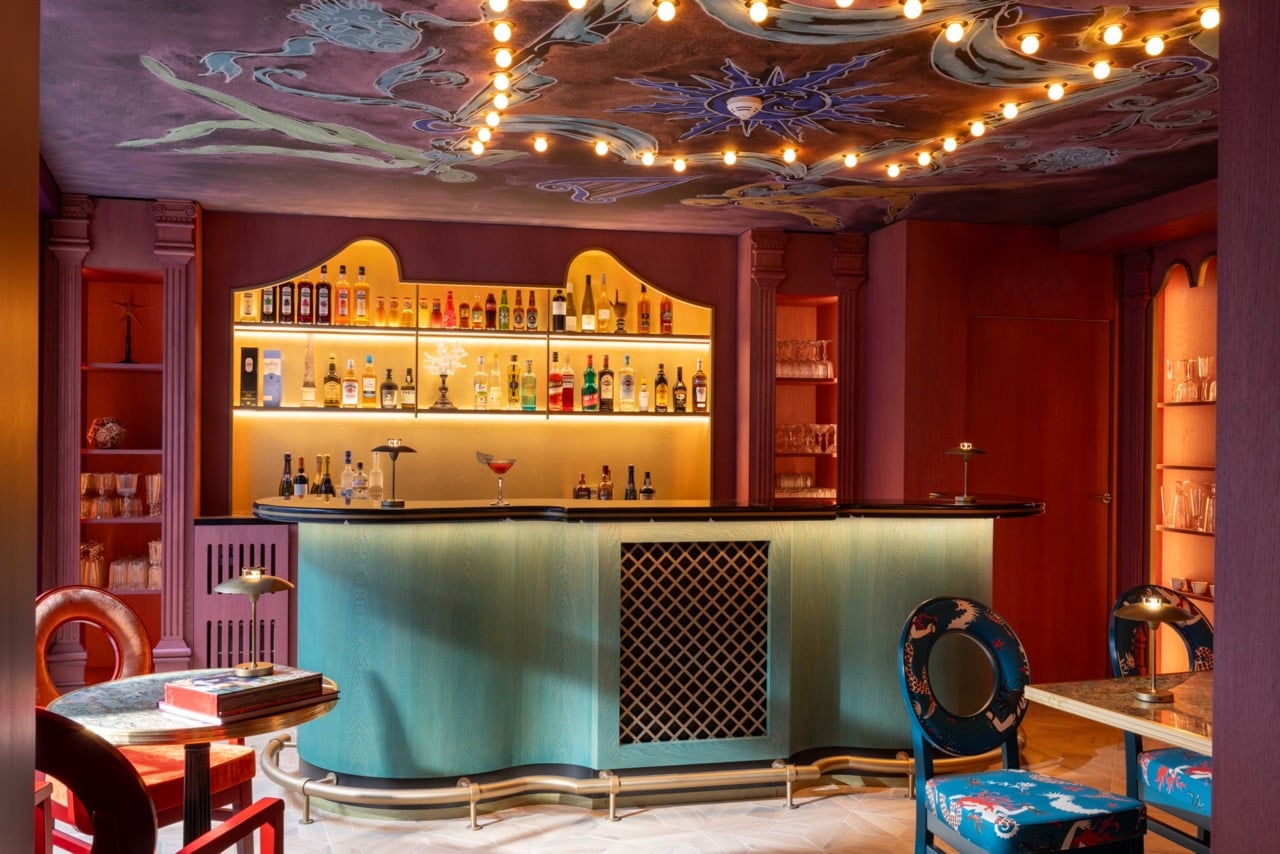
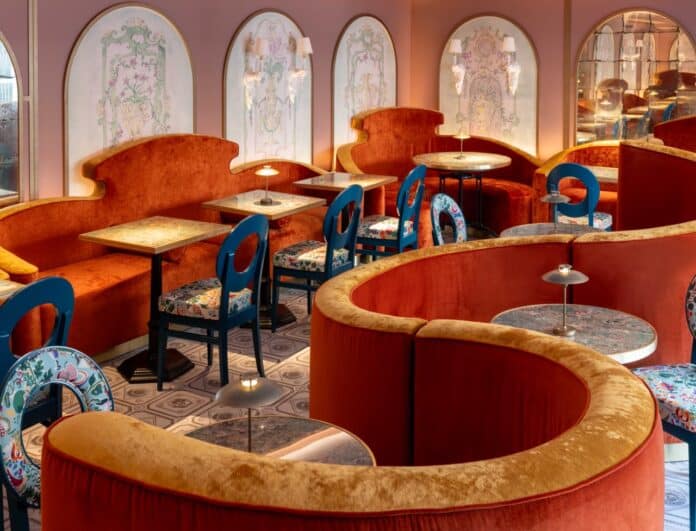
The bar, Le Picabia, named for the Parisian painter, lies at the center of the house. It is clad entirely in wood and lit by a string of glowing bulbs that circle a ceiling painted with pale, drifting figures, the way a dressing room mirror is framed for the hour before curtain. A curved counter in sea green oak, with a brass rail at its foot, catches the amber light from shelves behind it. Marble tables carry small brass lamps. Velvet banquettes in poppy and brick red curve around the edges, and a grand piano waits for whoever feels moved. The room keeps the time of the neighboring theaters. Showtimes are displayed, and a bell rings at curtain and at the close of each interval, calling spectators back to their seats with a small clear note. On the menu, everything wears a costume: the sharing plates are “Les petites scènes,” the wines “La belle distribution,” the water and soft drinks “Les Figurants,” the background actors, and coffee arrives as “L’aparté,” the aside. An Aperol Spritz costs nine euros and a Manhattan thirteen, prices that include VAT and service, though cheques are not taken. The menu cover is a wash of deep navy watercolor, with three white hands lifted in gesture and the hotel’s crest in red, a hand and laurel wreath beneath the letter M.
That letter is the hotel’s quiet signature. It stands for Montparnasse, for the painters and poets who once crowded these streets, and it lends the house its Nouvelle Vague spirit, playful and a little insolent, in love with the past without being tied to it.
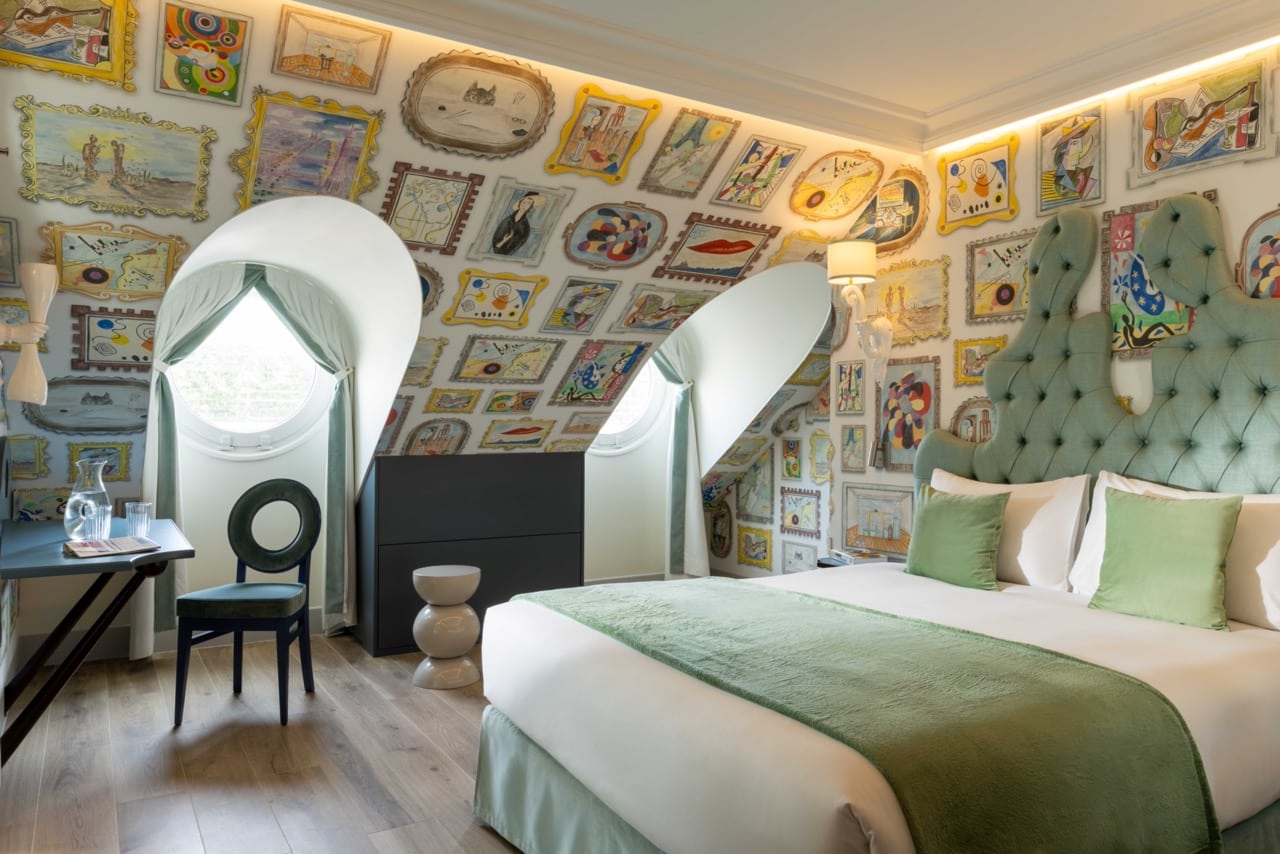
Upstairs, a glass elevator lined with mermaids, seahorses and starfish carries guests through five floors, each given its own world: the Garden of Eden, mythology, the deep sea, Art Nouveau, the Milky Way, the legendary artists of a lost Paris. The corridors keep the mood, with door surrounds cut in bold geometry, yellow curling around green like the letters of a private alphabet. No two rooms are alike. In one, a mustard velvet headboard rises in a scalloped crest against wallpaper alive with birds and a lounging leopard, and the pillows glow the same warm saffron. In another, an emerald arch opens onto a bed dressed in deep green, while painted foliage in blue and pale green climbs the walls beside it. Furniture, stretched wall textiles, lamps, ceramics, carpets: all of it was drawn by Darré himself, and none of it was chosen from a catalogue. The effect is of a single hand at work across every surface, patient and unembarrassed.
Those who wish to ask about a room can reach reception on 01.40.47.48.49, or write to [email protected].
Darré has said that travelers should leave with stars in their eyes. It is easy to see how. On the last evening, the bell at Le Picabia rings, the theatergoers rise from their velvet seats, and the marble in the lobby goes on turning quietly in the dark, waiting for the next act.
