
HomeNewsTechnologyGoogle Unveils Gemini, a Cutting-Edge AI Model Redefining Multimodal Capabilities

Google Unveils Gemini, a Cutting-Edge AI Model Redefining Multimodal Capabilities

follow us on Google News

In a groundbreaking announcement, Google has introduced Gemini, a revolutionary generation of AI models inspired by human understanding and interaction with the world. The collaborative efforts of teams across Google, including Google Research, have culminated in the development of Gemini, designed from scratch to seamlessly comprehend and integrate various types of information such as text, code, audio, image, and video.

Gemini, now revealed as Google’s largest and most versatile AI model, boasts unprecedented flexibility, capable of efficient operation across a spectrum of devices, from data centers to mobile platforms. This state-of-the-art model is poised to reshape the landscape for developers and enterprise customers, enhancing their ability to build and scale with AI.

Gemini 1.0 comes in three optimized versions to cater to diverse needs:

– Gemini Ultra: The most advanced model tailored for highly complex tasks.

Ads

– Gemini Pro: Optimal for scaling across a wide array of tasks.

– Gemini Nano: The most efficient model designed for on-device tasks.

Rigorous testing of Gemini models across various tasks showcases their prowess. Gemini Ultra, in particular, surpasses current benchmarks, achieving a remarkable 90.0% on the Massive Multitask Language Understanding (MMLU) test, outperforming human experts. Moreover, Gemini Ultra excels in the new Multimodal Multitask Understanding (MMMU) benchmark, achieving a state-of-the-art score of 59.4%.
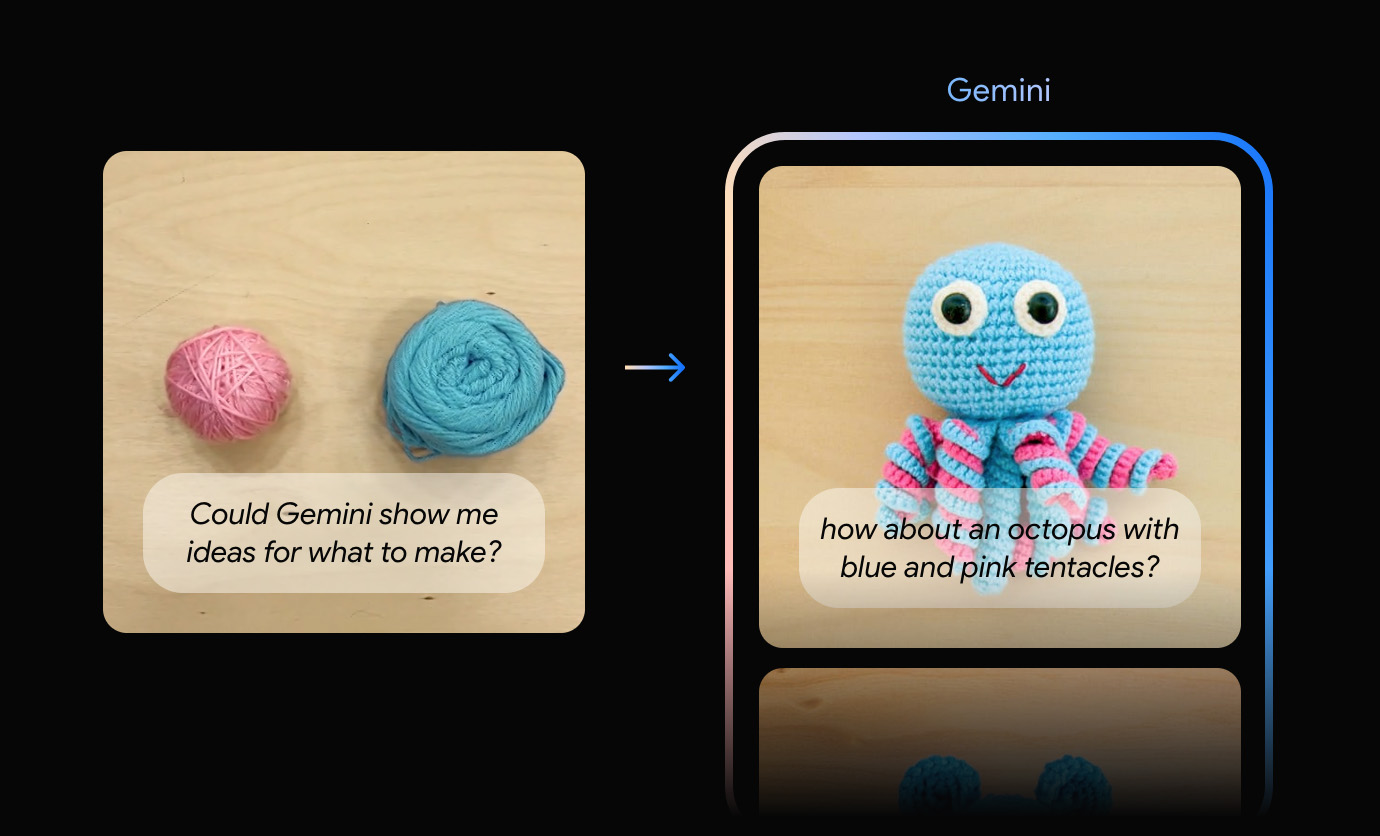
Google's Gemini
Google’s Gemini (Google)

The Gemini series exhibits remarkable capabilities in image benchmarks, outperforming previous state-of-the-art models without relying on object character recognition (OCR) systems. Gemini’s native multimodality and advanced reasoning abilities shine through, especially in complex subjects like mathematics and physics.

Gemini 1.0’s proficiency extends to understanding and generating high-quality code in popular programming languages, making it a leading foundational model for coding worldwide. Its capabilities in various coding benchmarks, including HumanEval and Natural2Code, position it as a formidable tool for developers.

Google’s AI infrastructure, powered by Tensor Processing Units (TPUs) v4 and v5e, played a pivotal role in training Gemini 1.0. The introduction of Cloud TPU v5p, the most powerful TPU system to date, is expected to accelerate Gemini’s development and facilitate faster training of large-scale generative AI models.

Gemini 1.0 is already rolling out across products and platforms. Notably, Bard, a key application, will leverage a fine-tuned version of Gemini Pro for advanced reasoning and understanding. Additionally, Pixel 8 Pro becomes the first smartphone engineered to run Gemini Nano, introducing new features like Summarize and Smart Reply.

Ads

In the coming months, Gemini will be integrated into more Google products and services, including Search, Ads, Chrome, and Duet AI. Early experiments with Gemini in Search have already yielded a 40% reduction in latency in the United States, coupled with improvements in quality.

Developers and enterprise customers can access Gemini Pro via the Gemini API in Google AI Studio or Google Cloud Vertex AI starting December 13. Android developers will also harness the power of Gemini Nano via AICore in Android 14, available on Pixel 8 Pro devices. Moreover, Google plans to launch Bard Advanced, offering cutting-edge AI experiences with access to Gemini Ultra, early next year.

Want Instant Updates?

Subscribe to receive instant email whenever a new article is available!

Julie Nguyen
Julie Nguyen

Julie is the founder of SNAP TASTE and a driving force in global storytelling, innovation, and creative leadership. A respected member of the Harvard Business Review Advisory Council, she also serves as a judge for the CES Innovation Awards (2024, 2025, and 2026), bringing her perspective to the intersections of business, culture, and breakthrough technologies.

Her immersive reporting has taken audiences behind the scenes of defining world moments, from the FIFA World Cup Qatar 2022 and Expo 2020 Dubai to CES, D23 Expo, and the Milano Monza Motor Show. Through her lens, global events become intimate, human stories.

An accomplished film critic and editorial voice, Julie has built a reputation for reviews that go beyond analysis, finding the heartbeat within the frame. Her work on National Geographic documentaries and other cinematic works speaks to audiences who believe that great storytelling has the power to shift perspectives and expand the world.

Beyond her media brand, Julie serves as Group Executive Director and Strategic Architect, and is the custodian of a growing global group that spans flagship art studios and international offices across Asia. She is the connective tissue between vision and execution, setting the standard for brand integrity, shaping the visual identity of every corporate entity under her stewardship, and guiding the curriculum of flagship art departments. She builds the kinds of teams and systems that turn ambitious ideas into something the world can actually see and feel.

At the heart of everything Julie does is a belief that art, technology, and culture are not separate conversations. She has spent her career proving they never were.

Ad

Leave a Reply

More to Explore

Blender 5.1: The Precision Refinement Every Designer Needs

Released on March 17, 2026, Blender 5.1 arrives not as a radical departure, but as a masterclass in refinement. While version 5.0 was the...

How to Set Up Firefox’s New Free Built-in VPN and Use Native Split View

Digital privacy often feels like a full-time job, requiring users to juggle various extensions and subscriptions just to keep their personal data from leaking...

OpenAI Shuts Down Sora as Disney’s $1 Billion Deal Collapses

The sudden closure of OpenAI's AI video platform marks one of the most dramatic reversals in the brief history of generative AI, and leaves...

Sony’s Tokyo Studio Is Where the Future of Filmmaking Gets Made

Sony is bringing its global media production hub network to Japan, opening the Digital Media Production Center Japan (DMPC Japan) inside the company's Group...

Anthropic’s Claude Cowork Lets You Assign AI Tasks From Your Phone and Walk Away

Artificial intelligence is getting better at doing things. The harder challenge has always been getting it to do things without you watching. Anthropic's Claude...

NVIDIA’s Dynamo 1.0 Is Free, Open Source Software That Makes AI Inference Up to 7x Faster

Running AI models at scale is harder than it looks. Training a model is a one-time investment. Inference, the process of actually using that...

Adobe and NVIDIA Are Teaming Up to Reinvent Creative and Marketing Workflows With AI

Two of the most influential companies in creative technology are deepening a partnership that goes back more than two decades. Adobe and NVIDIA have...

NVIDIA Is Trying to Become the Default Platform for Every Kind of Robot

Jensen Huang has a bold prediction: every industrial company will become a robotics company. Whether or not that timeline plays out exactly as he...

NVIDIA and T-Mobile Want to Turn the 5G Network Into a Distributed AI Computer

Most conversations about AI infrastructure focus on data centers, the massive facilities packed with GPU racks that train and run the world's most powerful...

BYD, Nissan, Geely and More Are Building Self-Driving Cars on NVIDIA’s Platform — and Robotaxis Are Coming to Uber by 2027

Self-driving vehicles have been a promise for a long time. The technology has advanced significantly, but wide-scale deployment has remained perpetually just around the...

NVIDIA Wants to Be the Platform That Powers Every Enterprise AI Agent

Autonomous AI agents are moving from experiment to enterprise infrastructure faster than most organizations anticipated. The question is no longer whether companies will deploy...

NVIDIA Is Building a Coalition of AI Labs to Develop Open Frontier Models Together

The race to build the most powerful AI models has largely been a competition, with labs guarding their research, their data, and their techniques...

Handpicked for You

You Might Also Like