



Google is not slowing down. On September 2, 2026, the company rolled out Gemini 3.8 Flash, a new entry in its Flash lineup that it’s calling its most capable reasoning and coding model to date, alongside a companion model, Gemini 3.8 Flash Cyber, built specifically for finding and fixing software vulnerabilities. The move came just as Google’s commitment to the frontier model race had been drawing scrutiny since Google DeepMind CEO Demis Hassabis stepped aside in early August to become chairman, with Koray Kavukcuoglu stepping into the leadership role under the title of SVP.
The timing is notable for another reason too. Google described the launch as its third Flash generation release in six weeks, following Gemini 3.7 Flash by only three weeks. That’s an unusually rapid cadence even by the standards of an industry that has grown used to near monthly model refreshes.
What’s actually new in Gemini 3.8 Flash
Google is positioning Gemini 3.8 Flash as a workhorse model rather than a headline grabbing frontier release, but the improvements it’s touting are substantial. The company says the model brings real gains in software engineering, agentic task execution, and multi step reasoning in specialized domains, all while holding onto the low cost profile that made 3.7 Flash popular with developers.
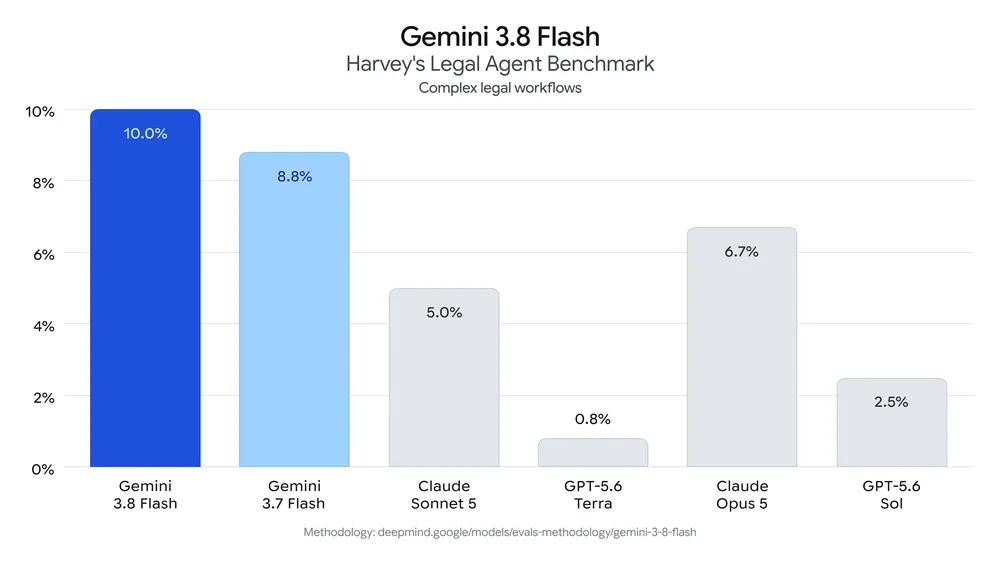
The headline benchmark result involves long horizon coding. On DeepSWE v1.1, a benchmark focused on long horizon software engineering, Google says 3.8 Flash outperforms most larger, more expensive frontier models when it comes to autonomously solving complex engineering problems end to end. The company also points to strong showings in domains that matter to enterprise customers, including Vals Finance Agent V2 and Harvey’s Legal Agent Benchmark, plus a score of 54.9% on HLE Verified, a measure of multi step reasoning across STEM, humanities, and professional fields.
Independent benchmarking backs up at least some of that positioning. With reasoning set to high, Gemini 3.8 Flash scores 59 on the Artificial Analysis Intelligence Index, three points above its predecessor, putting it roughly level with GPT 5.6 Sol running at extra high effort and Grok 4.6 at medium effort. That’s a meaningful jump for a model that’s still priced like a budget option.
Google credits the gains to what it describes as a simple design philosophy: the model works harder. Rather than answering instantly, 3.8 Flash is built to take extra reasoning steps, call tools iteratively, and verify its own work when a task gets complicated. That diligence comes at a cost, though. The model can burn through more tokens than its predecessor on hard problems, especially when developers dial up the effort setting. For teams that care more about speed and token efficiency than maximum accuracy, Google says 3.7 Flash remains fully supported and isn’t going anywhere.
Pricing and where you can actually use it
For developers, the pitch is straightforward: more capability at the same price. Gemini 3.8 Flash launched with an introductory rate of $0.75 per million input tokens and $3.75 per million output tokens, good through the end of 2026, available across Google AI Studio and the Gemini Enterprise Agent Platform. That promotional pricing rolls off on January 1, 2027, when standard rates of $1.50 per million input tokens and $7.50 per million output tokens kick in, according to Google’s developer documentation. Google is also rolling out pay as you go options alongside token discounts of up to 20% for subscribers on the Gemini Enterprise tier.
On the technical side, the model ships with a one million token context window, a maximum output of 64,000 tokens, and tunable thinking levels of low, medium, and high, with medium set as the default. It’s a genuinely multimodal model too, accepting text, images, video, audio, and PDF files as input, and it’s live under the stable API model ID gemini-3.8-flash.
Consumers get access as well, and fairly quickly. Gemini 3.8 Flash showed up the same day in the Gemini app, in AI Mode inside Google Search, and in Gemini for Google Sheets, available to Google AI Pro and AI Ultra subscribers. Robby Stein, Google’s VP of Product for Search, confirmed on social media that the model was live in AI Mode for Pro and Ultra subscribers globally on release day, selectable from the model menu’s plus icon. Google also used the launch to show off a flashier demo: using the model inside its Antigravity agentic coding environment, pairing native video understanding with coding ability to autonomously build a 3D game, play it to hunt for bugs, and push code fixes in a continuous loop.
Meet Gemini 3.8 Flash Cyber, and the Fairwind Program gatekeeping it
The more unusual half of this launch is Gemini 3.8 Flash Cyber, a variant trained specifically for cybersecurity work. Unlike the general purpose Flash model, this one isn’t showing up in your Gemini app anytime soon. Access is restricted to participants in a new initiative called the Fairwind Program, which Google says will extend access to government authorities, critical infrastructure operators, and software maintainers. The Cyber model effectively replaces Google’s earlier 3.5 Cyber model, and is being made available exclusively to vetted security researchers, government agencies, and critical infrastructure operators.
Google is framing the gatekeeping as a deliberate tradeoff. The company says it prioritized defensive capability over offensive capability from the start, investing heavily in automated vulnerability patching rather than exploitation tooling, precisely because a model this good at finding software flaws could just as easily be turned into an attacker’s tool if it landed in the wrong hands.
On the benchmarking side, the results are eye catching. On CyberGym, an industry standard benchmark for autonomous vulnerability discovery, the Cyber model surpasses both its own predecessor and larger frontier competitors. Google also ran the model against an internal benchmark spanning 20 programming languages to better simulate real world defensive work, well beyond the C and C++ focus of CyberGym, and reported a success rate above 70%, a sizable jump from prior generations. On patching specifically, an external benchmark called CWE Bench, run by Collinear, put the model’s pass at one rate at 47.2%, just behind a leading frontier model’s 47.8%, but at a fraction of the cost.
Google says the model is already proving itself internally. The Chrome Security team reportedly generated correct vulnerability patches at 2.6 times the rate of larger commercial models. Security firm Wiz found the model delivering meaningfully higher recall on its internal penetration testing benchmark while costing several times less than competing frontier options. And Google’s own Cloud Vulnerability Research team used the model to uncover a critical foundational vulnerability in under two hours, a process the company says would typically take months.
Why Google is moving this fast
The rapid succession of Flash releases, three in six weeks by Google’s own count, reads as a deliberate signal to the market. Coming on the heels of leadership uncertainty at Google DeepMind following Hassabis’s move to chairman, the release looks like an attempt to reassert Google’s standing as a top tier model maker. Speaking about the release, Tulsee Doshi, Google’s senior director of product management, and Raluca Ada Popa, Gemini Security Lead at Google DeepMind, said in a blog post that the model delivers substantial gains and often approaches the performance of pricier frontier competitors.
The launch also landed on an eventful news day for Google more broadly. A federal judge separately rejected the Department of Justice’s push to force Alphabet to sell its AdX ad exchange, a ruling that arrived the same day as the Gemini 3.8 Flash unveiling. Discussing the defender focused model with CNBC, Doshi described the goal as giving security teams a frontier level option at a fraction of the usual cost and speed.
Safety guardrails
Google says both models were built with its Frontier Safety Framework in mind. Gemini 3.8 Flash ships with safeguards intended to prevent misuse in chemical, biological, radiological, and nuclear domains, as well as cyber offense, while still enabling legitimate defensive use cases. Because 3.8 Flash Cyber carries a more permissive set of cybersecurity capabilities, it’s locked behind the vetted Fairwind Program rather than shipped broadly. Google also says the 3.8 generation made a significant leap in resisting prompt injection attacks, as measured by third party evaluator Gray Swan, aimed at protecting users from malicious prompt injection attempts embedded in content the models process.
Taken together, the release underscores a broader shift happening across the industry: frontier labs are no longer just racing to build the single smartest model, they’re racing to ship specialized, cheaper variants fast enough to keep developers, enterprises, and now cybersecurity defenders locked into their ecosystems.