


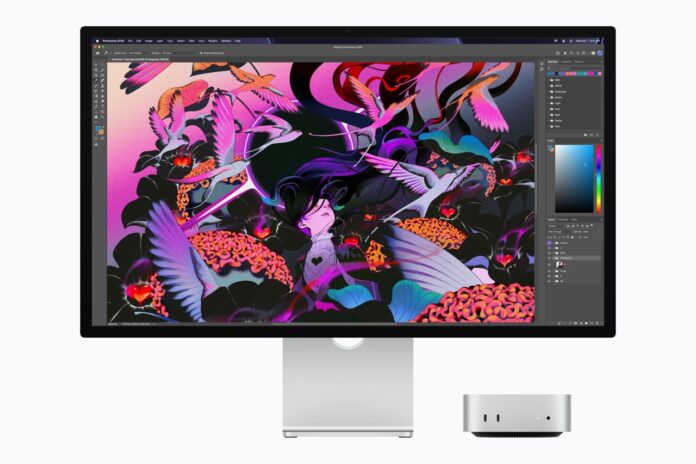

Apple has unveiled a refreshed Mac mini, and the headline story is a big one for anyone who cares about on device AI performance. The new lineup is built around two chips, the all new M6 and the more powerful M5 Pro, and Apple says the update brings the biggest jump in AI capability the tiny desktop has ever seen. For a computer that has long been Apple’s most flexible machine, this update pushes it further into the world of agentic computing, where the Mac is expected to run AI tools and automated workflows continuously in the background.
According to Apple, the new Mac mini delivers up to four times faster AI performance, twice the graphics and storage speed, and a 40 percent boost in CPU performance compared to the outgoing M4 model. Just as important, both new configurations gain modern wireless standards and expanded ports, making the mini easier to slot into a home office, a creative studio, or a server closet running AI agents around the clock.
Apple’s hardware chief, Johny Srouji, framed the mini as the company’s most versatile Mac yet, capable of serving as a everyday home computer, a professional workstation, or an always on machine dedicated to AI tasks. With Neural Accelerators now built into the GPU and higher memory bandwidth across the board, Apple is positioning this generation of Mac mini less as a budget desktop and more as a compact AI workhorse.
What’s New in the Standard Mac Mini With M6
The base Mac mini now ships with Apple’s new M6 chip, and the changes go well beyond a simple speed bump. The chip includes a 12 core CPU, two more cores than the previous generation, which Apple claims offers the fastest single threaded performance of any chip it has built. That translates to snappier everyday tasks, from opening apps to switching between windows.
On the graphics side, the M6 also grows to a 12 core GPU, and for the first time on a standard Mac mini, every one of those cores includes a Neural Accelerator dedicated to AI workloads. The result is graphics performance twice as fast as the M4 mini, paired with up to four times the AI throughput. Apple also redesigned the Neural Engine, now a dual 16 core unit that the company says runs twice as fast as before.
Memory gets a boost too. The M6 Mac mini starts with 16GB of unified memory, configurable up to 32GB, and memory bandwidth climbs to 170GB per second. For users who multitask heavily or run AI models locally, that bandwidth increase should translate into noticeably smoother performance under load.
Apple backed up these claims with some specific benchmarks. In LM Studio, a popular app for running large language models locally, the M6 mini is up to 13.5 times faster at prompt processing than the original M1 mini, and 4.8 times faster than the M4. Spreadsheet heavy users get a win too, with Excel calculations running up to 2.3 times faster than on the M1 and 1.5 times faster than the M4. Even gamers benefit, with ray traced titles like Cyberpunk 2077: Ultimate Edition running up to twice as fast as they did on the M4 mini.
Mac Mini With M5 Pro Targets Serious Creative and AI Workflows
For users who need more headroom, Apple is also offering the Mac mini with its new M5 Pro chip, aimed squarely at professionals doing app development, video editing, 3D rendering, and scientific computing on a desktop small enough to tuck behind a monitor.
The M5 Pro scales up to an 18 core CPU and a 20 core GPU, with an upgraded shader core and third generation ray tracing support built in. Like the M6, every GPU core includes a Neural Accelerator, which Apple says meaningfully improves performance in AI heavy tasks like photo and video upscaling, as well as running larger diffusion models directly on the machine rather than relying on the cloud.
This configuration also supports significantly more memory, up to 64GB of unified memory with 307GB per second of bandwidth. That opens the door to running larger local AI models, editing ProRes RAW footage without slowdown, working with complex 3D scenes, and loading large research datasets, all without needing a bulkier desktop tower.
Apple’s own benchmarks show the M5 Pro mini processing LLM prompts in LM Studio up to 8.5 times faster than the M2 Pro version and 4 times faster than the M4 Pro. Rendering in Blender with ray tracing enabled is up to 4.5 times faster than the M2 Pro and 1.4 times faster than the M4 Pro, while image processing in Affinity is up to 2.1 times faster than the M2 Pro and 1.5 times faster than the M4 Pro. Apple also emphasizes that the chip’s efficiency makes it well suited to running quietly as an always on machine, whether that means hosting AI agents or handling background creative rendering jobs overnight.
Faster Connections, Inside and Out
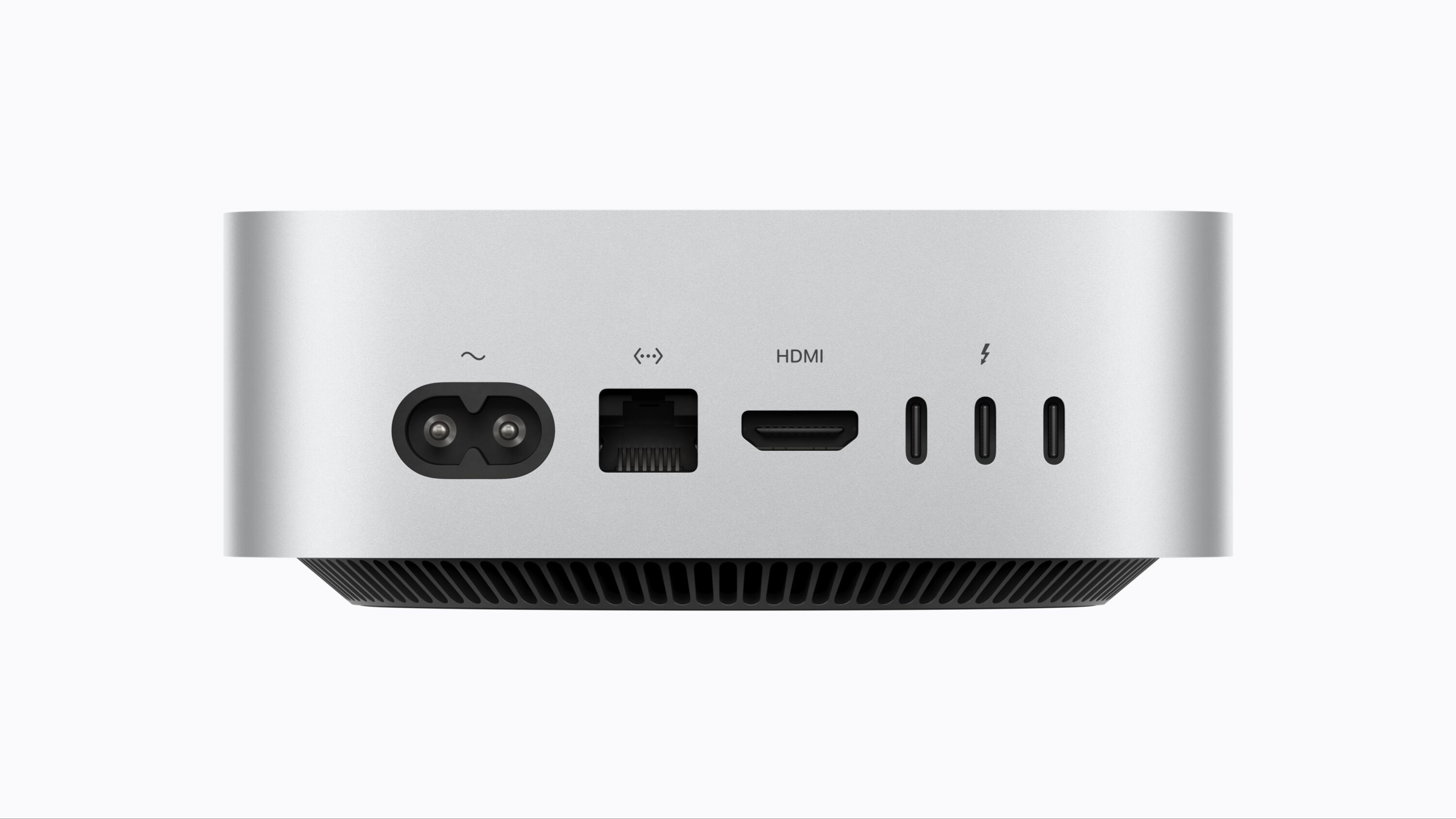
Connectivity sees a meaningful upgrade across both models. The new Mac mini supports Wi-Fi 7 and Bluetooth 6, along with 2.5Gb Ethernet as standard and an optional 10Gb Ethernet upgrade for users who need faster wired networking.
Port selection has been thoughtfully split between the front and back of the machine. Two front facing USB-C ports support USB 3 speeds, making it easy to plug in accessories without reaching around the back, and there is a headphone jack that supports high impedance headphones. Around back, the M6 model includes three Thunderbolt 4 ports, while the M5 Pro model steps up to three Thunderbolt 5 ports, plus HDMI and Ethernet.
Thunderbolt 5 brings an interesting capability for power users, allowing multiple Mac mini units to be clustered together to run large AI models entirely on device, without needing a cloud connection. Apple has also added genlock support over USB-C, which allows precise synchronization between a display and a camera, including the iPhone 17 Pro, a detail that will matter most to video professionals working with multi camera setups.
Built for macOS 27 and Siri AI
The new Mac mini is designed to run alongside macOS 27, codenamed Golden Gate, which brings a significantly upgraded Siri to the platform. Apple describes the new assistant, referred to as Siri AI, as far more capable and personal, able to draw on context from a user’s messages, emails, and photos to help find information and complete tasks across apps.
Siri AI is woven into Spotlight search and system wide context menus, and users can invoke Visual Intelligence with a keyboard shortcut to ask questions about whatever is currently on their screen. The assistant can also help with writing and editing text in almost any app.
Beyond Siri, macOS 27 brings broader Apple Intelligence features, including smarter browsing tools in Safari, the ability to build Shortcuts automations just by describing what they should do, and more advanced editing tools inside the Photos app. Apple also says it has refined the Liquid Glass visual design introduced in earlier updates, improving readability and adding more uniform toolbars, edge to edge sidebars, and updated window shapes, giving users more ways to personalize how macOS looks and feels.
Environmental Details
Apple continues to highlight sustainability as part of its product story. The new Mac mini is made with 50 percent recycled material overall, including a fully recycled aluminum enclosure and completely recycled rare earth elements in its magnets. Apple says all of the electricity used to manufacture the Mac mini comes from renewable sources such as wind and solar, and the company has invested in enough renewable energy globally to offset the electricity customers use while running the device. As with other recent Apple products, the packaging is entirely fiber based and can be recycled through normal household recycling.
Pricing and Availability
The new Mac mini is available to pre-order starting today, August 25, through Apple’s online store, the Apple Store app, and in 30 countries and regions, including the United States. Apple says units will begin arriving to customers, along with availability in physical Apple Store locations and Apple Authorized Resellers, on September 22.
For anyone weighing whether to upgrade, the pitch is straightforward. If AI performance, faster storage, and better connectivity matter to your workflow, this generation of Mac mini represents one of the more substantial upgrades Apple has made to the product in years, all while keeping its signature compact footprint intact.