




Apple has introduced a new generation of MacBook Pro powered by its latest M5 Pro and M5 Max chips, bringing significant gains in performance, AI processing, and storage speeds to its flagship professional laptop. The updated 14 inch and 16 inch models are designed for developers, creators, researchers, and power users who increasingly rely on local computing power for complex workflows, especially as AI tools become part of everyday work.
The new MacBook Pro builds on Apple silicon’s momentum by focusing heavily on on device intelligence. The M5 Pro and M5 Max chips combine faster CPU and GPU performance with a redesigned architecture that integrates AI acceleration directly into the graphics cores. Apple says the result is up to four times the AI performance of the previous generation and up to eight times the performance of MacBook Pro models powered by M1 chips.
For professionals experimenting with AI models, editing large media projects, or running data intensive workloads, that increase in local processing power can make a meaningful difference. Tasks that once relied on cloud computing, such as generating images or processing large language model prompts, can now run much faster directly on the laptop.
At the center of the update are the M5 Pro and M5 Max chips themselves. Both are built on Apple’s new Fusion Architecture, which combines two dies into a single system on a chip. The design is aimed at boosting performance while maintaining the power efficiency Apple silicon is known for.
The chips feature a CPU with up to 18 cores, including six super cores designed for peak performance and 12 additional performance cores optimized for multithreaded workloads. Apple says this configuration can deliver up to 30 percent faster CPU performance compared with the previous generation.
The GPU architecture is also new. Each GPU core now includes a Neural Accelerator designed specifically to speed up AI related workloads. That means faster image generation, quicker prompt processing for large language models, and smoother performance when creative software uses AI powered tools.
According to Apple, systems powered by M5 Pro or M5 Max can process LLM prompts up to four times faster than systems powered by M4 Pro and M4 Max. AI image generation can be up to eight times faster compared with MacBook Pro models running M1 Pro or M1 Max.
Graphics performance sees a notable jump as well. Apple says the GPU can deliver up to 50 percent more graphics performance compared with the previous generation. In practical terms, that allows motion designers to work with complex 3D scenes in real time and visual effects artists to preview edits immediately instead of waiting for renders.
Memory capacity and bandwidth have also increased to support these workloads. MacBook Pro with M5 Pro supports up to 64GB of unified memory with bandwidth up to 307GB per second. MacBook Pro with M5 Max expands that to up to 128GB of unified memory and bandwidth up to 614GB per second. That additional bandwidth is particularly useful for demanding tasks such as AI model training, large scale video editing, and data heavy simulations.
Performance improvements extend into specific creative and professional workflows. Apple says MacBook Pro models powered by M5 Pro can generate AI images up to 7.8 times faster than MacBook Pro with M1 Pro and up to 3.7 times faster than MacBook Pro with M4 Pro. LLM prompt processing can be up to 6.9 times faster than M1 Pro systems and up to 3.9 times faster than M4 Pro models.
For graphics workloads, 3D rendering in Maxon Redshift can be up to 5.2 times faster compared with M1 Pro systems and up to 1.4 times faster compared with M4 Pro. Gaming performance with ray tracing in titles like Cyberpunk 2077 Ultimate Edition can reach up to 1.6 times faster than systems powered by M4 Pro.
MacBook Pro models with M5 Max push those numbers further. AI image generation can be up to eight times faster than M1 Max systems and up to 3.8 times faster than M4 Max. LLM prompt processing can be up to 6.7 times faster than M1 Max systems and up to four times faster than M4 Max.
Video effects rendering in Blackmagic DaVinci Resolve Studio can be up to 5.4 times faster than M1 Max systems and up to three times faster than M4 Max models. AI powered video enhancement in Topaz Video can run up to 3.5 times faster compared with M4 Max systems.
Beyond the processor upgrades, Apple is also speeding up storage. The new MacBook Pro can reach read and write speeds up to 14.5GB per second, roughly twice as fast as the previous generation. Faster storage can significantly reduce wait times when working with large 4K or 8K video files, machine learning datasets, or complex project files.
Apple is also increasing base storage across the lineup. MacBook Pro models with M5 Pro now start with 1TB of storage, while models powered by M5 Max start with 2TB.
Connectivity and wireless performance also get an upgrade. The new MacBook Pro introduces N1, an Apple designed networking chip that enables Wi Fi 7 and Bluetooth 6. These standards bring faster wireless speeds and improved reliability, particularly in environments with many connected devices.
Battery life remains one of MacBook Pro’s standout features. Apple says the new models can deliver up to 24 hours of battery life depending on workload. For users upgrading from Intel based MacBook Pro systems, that could translate to up to 13 additional hours of use on a single charge. The laptop can also fast charge up to 50 percent in about 30 minutes using a 96W or higher USB C power adapter.
The display continues to be one of the defining features of the MacBook Pro. The Liquid Retina XDR display supports up to 1600 nits of peak brightness for HDR content and up to 1000 nits for standard content. For users working in bright environments, Apple also offers an optional nano texture finish designed to reduce glare and reflections.
Connectivity remains geared toward professional workflows. The laptop includes three Thunderbolt 5 ports for high speed data transfer, an HDMI port capable of driving displays up to 8K resolution, an SDXC card slot for quickly importing media, and MagSafe 3 for charging.
External display support is also expanded. MacBook Pro with M5 Pro can drive up to two high resolution external displays, while models powered by M5 Max can support up to four.
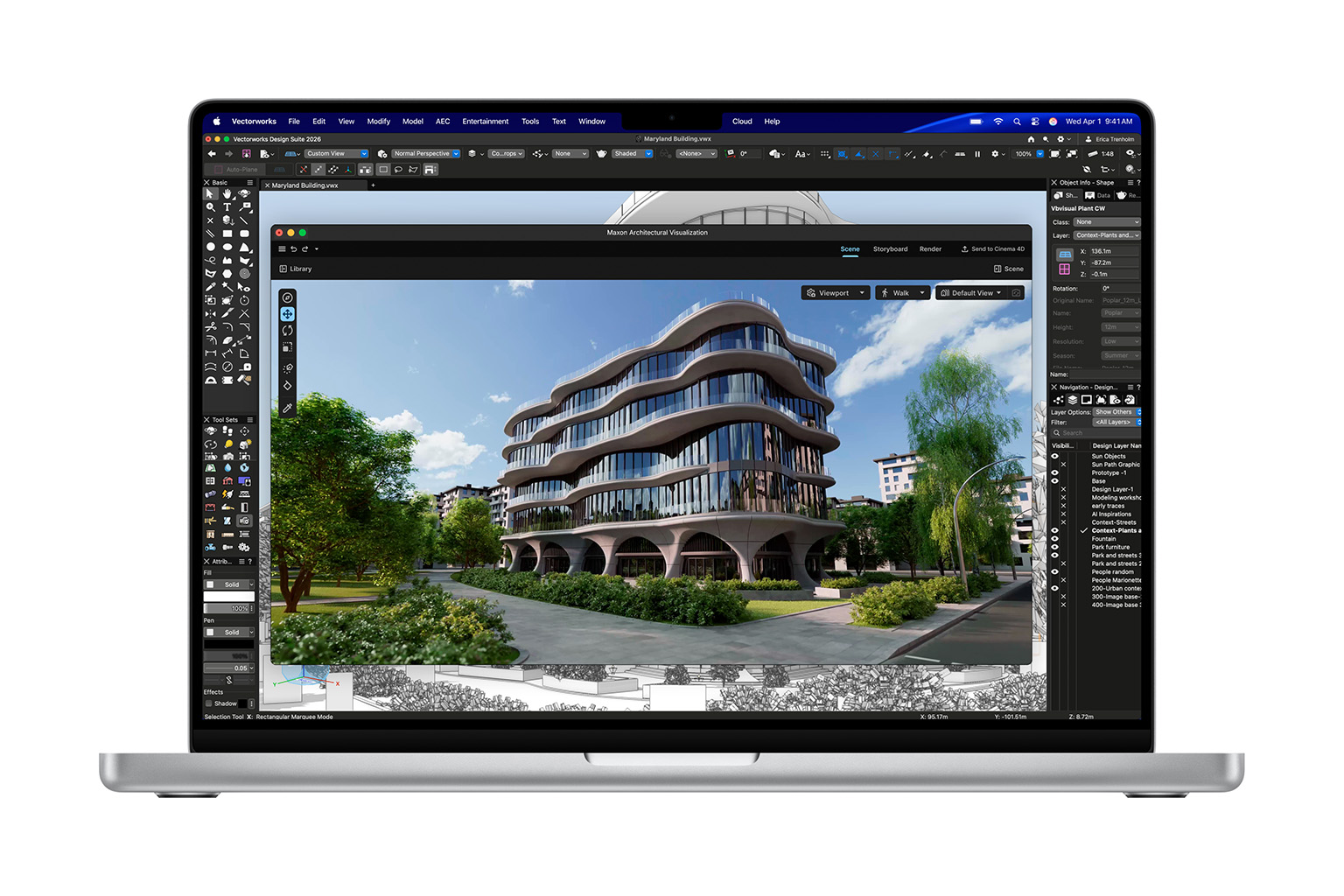
Apple also improved the system’s camera and audio setup. The new MacBook Pro includes a 12MP Center Stage camera with Desk View support, which automatically keeps users centered during video calls while also allowing a view of their desk. Studio quality microphones capture clearer voice audio, and a six speaker sound system with support for Spatial Audio provides immersive sound for media and creative work.
The laptop runs macOS Tahoe, which brings updates focused on productivity and AI powered features. Spotlight search has been redesigned to make it easier to find files and launch actions directly from the search bar. Apple Intelligence features are integrated across the operating system, enabling tools such as writing assistance, automation, and real time translation while keeping user data private.
Shortcuts also becomes more capable, with intelligent actions that can interact with Apple Intelligence models. Live Translation is built into Messages, FaceTime, and the Phone app, allowing users to translate text and spoken conversations across languages.
Continuity features continue to connect the Mac and iPhone experience. The Phone app can now relay cellular calls from a nearby iPhone directly to the Mac, and Live Activities from iPhone can appear on the Mac in real time.
Apple also emphasized environmental improvements in the new MacBook Pro. The laptop is built with 45 percent recycled materials, including 100 percent recycled aluminum in the enclosure and 100 percent recycled cobalt in the battery. Manufacturing across the supply chain uses about 50 percent renewable electricity, including wind and solar energy.
The new MacBook Pro will be available in space black and silver. Preorders begin March 4, with availability starting March 11.