


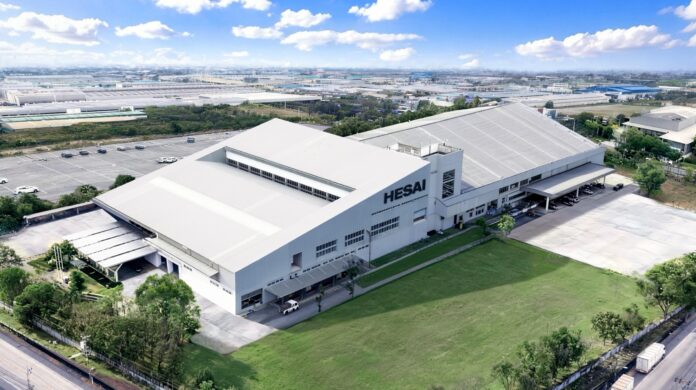

Hesai Technology is positioning itself for the next phase of large-scale adoption in autonomous driving and robotics by significantly expanding its manufacturing capacity and deepening its role in safety-critical sensing.
The company announced plans to more than double its annual lidar production capacity in 2026, increasing output from 2 million units to over 4 million units. The expansion reflects accelerating global demand for lidar across advanced driver assistance systems and robotics, and marks a new scale milestone for the industry.
Scaling manufacturing to meet structural demand
In 2025, Hesai became the first automotive lidar supplier to surpass 2 million cumulative deliveries worldwide. Building on that momentum, the company is investing in capacity expansion to support customers that are moving rapidly from pilot programs to mass deployment.
The scale up is underpinned by Hesai’s vertically integrated manufacturing strategy. The company has built its own research and production infrastructure, allowing tight coordination between design, testing, and manufacturing. Over four generations, Hesai has developed proprietary application-specific integrated circuits, enabling faster iteration cycles, higher reliability, and production processes that can be replicated globally.
Hesai’s automated production lines currently operate with a cycle time of roughly 10 seconds per unit, a level of throughput that supports high volume output while maintaining consistency. To further support global demand, the company is also developing a new manufacturing facility in Bangkok, Thailand. The site is expected to begin operations in early 2027 and will expand Hesai’s global production footprint.
Chief executive officer and co founder David Li said the expansion reflects the pace at which Hesai’s customers are scaling. As automakers and robotics companies move toward mass production, the company aims to provide dependable supply at automotive grade quality and volume.
Lidar becomes core safety infrastructure for ADAS
Growth in production is closely tied to changes in vehicle safety architecture. As advanced driver assistance systems evolve toward higher levels of automation, lidar is increasingly treated as a foundational safety component rather than an optional enhancement. Often described as an invisible seatbelt, lidar enables vehicles to detect and respond to hazards beyond the capabilities of camera-only systems.
Industry data shows that lidar equipped vehicles reduce fatal highway accidents by approximately 90 percent and lower overall traffic accidents by around 30 percent compared with camera-only approaches. Adoption is now reaching scale. In China’s electric vehicle market, lidar penetration has reached 28 percent, meaning roughly one in four EVs on the road includes lidar hardware.
Hesai has secured mass production design wins with 24 automotive original equipment manufacturers. Its customer base includes leading European automakers, top global new energy vehicle producers, and companies such as Li Auto, Xiaomi, Changan, Geely, Great Wall Motor, Chery, Zeekr, Leapmotor, SAIC Audi, SAIC GM, and a Toyota joint venture.
The company’s latest ATX lidar platform has already secured orders exceeding 4 million units from multiple OEMs, with mass production scheduled to begin in April 2026. Regulatory changes and redundancy requirements are further expanding the market. Vehicles designed for Level 3 autonomy are now expected to integrate between three and six lidar units each, materially increasing demand per vehicle.
At CES, Hesai is presenting its next generation Level 3 automotive lidar suite, which includes the long range ETX and short range FTX sensors. The ETX is designed for behind the windshield installation inside the cabin, simplifying vehicle integration, while the FTX focuses on short range perception for blind spot and near field detection. Both emphasize compact form factors and system level efficiency.
Lidar as the sensory layer for physical AI
Beyond passenger vehicles, Hesai is increasingly positioned as a core enabler of what many in the industry describe as physical AI. As robots move out of structured environments and into open, unpredictable settings, reliable three dimensional perception becomes a prerequisite for safe operation.
In the robotaxi and autonomous trucking sectors, fleet operators are scaling deployments where safety margins are non negotiable. Hesai lidar systems are widely used in these applications, with some autonomous vehicles integrating up to eight sensors per platform. At CES, Hesai is demonstrating live point cloud data from its OT128 long range lidar, which is currently deployed in Level 4 robotaxi programs operated by companies including Baidu, Pony.ai, Motional, WeRide, and others.
The company has also seen strong uptake in industrial and service robotics through its JT series of compact 360 degree three dimensional lidars. Designed with ultra low power consumption, a wide field of view, and a small physical footprint, the JT series is optimized for mobile robots and industrial platforms where space and energy efficiency are critical. Since launch, cumulative deliveries of the JT series have surpassed 200,000 units.
Applications now span lawn mowing robots, companion robots, humanoid platforms, automated guided vehicles, autonomous mobile robots, and three dimensional mapping and digitization systems. Companies such as DREAME, Vbot, MOVIN, and Realsee are among those integrating JT series sensors into commercial products, accelerating real world deployment of intelligent machines.
A foundational role in autonomous systems
As both automotive and robotics industries transition from experimentation to scaled deployment, lidar is becoming embedded infrastructure rather than emerging technology. Hesai’s strategy reflects that shift. By pairing high volume manufacturing with vertically integrated design and a broad customer base, the company is positioning itself as a long term supplier to industries where reliability, safety, and scale are inseparable.
At CES, Hesai is presenting its full portfolio at its booth in the West Hall, offering a view into how lidar is shaping the next generation of autonomous systems across transportation, robotics, and industrial automation.