


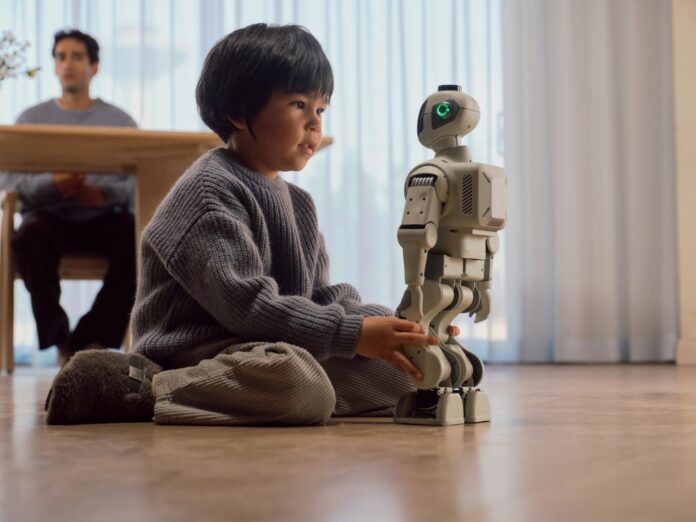

Home robots have promised a lot over the years and delivered very little beyond novelty. Zeroth Robotics thinks that is finally about to change.
At CES 2026, Zeroth Robotics officially emerged from stealth with its US launch and an unusually ambitious lineup of five AI powered robots built for homes, businesses, and developers. Leading the charge is Zeroth M1, a small humanoid robot aimed squarely at everyday life. Not as a gimmick, but as a practical interface for care, learning, and household support.
M1 is the first Zeroth robot scheduled to arrive in US homes and the clearest signal yet of the company’s philosophy. At roughly 15 inches tall, it is intentionally compact and non intimidating, designed to feel more like a household presence than a piece of industrial hardware. Zeroth is positioning M1 as a multi role companion that fits into modern routines rather than demanding attention for its own sake.
For older adults, M1 is designed to support independent living with gentle reminders, basic daily assistance, and light safety awareness. For busy parents, it acts as a kind of digital second set of hands, helping manage routines, reminders, and play. Zeroth is also leaning into the creator economy, pitching M1 as a customizable platform for robotics enthusiasts who want to build, tweak, and define what their first personal robot can do.
The robot itself is built around multimodal perception, a built in safety stack, and an app based ecosystem. Skills are available at launch, with new behaviors delivered over time through updates, reinforcing the idea that M1 is an evolving product rather than a fixed device. Zeroth says M1 will be available for preorder in the first quarter of 2026, starting at 2899 dollars, with general availability expected in April.
M1 may be the most relatable robot in the lineup, but it is far from the only one Zeroth is showing. The company used CES to reveal the broader shape of its ecosystem, spanning multiple form factors and use cases.
W1 is a wheel based autonomous assistant designed for homes and light commercial spaces, prioritizing utility and navigation over humanoid design. WALL•E, created in collaboration with Disney and Pixar, is an expressive, programmable companion aimed at families, classrooms, and high engagement environments like theme parks and retail. A1 is a developer focused quadruped built for universities and research teams exploring mobility and field robotics. Jupiter is a full size humanoid designed for real world task execution, blending autonomous movement with remote operation.
What ties all of these robots together is what Zeroth calls its Technology DNA. Rather than building isolated products, the company is developing a unified stack that spans advanced motion control, an evolving interaction model, and proprietary actuator engineering. The goal is more natural movement, more personal interaction, and more compact, high performance designs across the entire lineup.
This platform approach matters. It suggests Zeroth is not just shipping a cute home robot, but betting on robotics as a long term interface layer for how people and organizations interact with AI in the physical world. M1 is simply the most accessible entry point into that vision.
Zeroth will be demonstrating its robots throughout CES 2026 at Booth 10748 in the North Hall, where attendees can get hands on time with M1 and W1, preview concept capabilities for WALL•E, A1, and Jupiter, and speak directly with the team building them.
The company expects its full five robot lineup to roll out across the US in 2026, starting with M1. Whether Zeroth can turn that ambition into something consumers actually live with remains to be seen. But at a show crowded with abstract AI promises, its robots stand out for trying to answer a much simpler question: what does AI actually look like when it shows up at home.