
HomeNewsTechnologyCanva Just Took a Big Leap Into the AI Future, Starting with...

Canva Just Took a Big Leap Into the AI Future, Starting with ChatGPT

follow us on Google News

Canva is no stranger to innovation. But its latest move? It’s a big one.

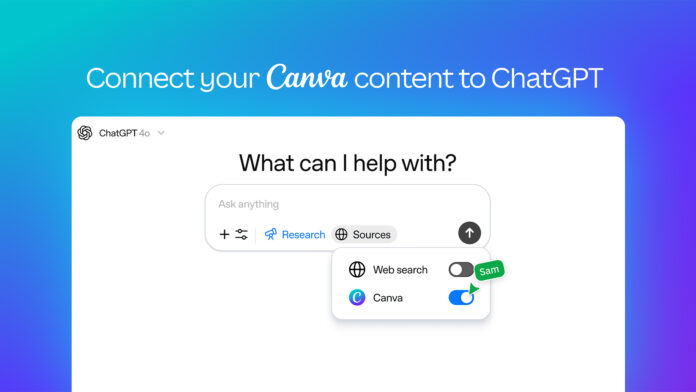
The design platform has officially embedded itself into the world’s top AI tools starting with OpenAI’s ChatGPT, unlocking a whole new way to create, collaborate, and move ideas forward. With two major launches, Canva is not just adding AI features; it is becoming an AI native platform built for the future of work.

First up: the Deep Research Connector for ChatGPT. This integration gives AI assistants direct access to your Canva designs, documents, presentations, and more so you can ask ChatGPT to summarize a brand guide, suggest improvements to a deck, or pull insights from past reports, all within one seamless chat. No tab switching. No digging around. Just fast, context aware creativity.

- Advertisement -

Then there is the Canva Model Context Protocol (MCP) Server, a bit more under the hood but just as impactful. It allows AI systems like ChatGPT, Salesforce Agentforce, and other assistants to tap into your full Canva workspace. So when you ask for a presentation or a branded social post, the AI knows your style, your templates, your data and delivers something useful on the spot.

The Future of Design Powered by Conversation

As more teams embrace AI in their everyday workflows, Canva is making it easier to do everything from ideating to publishing without ever leaving your AI assistant. Whether you are a marketer, a small business owner, or an educator, the idea is the same: less time managing files, more time creating.

For example:

  • Marketers can quickly reference past campaigns, summarize launch plans, or turn brand messaging into visual content
  • Sales teams can pull the right slide or pricing table mid conversation and turn it into a proposal
  • Educators can design lesson plans based on past curriculum with just a few prompts

And all of it happens securely. Canva Shield, the company’s trust and safety framework, is baked into every interaction, keeping data private and protected.

One Platform, Countless Possibilities

What makes this different from other AI integrations? Context. Canva’s MCP Server gives AI assistants live access to your actual work, not generic templates. That means smarter outputs, cleaner handoffs, and designs that actually feel like yours.

And it is not just about pulling from your history. These assistants can now generate new content, resize presentations, autofill charts with AI insights, even pull in files from a link without breaking stride. It is the kind of frictionless end to end flow creative professionals have been hoping for.

With over 18 billion AI tool uses already on the platform, Canva is clearly betting big on the future of generative creativity and building fast. These new tools join a growing suite that includes Canva AI, Canva Code, and advanced features in Canva Sheets.

What is next? If this rollout is any indication, the lines between design, productivity, and conversation are about to get a whole lot blurrier. In the best way.

Leave a Reply

More to Explore

From Pixels to the Body: Inside Midjourney’s Surprise Leap Into Medical Hardware

Midjourney has spent four years training the public to think of it as a company that turns text prompts into pictures. This week the...

Apple Just Redesigned Siri With AI, and iOS 27 Comes With Powerful New Parental Controls

Apple used its annual developer conference to lay out its vision for the next year of software across the iPhone, iPad, Mac, Apple Watch,...

The Strategic Implications of Anthropic Public Market Debut

The transition of frontier artificial intelligence from research and development into public market capitalization presents a critical study in operational resilience and capital allocation....

The End of the Passive PC: How NVIDIA RTX Spark is Making AI Your Local Teammate

For decades, personal computers have been exactly that: tools you operate. You click an application, type a command, and wait for a result. But...

Meet Claude Opus 4.8: The AI That Finally Admits What It Does Not Know

There is a specific anxiety that comes with using generative AI: the fear that the machine will confidently hand you a broken piece of...

The Age of the Agent: How Google I/O 2026 Rewrote the Rules of Artificial Intelligence

By the time Sundar Pichai walked off the Shoreline Amphitheatre stage on the evening of May 19, 2026, the word "assistant" had been quietly...

Sony Just Solved the Biggest Annoyance of Super Telephoto Lenses

Sony just redefined what photographers can expect from a long range zoom. The newly announced FE 100 to 400mm F4.5 GM OSS brings a...

Sony’s Alpha 7R VI Is the High-Resolution Camera Serious Photographers Have Been Waiting For

Sony just raised the bar for full-frame mirrorless photography, and for anyone who has been following the Alpha 7R series since its early days,...

Blender 5.1: The Precision Refinement Every Designer Needs

Released on March 17, 2026, Blender 5.1 arrives not as a radical departure, but as a masterclass in refinement. While version 5.0 was the...

How to Set Up Firefox’s New Free Built-in VPN and Use Native Split View

Digital privacy often feels like a full-time job, requiring users to juggle various extensions and subscriptions just to keep their personal data from leaking...

OpenAI Shuts Down Sora as Disney’s $1 Billion Deal Collapses

The sudden closure of OpenAI's AI video platform marks one of the most dramatic reversals in the brief history of generative AI, and leaves...

Sony’s Tokyo Studio Is Where the Future of Filmmaking Gets Made

Sony is bringing its global media production hub network to Japan, opening the Digital Media Production Center Japan (DMPC Japan) inside the company's Group...

Anthropic’s Claude Cowork Lets You Assign AI Tasks From Your Phone and Walk Away

Artificial intelligence is getting better at doing things. The harder challenge has always been getting it to do things without you watching. Anthropic's Claude...

NVIDIA’s Dynamo 1.0 Is Free, Open Source Software That Makes AI Inference Up to 7x Faster

Running AI models at scale is harder than it looks. Training a model is a one-time investment. Inference, the process of actually using that...

Adobe and NVIDIA Are Teaming Up to Reinvent Creative and Marketing Workflows With AI

Two of the most influential companies in creative technology are deepening a partnership that goes back more than two decades. Adobe and NVIDIA have...

Recommended for You

You Might Also Like