
HomeNewsTechnologyHyundai Mobis Showcases Holographic Heads-Up Display at CES 2025

Hyundai Mobis Showcases Holographic Heads-Up Display at CES 2025

follow us on Google News

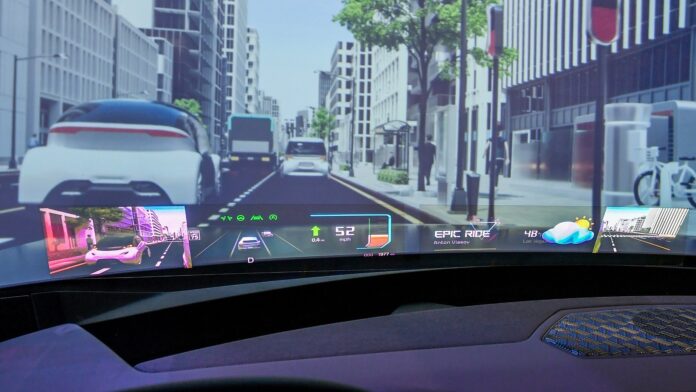
Hyundai Mobis unveiled the world’s first full-windshield holographic heads-up display (HUD) at CES 2025. Designed to revolutionize in-car display systems, this innovative solution eliminates traditional screens, offering a futuristic approach to delivering driving information with enhanced clarity and user experience.

- Advertisement -

Next-Generation Windshield Display Technology

Integrated into Kia’s EV9 electric vehicle for CES 2025, the holographic HUD transforms the front windshield into a seamless, transparent display. Key information such as navigation, driving metrics, and media controls is projected onto the lower portion of the windshield, enhancing driver focus and safety.

Externally, the windshield maintains a standard transparent appearance, but within the cabin, it provides bright, high-resolution visuals visible even in daylight. This breakthrough is made possible through a Holographic Optical Element (HOE) film embedded in the glass, leveraging light diffraction to project images directly into the driver’s line of sight.

Collaboration with ZEISS for Advanced Optics

Developed in partnership with ZEISS, a leader in optical technology, the holographic HUD represents a major leap in automotive innovation. Hyundai Mobis CEO Lee Gyu Suk and ZEISS CEO Karl Lamprecht met during CES 2025 to review the project’s progress and discuss plans for mass production.

- Advertisement -

Currently in pre-development, the holographic windshield is slated for completion by mid-2026, with a market launch anticipated in 2027. This collaboration emphasizes the technological synergy between Hyundai Mobis and ZEISS to bring advanced display solutions to the global automotive industry.

Global Innovations on Display at CES 2025

At its CES 2025 booth, Hyundai Mobis showcased 16 cutting-edge products, including the holographic HUD, electrification components, vehicle electronics, chassis systems, and advanced lighting technologies. The company also hosted over 30 meetings with international clients, underscoring its commitment to driving global business growth and advancing mobility innovation.

The holographic heads-up display sets a new standard for in-car technology, reaffirming Hyundai Mobis’s position as a trailblazer in the automotive industry and its vision for the future of smart mobility.

Leave a Reply

More to Explore

Blender 5.1: The Precision Refinement Every Designer Needs

Released on March 17, 2026, Blender 5.1 arrives not as a radical departure, but as a masterclass in refinement. While version 5.0 was the...

How to Set Up Firefox’s New Free Built-in VPN and Use Native Split View

Digital privacy often feels like a full-time job, requiring users to juggle various extensions and subscriptions just to keep their personal data from leaking...

OpenAI Shuts Down Sora as Disney’s $1 Billion Deal Collapses

The sudden closure of OpenAI's AI video platform marks one of the most dramatic reversals in the brief history of generative AI, and leaves...

Sony’s Tokyo Studio Is Where the Future of Filmmaking Gets Made

Sony is bringing its global media production hub network to Japan, opening the Digital Media Production Center Japan (DMPC Japan) inside the company's Group...

Anthropic’s Claude Cowork Lets You Assign AI Tasks From Your Phone and Walk Away

Artificial intelligence is getting better at doing things. The harder challenge has always been getting it to do things without you watching. Anthropic's Claude...

NVIDIA’s Dynamo 1.0 Is Free, Open Source Software That Makes AI Inference Up to 7x Faster

Running AI models at scale is harder than it looks. Training a model is a one-time investment. Inference, the process of actually using that...

Adobe and NVIDIA Are Teaming Up to Reinvent Creative and Marketing Workflows With AI

Two of the most influential companies in creative technology are deepening a partnership that goes back more than two decades. Adobe and NVIDIA have...

NVIDIA Is Trying to Become the Default Platform for Every Kind of Robot

Jensen Huang has a bold prediction: every industrial company will become a robotics company. Whether or not that timeline plays out exactly as he...

NVIDIA and T-Mobile Want to Turn the 5G Network Into a Distributed AI Computer

Most conversations about AI infrastructure focus on data centers, the massive facilities packed with GPU racks that train and run the world's most powerful...

BYD, Nissan, Geely and More Are Building Self-Driving Cars on NVIDIA’s Platform — and Robotaxis Are Coming to Uber by 2027

Self-driving vehicles have been a promise for a long time. The technology has advanced significantly, but wide-scale deployment has remained perpetually just around the...

NVIDIA Wants to Be the Platform That Powers Every Enterprise AI Agent

Autonomous AI agents are moving from experiment to enterprise infrastructure faster than most organizations anticipated. The question is no longer whether companies will deploy...

NVIDIA Is Building a Coalition of AI Labs to Develop Open Frontier Models Together

The race to build the most powerful AI models has largely been a competition, with labs guarding their research, their data, and their techniques...

NVIDIA Is Releasing a Wave of Open AI Models Covering Everything From Robot Brains to Drug Discovery

NVIDIA does not just make chips. It has spent years building a parallel business in AI software and open models, and at GTC this...

NVIDIA’s NemoClaw Brings Security and Privacy to OpenClaw’s Fast-Growing AI Agent Platform

AI agents are getting good enough to actually be useful, and that is precisely when the uncomfortable questions start. If a piece of software...

NVIDIA Is Taking Its AI Chips to Space — Here’s What That Actually Means

NVIDIA has spent the last several years building the infrastructure that powers AI on Earth. Now it is setting its sights considerably higher. The...

Recommended for You

You Might Also Like