
There are places that resist the modern compulsion to impress, and it is precisely this resistance that makes them unforgettable. Cap-Ferret is one of them. Curled at the tip of a slender peninsula in southwestern France, flanked by the wild Atlantic on one side and the glittering Bassin d’Arcachon on the other, it has long been the preferred escape of those who know that true luxury is not built, but found. Villa Colette, the vision of hotelier Laurent Taïeb brought to life by the singular imagination of Philippe Starck, understands this completely.
The drive alone prepares the senses. Past the oyster villages of Claouey, Petit and Grand Piquey, Le Canon, and the achingly pretty L’Herbe, the cape narrows, the pine forest thickens, and the outside world quietly falls away. By the time Cap-Ferret appears, something has already shifted. The air is different. The light is different. Time, it seems, has renegotiated its terms.
A House That Happens to Be a Hotel
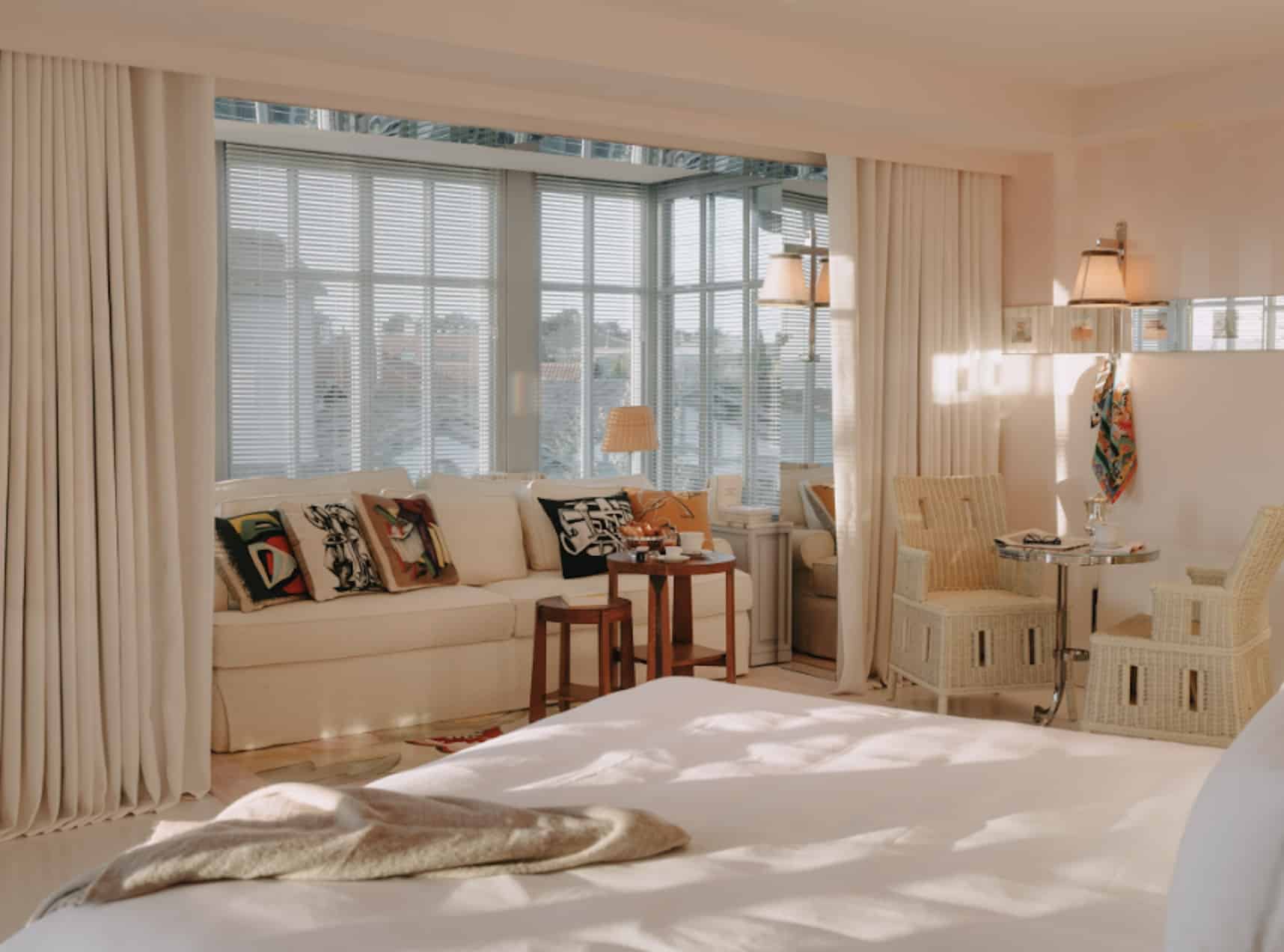
On the village square, behind a facade of elegant neo-19th-century architecture, Villa Colette makes no attempt to announce itself. It simply opens, like a home belonging to someone with exceptional taste and the generosity to share it. Twenty-eight rooms and suites are arranged around the kind of life one imagines living here rather than merely visiting. Terraces and private gardens face the bay, the pines, or the quiet rhythm of village life. Inside, powdery pinks and warm mahogany create an atmosphere that is less decorated than inhabited. Surrealist photographs line the walls. Bathrooms are impeccable without being cold. The overall effect is one of floating, gently, somewhere between a memory and a wish.
Philippe Starck’s hand is felt rather than seen. Nothing shouts. Everything resonates.
The Table
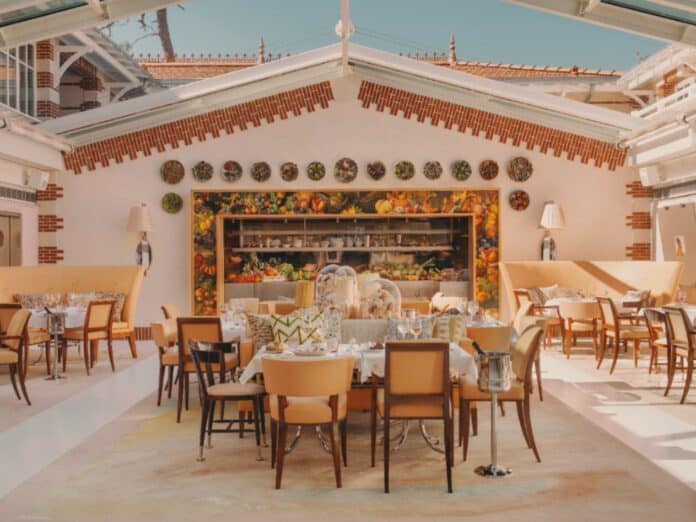
Chef Benjamin Six runs a kitchen that treats geography as a starting point rather than a constraint. The morning’s catch from local waters might arrive alongside something shaped by Southeast Asia or the Levant, and the conversation between the two is always intelligent, never forced. The dining room itself is a theater of considered detail: mirrored galleries, candlelit silverware, portraits that seem to be hiding something. A glass roof pours in light by day and dissolves into stars by night. It is the kind of room that makes a meal feel like an occasion, without ever making it feel like a performance.
The Bar
Lemon yellow, unhurried, and entirely itself, the bar at Villa Colette is where the day organizes itself around pleasure. Morning coffee with the bay spread out before the windows. Tea and oysters after an afternoon on a traditional pinasse. Backgammon by the fire as the temperature drops. And then, as the Bassin turns gold and the piano begins, a cocktail that tastes precisely like where one is. There is a word in French, dépaysement, the feeling of being beautifully elsewhere. The bar at Villa Colette delivers it, glass by glass.
The Life of It
What Villa Colette offers, beyond its considerable beauty, is permission. Permission to swim at daybreak when the water is still cool and the beach is empty. To cycle beneath the pines all the way to L’Herbe without a destination in mind. To eat oysters at noon facing the open sea and consider that sufficient. To arrive with a full calendar and leave having done almost none of it.
Between the Dune du Pilat and Le Banc d’Arguin, between the Atlantic and the bay, Cap-Ferret has always known something that its visitors eventually learn: the most refined thing one can do here is slow down entirely. Villa Colette has simply made that easier, and considerably more beautiful, to do.