
A Mirror Too Clear
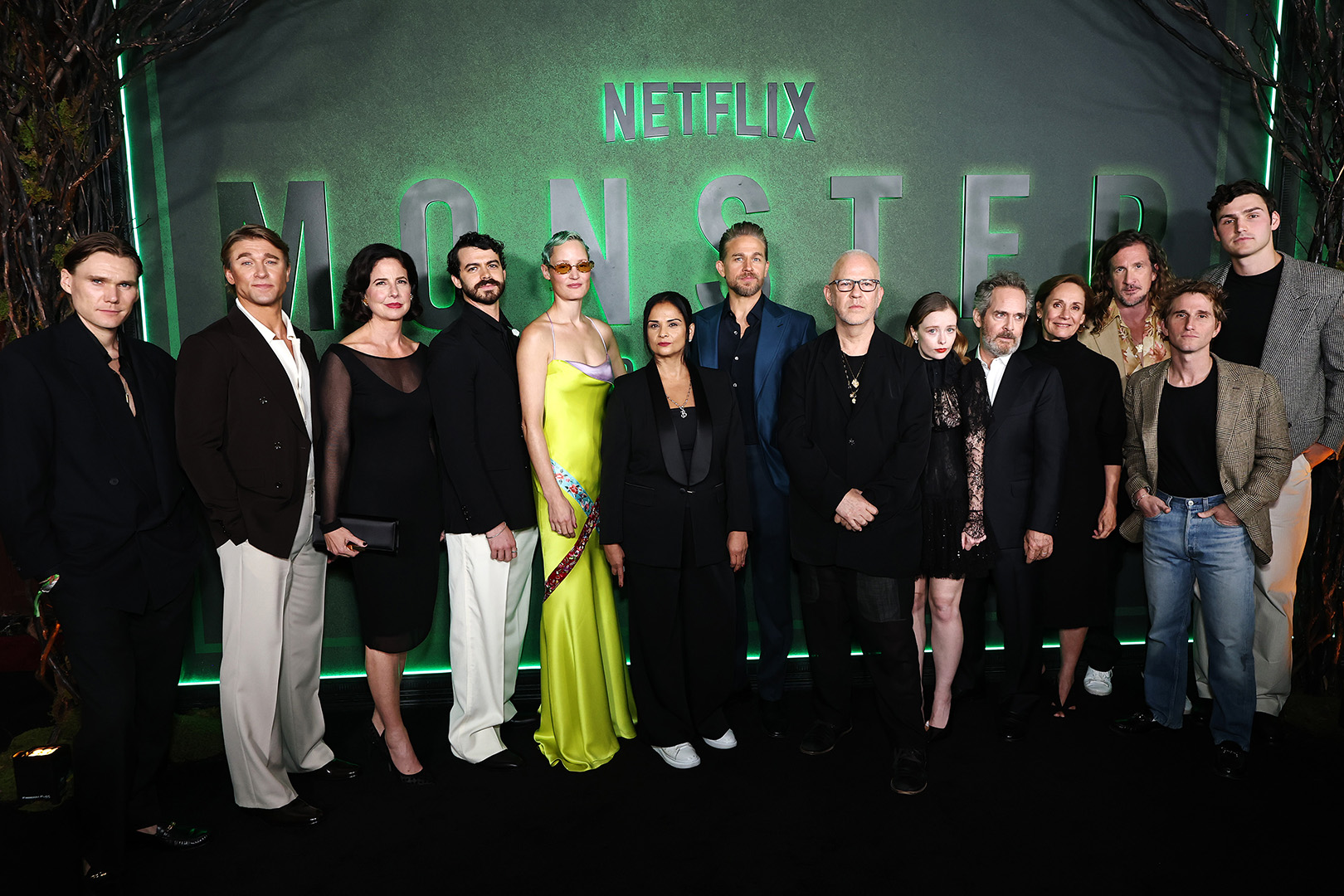
The camera lingers on a snow-choked field in rural Wisconsin. A voice mumbles somewhere offscreen — uncertain, almost childlike. It’s Ed Gein, portrayed by Charlie Hunnam, standing at the center of Netflix’s latest true-crime spectacle, Monster: The Ed Gein Story.
But what the series reflects may not be the man at all. It may be the audience.
Co-creator Ryan Murphy poses a question that echoes throughout every scene: Are monsters born, or are they made? The answer, as he admits, “is probably a little of both.” Yet the show’s real thesis goes deeper: what happens when the making of a monster is as much the work of society as it is of the killer himself?

The Real Ed Gein: Isolation, Madness, and the Making of a Myth
Before Gein became a horror archetype, he was a small-town handyman in Plainfield, Wisconsin, born in 1906. His father drank, his mother — Augusta — preached the apocalypse. She ruled her son’s life through fear, sexual shame, and Old Testament morality.
When she died in 1945, Gein was left alone on the family’s decaying farm. Over the next decade, he transformed it into a museum of death. Police would later find bowls made from skulls, chairs upholstered with human skin, and a mask fashioned from the face of a woman long buried.
Gein admitted to murdering Bernice Worden and Mary Hogan but confessed to countless grave robberies, often targeting women who resembled his mother. He told investigators he wanted to “be her again.” Declared insane, he was sent to the Central State Hospital and later Mendota Mental Health Institute, where he died in 1984.
What distinguishes Gein’s crimes is not their scale — he killed only twice — but their symbolism. They tapped into the mid-century American subconscious: repression, domesticity, gender, and guilt. He became the grotesque stand-in for everything polite society tried to bury.
From Farmhouse to Film Set
Nearly seven decades later, Netflix has turned that darkness into entertainment again. Filmed in Chicago and surrounding towns beginning in late 2024, Monster: The Ed Gein Story reconstructs the 1950s Midwest in cold, muted tones. Director Max Winkler and cinematographer Nicolas Karakatsanis (known for Bullhead and The Drop) built a visual language of decay: natural light, shallow focus, and handheld motion, imitating the jittery realism of crime scene footage.
Production design leaned heavily on archival evidence — FBI photographs, police inventories, and Wisconsin Historical Society files. The result is chilling in its accuracy: the wallpaper patterns match the real Gein house; the placement of objects mirrors how deputies found them in 1957.
Still, accuracy is not truth. The series mixes fact with invention. Fictional characters like Adeline Watkins (Suzanna Son) embody Gein’s loneliness and delusion, but she’s based only loosely on a woman from Plainfield who once claimed, and later denied, an engagement to him. The blurred line between fact and fantasy mirrors Gein’s own fractured psychology — and the viewer’s complicity in wanting the story to be more cinematic than it was.
A Voice from the Archive
Hunnam’s performance is grounded in something extraordinary: a real 70-minute police interview conducted the night of Gein’s arrest, long suppressed because officers failed to issue Miranda warnings. Hunnam located a copy, unheard for decades, and studied Gein’s halting cadence — a man trapped between remorse and vacancy.
“It wasn’t an authentic voice,” Hunnam said during production. “It was what his mother wanted him to be.”
This is one of the few points where performance and history align perfectly. The sound of Gein’s voice — slow, uncertain, clinging to politeness — underscores how far he was from the archetype of the cinematic killer. He was not Hannibal Lecter. He was a man with the emotional development of a child and access to graves.
The Machinery of Myth
Murphy and Brennan’s narrative takes an audacious leap: placing Alfred Hitchcock, Anthony Perkins, and later Tobe Hooper and Jonathan Demme inside the story, dramatizing how Gein’s crimes mutated into film. Hitchcock’s Psycho (1960), Hooper’s Texas Chain Saw Massacre (1974), and Demme’s Silence of the Lambs (1991) each drew, directly or indirectly, from the “Butcher of Plainfield.”
By weaving these creators into the narrative, the series stages a feedback loop — horror creating horror, culture feeding on itself. Hitchcock is portrayed planning the Psycho marketing stunt forbidding late entry to theaters, while Demme’s Silence sequence with Buffalo Bill mirrors Gein’s fixation with skin.
Murphy’s argument is pointed: the entertainment industry has been reconstructing Gein for decades, one movie at a time.
The War Within the Mind
Where Monster diverges from simple biography is in its attention to Gein’s imagination. The series links his obsessions to wartime atrocities — notably his fixation on Ilse Koch, the “Bitch of Buchenwald.” During interrogation, Gein reportedly referenced Koch’s alleged practice of preserving human skin, an image that fueled his own grotesque creations.
Murphy and Brennan use this detail to comment on postwar media saturation: photographs of Nazi crimes circulated globally in the late 1940s, often without context. The horror was real, but the meaning was lost. For Gein, these images were not evidence — they were instruction.
Fact, Fiction, and the Ham Radio
One of the most startling creative choices in the series is the ham radio, through which Gein imagines conversations with Koch and Christine Jorgensen, the first American to undergo gender confirmation surgery. The radio is historically accurate — Gein did have one while institutionalized — but the conversations are not.
In the show, Jorgensen tells him he is not transgender but gynephilic, “a man so aroused by the female body that he wants to be inside it.” The line is fiction, but the distinction matters. It clarifies the difference between gender identity and pathology — a corrective to decades of misunderstanding in pop culture.
The Reception: Admiration and Unease
Since its October 2025 release, Monster: The Ed Gein Story has divided viewers. Some hail its ambition, its cinematography, and its refusal to sanitize its subject. Others accuse it of turning a murderer into a metaphor, of aestheticizing pain.
The series does succeed at one thing: it forces the viewer to confront their role in the spectacle. As one cultural analysis observed, “The attempt to blend Gein’s life with the broader history of horror films is an interesting creative angle.” It implicates the audience in the machinery that keeps such stories alive — long after the graves have closed.
The End of the Line
In the final episode, Gein lies dying in Mendota Hospital. He imagines himself congratulated by the killers he inspired — Bundy, Speck, Leatherface, Buffalo Bill — a macabre parade of progeny. Later, teens try to steal his gravestone, echoing real events in 2000, when the headstone was removed after repeated thefts.
The final frame mirrors The Texas Chain Saw Massacre: Leatherface spinning in the dawn light. Gein’s smile lingers, almost satisfied.
It is not triumph. It is indictment.
The Real Monster
What Monster: The Ed Gein Story reveals, intentionally or not, is that Ed Gein’s legacy is not confined to his crimes. It lives in every retelling, every film, every viewer who leans closer when the story turns grotesque.
By turning Gein’s horrors into myth, the culture gave him what he lacked in life — immortality.
Murphy and Brennan claim to hold up a mirror to American fascination with killers. The reflection staring back is unflattering. In the end, it is not Ed Gein who is under investigation. It is us.