


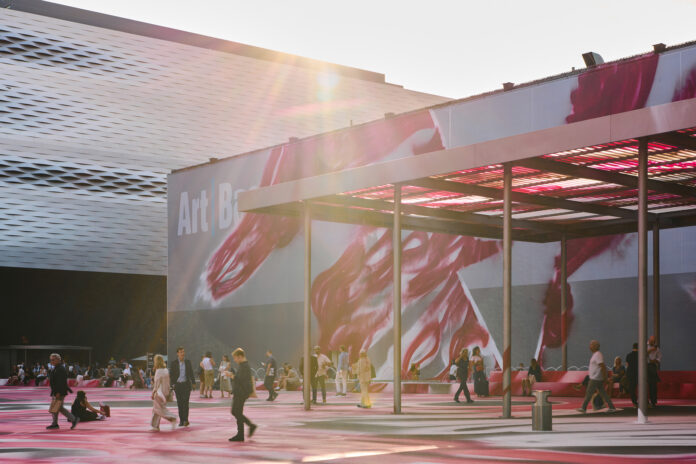

Art Basel has confirmed the 290 galleries selected for its 2026 flagship fair in Basel, drawing exhibitors from 43 countries and territories, including 21 first time participants across sectors. The scale is decisive. The concentration is equally so. From early modernism to digital experimentation, the edition presents the market not as a trend report, but as a structured cross section of global production.
The fair takes place June 18 to 21, 2026, with Preview Days on June 16 and 17. UBS continues as Global Lead Partner.
Public Commissions: Form in the Civic Realm
Two major public works extend the fair beyond Messe Basel into the city’s architectural fabric. As inaugural Gold Awardees in the Established Artist category, Nairy Baghramian and Ibrahim Mahama have been invited to conceive site responsive projects for Basel’s public sphere.
Baghramian’s new large scale work unfolds across the Messeplatz, where the geometry of the fair’s architecture meets open civic space. Mahama’s installation occupies the Münsterplatz, embedding contemporary material language within the city’s historic core. Both commissions mark the first time projects stemming from the Art Basel Awards program premiere in Basel, translating recognition into physical presence. The gesture is measured: institutional endorsement becomes urban intervention.
Parcours: Conviviality as Structure
Parcours, dedicated to site specific installations, sculpture, performance, and public intervention, is curated for the third consecutive year by Stefanie Hessler, Director of the Swiss Institute in New York. The 2026 edition centers on the concept of conviviality, examining both the pleasure and friction of shared space.
Installations trace a path along Clarastrasse, in close proximity to the fair. Historic facades, storefronts, and civic thresholds become surfaces and stages. The curatorial framing prioritizes dialogue between artwork and infrastructure. Urban texture is not backdrop but medium.
The Main Sector: Density and Depth
The Galleries sector brings together 232 exhibitors presenting the core of their programs. Increasingly, booths are conceived as tightly edited exhibitions rather than inventory displays. Themes emerge with clarity: metamorphosis, material transformation, memory, abstraction, spatial perception. Scale is controlled. Sightlines are deliberate. Works from distinct periods are placed in calibrated proximity, compressing art historical depth into a continuous visual field.
Twelve galleries enter the main sector for the first time, eight of them graduating from Feature, Statements, and Premiere. Four galleries join the flagship show directly in the main sector, signaling the strength and coherence of their programs.
Among first time participants:
- Jessica Silverman presents Significant Others, a curated booth featuring Judy Chicago, Loie Hollowell, Atsushi Kaga, Woody De Othello, GaHee Park, and Rose B. Simpson, framing intergenerational dialogue through figuration and form.
- Silverlens foregrounds contemporary practices from Southeast Asia with works by Pacita Abad, Yee I Lahn, and Geraldine Javier, mapping regional specificity within global circulation.
- LC Queisser stages a group presentation exploring transition and instability through works by Ser Serpas, Tolia Astakhishvili, Sitara Abuzar Ghaznawi, and Karlo Kacharava.
- Pippy Houldsworth presents paintings from Jacqueline de Jong’s La vie privée des Cosmonautes, dating from 1966 to 1967 and unseen publicly since their Paris debut, reintroducing a critical moment of postwar iconoclasm.
- Larkin Erdmann places Dada, Surrealism, Minimalism, and Concrete Art in dialogue, with major works by Agnes Martin, Man Ray, Marcel Duchamp, and Meret Oppenheim.
- Marcelle Alix structures Aftershow around the backstage as a site of feminist reimagination, bringing together Charlotte Moth, Pauline Boudry and Renate Lorenz, Armineh Negahdari, Mira Schor, and Donna Gottschalk.
- Kalfayan Galleries juxtaposes a historic presentation of Vlassis Caniaris’s installation Bicycle from 1973 to 1980 with paintings by Giorgos Ioannou and new works by Antonis Donef and Farida El Gazzar.
- P420 pairs works by Irma Blank, Laura Grisi, and Ana Lupas with newly commissioned pieces by Adelaide Cioni, June Crespo, and Francis Offman, underscoring its commitment to rediscovery and new production.
Four galleries make their Art Basel debut directly in the main sector:
- Berry Campbell presents a focused group of ten American postwar women artists, including Elaine de Kooning, Lynne Drexler, and Lucia Wilcox.
- Tim Van Laere Gallery proposes a cross generational presentation with Dirk Braeckman, Carroll Dunham, Adrian Ghenie, Leiko Ikemura, Tal R, Rinus Van de Velde, Eline Vansteenkiste, and Franz West.
- Phillida Reid debuts with a multigenerational presentation featuring Mohammed Z. Rahman, Prem Sahib, and major works by Joanna Piotrowska.
- Ortuzar stages a dialogue among Lynda Benglis, Suzanne Jackson, and Lee Bontecou, tracing material experimentation across decades.
Premiere: Recent Production at Architectural Scale
Premiere expands from 10 to 17 presentations, sharpening its focus on work produced within the past five years. The sector accommodates museum scale installation, sculptural environments, film, sound, and materially experimental practices.
Three galleries join Premiere for the first time: Ehrhardt Flórez, Magenta Plains, and Öktem Aykut.
Highlights include:
- Athr Gallery presents Treehouse by Ayman Yossri Daydban, a walk through installation of translucent acrylic panels using light, reflection, and void to reconsider architecture as a site of identity and displacement.
- Ehrhardt Flórez shows a large scale wall sculpture by June Crespo that transforms the booth into a field of circulation and tension through industrial material and structural constraint.
- Hoffman Donahue brings together Susan Cianciolo, Lynn Hershman Leeson, and Kate Mosher Hall in a generational dialogue across craft, technology, and collage.
- Magenta Plains presents a curated grouping by Jennifer Bolande, Liza Lacroix, and Josephine Meckseper, examining gender, image, and power through the visual language of advertising and display.
- Öktem Aykut introduces Strings by Koray Ariş, a suspended sculptural environment in leather and wood that invites movement and proximity.
- White Space stages Wang Tuo’s six channel video installation Intensity in Ten Cities, revisiting modern Chinese architecture through suppressed histories and spatial fragmentation.
Premiere functions as a testing ground where recent work is given institutional scale within a commercial framework.
Feature: Art History in the Present Tense
Feature positions 16 art historical projects within the fair’s broader program. Five galleries participate in the show for the first time in this sector: Galerie Cécile Fakhoury, Galería Guillermo de Osma, Galerie Kaléidoscope, ML Fine Art, and Kotaro Nukaga.
Projects span early modernism through the postwar period:
- Galería Guillermo de Osma presents works by Joaquín Torres García from 1916 to 1935, tracing the development of Universal Constructivism across painting, sculpture, drawing, and object.
- Galerie Hubert Winter shows rare works by Marcia Hafif from her Italian Paintings and Acrylic Paintings, charting her transition toward Radical Painting.
- Galerie Cécile Fakhoury revisits abstract works by Souleymane Keïta from the 1970s through the 1990s, repositioning his practice within broader narratives of African modernism.
- Giorgio Persano places Mario Merz and Michelangelo Pistoletto in dialogue, underscoring continuity within Arte Povera.
- Kotaro Nukaga presents a solo project dedicated to Saori Akutagawa, tracing her evolution from oil painting to dye based abstraction in postwar Japan.
- Galerie Kaléidoscope stages a focused presentation of Eduardo Arroyo, foregrounding politically charged works from the 1960s and 1970s.
In each case, historical work is not isolated. It is positioned as structural foundation.
Statements: New Voices, Integrated Context
Statements presents 18 solo projects by emerging artists whose practices are research driven, materially rigorous, and socially attentive. Nine galleries join Basel for the first time in this sector, reinforcing the fair’s role as a platform where new practices are introduced within a layered ecosystem rather than in isolation.
Highlights include:
- a. SQUIRE presents Delamination by Eli Coplan, dissecting LCD screen infrastructure through peeled polarizing films and sculptural partitions.
- Galerie Molitor debuts Fireworks Festival by Yalda Afsah, a film examining ritual and collective intensity through immersive sound and image.
- Gypsum Gallery shows Plot Twist by Hana El Sagini, an installation of braided bronze branches and relief forms translating personal experience into sculptural landscape.
- sans titre presents The depths beneath the cage by Liselor Perez, a monumental textile and silicone installation reconfiguring domestic scale.
- Wschód presents a site specific installation by Adam Shiu Yang Shaw examining Berlin’s waste infrastructure through architectural sculpture and projection.
- Blue Velvet introduces a sculptural installation by Mónica Mays interrogating the Western genre as a fiction of conquest through assemblage and reflective surfaces.
Statements operates with precision: research and material experiment foregrounded within the broader visual field of the fair.
Editions and the Broader Cultural Field
Editions spans both floors of Hall 2 with seven leading galleries devoted to prints and editioned works, including Cristea Roberts Gallery, Gemini G.E.L., knust kunz gallery editions, Carolina Nitsch, René Schmitt, Susan Sheehan Gallery, and STPI. The sector emphasizes process, repetition, and graphic clarity.
Beyond the fairgrounds, Basel’s institutions synchronize their exhibition calendars. Major presentations open at Fondation Beyeler, Kunstmuseum Basel, Kunsthalle Basel, Kunsthaus Baselland, Museum Tinguely, the Vitra Design Museum, and the Vitra Schaudepot, among others. The proximity is strategic. Museum, foundation, gallery, and public square operate as a single circuit.
In Basel, scale is disciplined by structure. The 2026 edition does not expand for spectacle. It expands to clarify position. Art historical depth, recent production, and civic intervention align within a single, legible framework.