
Monday, February 9, 2026
HomeNewsArtUnveiling the Oldest Printed Book: The Scripture of the Great Flower Ornament...

Unveiling the Oldest Printed Book: The Scripture of the Great Flower Ornament of the Buddha

follow us on Google News

The oldest printed book in the collection of The Huntington Library, Art Museum, and Botanical Gardens will be exhibited for the first time in “Printed in 1085: The Chinese Buddhist Canon from the Song Dynasty,” an exhibition on view in the Library’s West Hall from April 29 through Dec. 4, 2023. The exhibition aims to explore the book’s creation and religious significance while providing historical context and broadening visitors’ understanding of Chinese textual tradition. 

The exhibition will also display additional materials related to the text. According to Li Wei Yang, curator of the Pacific Rim collections at The Huntington, a specially designed display case will offer visitors a unique viewing experience of the sacred text. The book, known as The Scripture of the Great Flower Ornament of the Buddha, is more than 900 years old and is part of the 5,850-volume Great Canon of the Eternal Longevity of the Chongning Reign Period. Produced during the Song dynasty between 1080 and 1112, the accordion-style book unfolds to a length of 31 feet, 21 feet of which will be on display. 
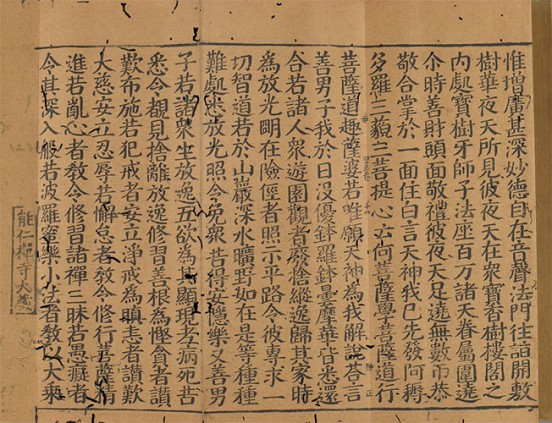
Panel: Unknown author(s), Dafangguang fo huayan jing, fascicle 45, 1085, ink on paper.  © The Huntington Library, Art Museum, and Botanical Gardens.  Burndy Library Collection, Gift of Dibner Family.
Panel: Unknown author(s), Dafangguang fo huayan jing, fascicle 45, 1085, ink on paper. © The Huntington Library, Art Museum, and Botanical Gardens. Burndy Library Collection, Gift of Dibner Family.

The book is one of the longest sutras in the Buddhist canon and presents a vision of the entire universe as consisting of interpenetrating elements within the body of the Cosmic Buddha. “Printed in 1085” will also show the connection between religion and China’s printmaking, which had been practiced centuries before the first use of movable metal type in Europe. The book was printed using more than 165,000 woodblocks, making it one of the most time- and resource-intensive printing projects ever undertaken in China’s imperial history. Today, incomplete collections of the Chongning canon volumes are scattered in libraries and private collections throughout Asia, Europe, and North America, which makes The Huntington’s volume of the Chongning canon an especially valuable historical artifact.


Discover more from SNAP TASTE

Subscribe to get the latest posts sent to your email.

Julie Nguyen
Julie Nguyen
Julie is the visionary founder of SNAP TASTE and a dynamic force in global storytelling, innovation and creative leadership. She is a respected member of the Harvard Business Review Advisory Council and serves as a judge for the CES Innovation Awards (2024, 2025 and 2026), where she contributes thought leadership on the intersections of business, culture and breakthrough technologies. As Managing Director, she also oversees the Fine Art, Digital Art, Portfolios and Marketing departments, ensuring the brand’s strategic vision and creative direction are realized across disciplines. Her immersive reporting has brought audiences behind the scenes of global milestones such as the FIFA World Cup Qatar 2022, Expo 2020 Dubai, CES, D23 Expo, and the Milano Monza Motor Show, offering exclusive access to moments that define contemporary culture. An accomplished film critic and editorial voice, Julie is also recognized for her compelling reviews of National Geographic documentaries and other cinematic works. Her ability to combine analytical depth with narrative finesse inspires audiences seeking intelligent, meaningful, and globally relevant content. With a multidisciplinary perspective that bridges art, technology, and culture, Julie continues to shape the dialogue on how storytelling and innovation converge to influence the way we experience the world.
Ad

Leave a Reply

FEATURED

RELATED NEWS