


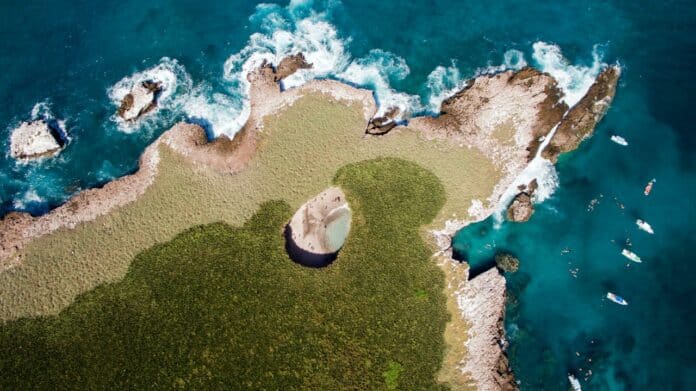

Just north of Puerto Vallarta’s famous bay, another Mexico begins. Less performed, more felt. A coastline that hasn’t yet decided what it wants to be when it grows up, and is all the more beautiful for it.
There is a particular quality of light in Nayarit that doesn’t appear in photographs. It arrives in the hour before sunset, when the Sierra Madre to the east turns from green to the color of pewter and the Pacific ahead goes liquid copper, and for a moment the whole landscape seems to be breathing in. Puerto Vallarta, just across the state line in Jalisco, will be announcing itself in the usual ways. Nayarit simply waits.
The state stretches from highland cloud forest to mangrove estuary to open ocean, encompassing a coastline the tourism ministry has branded the Riviera Nayarit with entirely reasonable pride. What the branding doesn’t quite capture is the strangeness of the place, its insistence on existing outside whatever category you arrive with. Luxury eco-resorts share hillsides with Wixárika communities whose traditions predate the conquest by centuries. World-class surf breaks sit an hour’s drive from colonial market towns the guidebooks haven’t found yet. And just offshore, inside a collapsed volcanic crater accessible only by swimming through a dark tunnel at low tide, there is a beach that some people describe as the most beautiful they have ever seen.
That last part is worth dwelling on. Beauty is a word that travels poorly, abraded by overuse. But the Marietas Islands have a way of restoring its meaning.
“Nayarit does not perform for the camera. It rewards the traveler who arrives with patience, and something like genuine curiosity about what a place can hold.”
Before the Hidden Beach: The Places That Define the State
Sayulita & San Pancho
Sayulita holds the government’s Pueblo Mágico designation, awarded in 2015, and earns it through a particular brand of organized bohemianism: Huichol beadwork sold beside natural wine bars, surf tournaments on beaches draped with flag garlands. Just fifteen minutes north, San Pancho, officially San Francisco, operates at a lower frequency entirely, functioning more as a cultural village, its polo club and Casa de Arte existing in quiet counterpoint to its neighbor’s performance.
Humpback Whales in Banderas Bay
Each winter, the bay becomes a nursery. Humpbacks migrate from Alaskan feeding grounds to breach and calve in these protected waters, and the sight of one surfacing against the green wall of the Sierra Madre is the kind of image that recalibrates your sense of scale. Any boat heading toward the Marietas Islands during these months doubles, inevitably, as a whale watch.
Mexcaltitán — The Mexican Venice
During the rainy season, the streets of this tiny circular island flood entirely, and residents move through town by canoe. It is widely believed to be Aztlán, the ancestral origin point of the Aztec people, which lends a particular weight to the experience of arriving by boat through the lagoon’s mangrove corridors, surrounded by birds, in a place that has been inhabited continuously for a very long time.
The Wixáritari — Huichol Art
The Wixárika people maintain a ceremonial and artistic tradition among the most intact in Mexico. Their yarn paintings and intricate beadwork, alive with cosmological imagery, are not souvenirs in any reductive sense but windows into a worldview that has survived centuries of pressure to dissolve. You will find their work throughout the state, and the quality of attention it demands is worth meeting.
Pescado Zarandeado
There is a whole fish, slow-smoked over wood in the mangroves of San Blas, marinated in chiles and achiote and the juice of things that grew nearby, that constitutes a kind of regional argument: this is what the land and sea can do together when left to their own logic. It originated in the kind of place with plastic chairs and a view of the estuary, and that version remains the more honest one.
San Blas — Where Jungle Meets Sea
A colonial port with a ruined 18th-century fort watching over it, San Blas attracts ornithologists from across the Americas for its extraordinary biodiversity. The boat ride up the La Tovara river, through mangrove tunnels past freshwater springs where crocodiles observe from the banks with magnificent indifference, is among the most underrated experiences in the entire state.
Marietas Islands National Park
Playa del Amor – The Hidden Beach
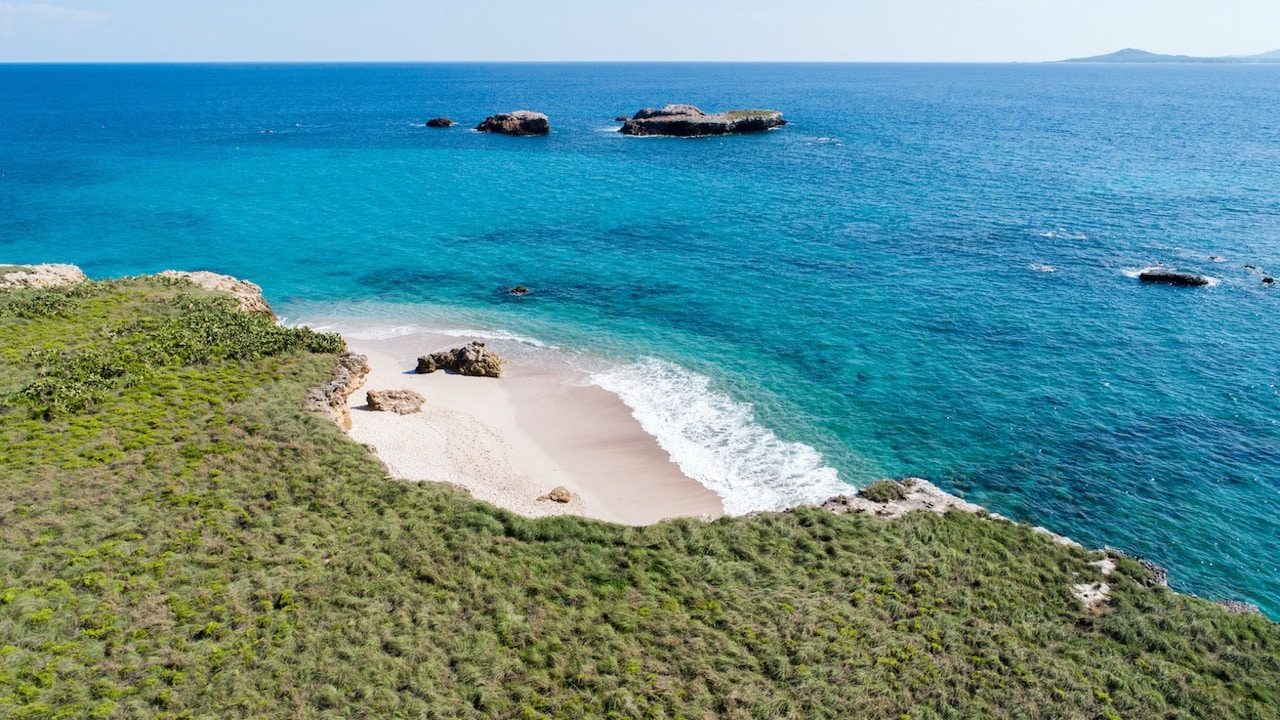
A geological event and a love story, compressed into a crater of white sand and impossible water. The most protected beach in Mexico. Possibly the most beautiful.
The Marietas Islands sit five miles off the coast of Punta de Mita, two uninhabited volcanic islands formed some sixty thousand years ago, and for most of their existence they were known primarily to fishermen and the blue-footed boobies who nest on their cliffs in numbers found almost nowhere else outside the Galápagos. What lies inside the northern end of Isla Redonda, the smaller of the two, was likely visible to locals long before anyone thought to photograph it. The rest of the world arrived shortly after someone did.
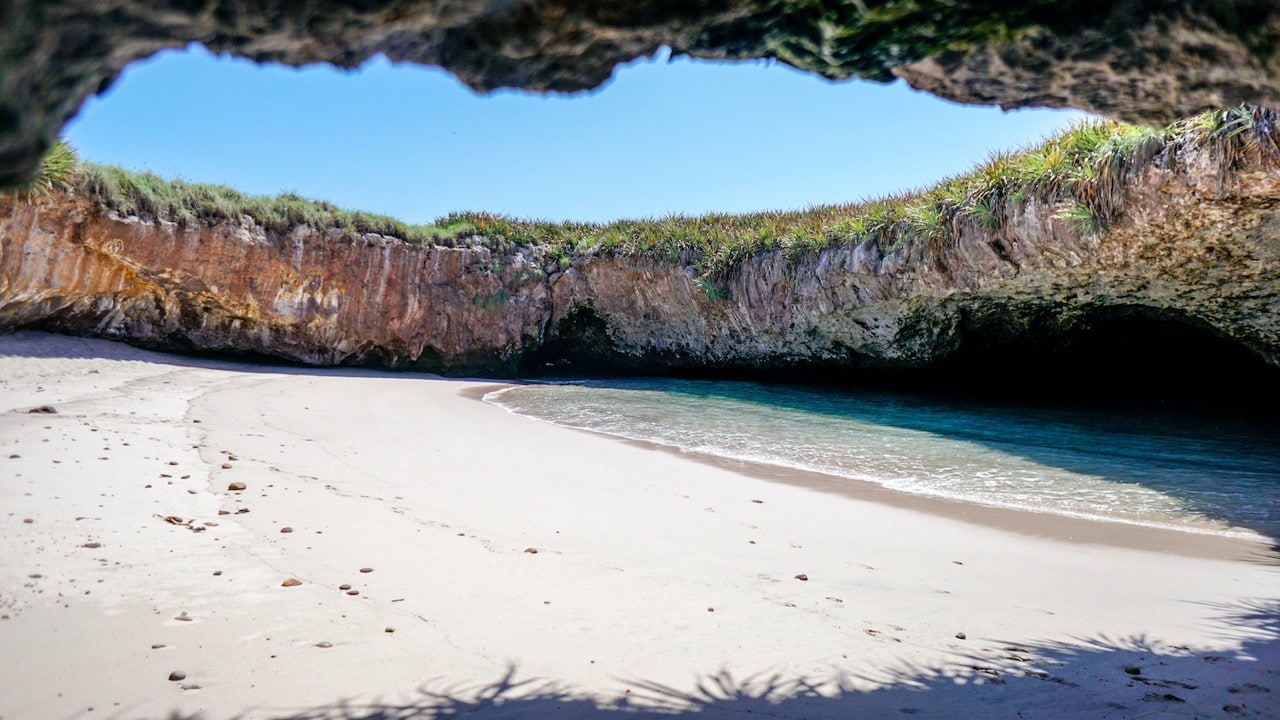
The beach occupies the floor of a collapsed crater, open to the sky through a circular break in the rock, accessible from the ocean only through a tunnel that disappears at high tide. Swimming through it, with the light dying as you go and the current pushing wherever it chooses, and then emerging into that white amphitheater of stone and turquoise water, is an experience that lands differently than most travel experiences do. It doesn’t feel like arriving at a destination. It feels like finding something.
The Mexican government, having used the islands as a military target range in the early twentieth century and thereby inadvertently contributed to the crater’s formation, eventually declared them a National Park in 2005. In 2008, the islands received designation as a UNESCO Biosphere Reserve. When social media arrived and the visitor numbers followed, the coral reefs began to show the strain. In 2012, the authorities closed the beach entirely for six months of restoration. It reopened under conditions that have held since: a daily limit of 116 people, strict rules, and a patrol of park rangers who treat the ecosystem as the primary client.
On the Nature of Access
The islands are closed entirely on Mondays. On Tuesdays, boats may visit, but the Hidden Beach itself remains off-limits. On the days it does open, 116 permits are distributed; the limit was introduced after the 2012 closure and has not changed. Tours sell out weeks in advance during high season. Book early, and confirm that your operator’s permit specifically includes the beach landing, as many island tours do not.
A government park fee of approximately six US dollars is collected at the marina, separate from tour costs. The Hidden Beach permit adds three to five dollars more, usually bundled into the tour price. Guided group tours run between eighty and one hundred fifty dollars per person from most departure points; private charters, for groups who prefer the islands to themselves, range considerably higher.
Most tours depart from Punta de Mita, the nearest point on the mainland at eight kilometers by sea, roughly fifteen minutes by motorboat. Sayulita and Bucerías offer departures of thirty to forty minutes. Tours leaving from Puerto Vallarta, an hour and a half out, are full-day affairs, which is not without its pleasures: more water, more whales in season, more time for the islands to materialize from the horizon in the way that islands do when you’ve waited for them.
The beach cannot be entered by boat. Once your vessel reaches the island’s perimeter, you enter the water, life jacket and helmet already secured, and swim approximately fifteen meters through a rock tunnel that grows darker as you go. The current is variable. The experience is physical and a little vertiginous, and that tension, the small surrender required, is part of what makes arriving on the other side feel earned rather than delivered.
What the Park Requires — Rules Without Exception
- Life Jackets: Mandatory at all times in the water, which also prevents freediving and protects the reef from unintended contact.
- Helmets: Required for the tunnel swim through the rock passage to the beach.
- Age Restrictions: Children under 6 and adults over 65 are not permitted on the Hidden Beach. Pregnant women are also excluded under park regulation.
- No Fins: Banned throughout the park to protect coral reefs from contact damage.
- No Sunscreen: Chemical sunscreens damage coral. Wear a UV-rated rash guard instead; apply any sunscreen well before boarding so it absorbs into skin before the water.
- No Snorkeling, No Alcohol, No Plastic: Snorkeling and freediving are prohibited near the beach. Alcohol and single-use plastics are banned across the entire park.
The tide governs everything. If it is too high, the tunnel closes and the beach with it, regardless of permits held or mornings rearranged. Your guide will know before you leave the dock whether conditions allow entry. This uncertainty, which can feel like injustice in the moment, is in fact the point: the beach survives because it is not always available, and there is something quietly instructive in that.
Daily Limit: 116 permits to the beach itself
Closed Days: Mon & Tue beach closed Tue; all islands Mon
Best Season: Nov – May calmer seas, peak visibility
Time on Beach: 20–30 min enforced by park rangers
If the Tunnel is Closed
Playa Nopalera, on the far side of Isla Larga, offers the same volcanic scenery, the same improbable blue water, the same sense of having arrived somewhere that does not know or care about the mainland’s priorities. It requires no tunnel, no permit, no particular bravery. On some days it might be the better choice anyway.
On Packing for the Beach
You will be swimming to wherever you want to bring. A floating waterproof phone pouch is the practical solution for photography. Leave the backpack on the boat; there is nowhere to put it and the rangers will ask you to return it anyway. Bring cash for the marina fees, your government ID, and perhaps the willingness to leave the phone in the bag for at least a few of the twenty or thirty minutes you’ll have there. The beach tends to hold attention better than any screen.
The Galápagos of Mexico
The islands support ninety-two species of birds, the largest laughing gull colony in Mexico, seventy-eight hectares of coral reef, and a marine environment of such density that the comparison to Ecuador’s famous archipelago is not as hyperbolic as it first sounds. Keep your eyes open throughout the boat ride. The show begins well before you reach the islands.
Blue-Footed Booby – Sula nebouxii
The bird that has become shorthand for the islands, those turquoise feet unmistakable from a distance, used in elaborate mating dances that are simultaneously absurd and entirely compelling to watch. The Marietas host one of the only significant nesting colonies outside the Galápagos, which is in part why the visitor limits exist: the birds were here long before the tour boats.
Sea Turtles & Giant Manta Rays – Chelonia mydas & Manta birostris
The water around the islands is clear enough that large animals appear as shadows before you can identify them. Giant mantas cruise the shallows in a manner that suggests purposeful flight rather than swimming. Sea turtles surface with a deliberateness that makes you feel watched. The reef itself, twelve coral species hosting over a hundred and fifteen species of fish, is visible from above the waterline in the shallows near Playa Nopalera.
Humpback Whales – Megaptera novaeangliae (December through March)
They arrive from Alaska each winter, the same individual animals returning year after year to the same warm water to breed and nurse their calves. A humpback breaching against the green sierra is the signature image of Nayarit in season, and the boat ride to the Marietas Islands during these months tends to produce exactly that, often several times over, often with dolphins playing alongside the hull in what looks like sheer enthusiasm for being alive.
Magnificent Frigatebird & Seabirds – Fregata magnificens
Frigatebirds circle the islands with a patience that feels geological. Brown pelicans dive with a violence that seems incompatible with the grace of their glide. The islands support nesting and breeding for dozens of species, which is why going inland is forbidden: the birds require the undisturbed interior to sustain the populations that make the Marietas what they are.