



Every year, Mobile World Congress serves as a proving ground for the companies that build the fundamental components most consumers never think about. The displays. The panels. The micro-engineered layers of glass, organic compounds, and transistors that mediate every interaction between a person and their device. This year, TCL CSOT arrived in Barcelona not with incremental refinements but with a cluster of technologies that, taken together, represent a meaningful leap forward in how mobile and portable displays are designed, manufactured, and experienced.
Under the theme “Super Pixel Beyond Limits,” TCL CSOT unveiled its proprietary Super Pixel technology, a sweeping range of Inkjet-Printed OLED (IJP OLED) advancements spanning form factors from 5.65 inches to 28 inches, and a full portfolio of next-generation displays organized under its APEX innovation philosophy. The scope of what the company showed in Barcelona is broad enough to warrant a careful, category-by-category examination.
The APEX Framework: Engineering With Purpose
Before diving into individual products, it is worth understanding the organizing philosophy that TCL CSOT says guides all of its development work. The company calls it APEX, an acronym that maps to four pillars: Amazing Display Experience, Protective of Eye Health, Eco-Friendly to Build and Use, and X-Unlimited Imaginative Potential.
The framing is intentional. Rather than competing purely on peak specifications, a race that has produced diminishing returns for consumers, TCL CSOT is positioning its engineering decisions around what it calls human-centric benefits. Jun Zhao, Senior Vice President of TCL Technology and CEO of TCL CSOT, articulated this directly at the event: “The APEX philosophy is our compass, guiding us to create visually stunning, healthier, more sustainable technologies. Advancements like Super Pixel and IJP OLED aren’t just single-component improvements; they represent a fundamental shift toward manufacturing stunning, flexible, and efficient displays.”
Whether a philosophy translates into real product outcomes is always a fair question. In TCL CSOT’s case at MWC 2026, the answer appears to be yes, at least at the prototype and early production level. Nearly every display shown in Barcelona can be traced back to one or more of those four pillars in a technically meaningful way.
Super Pixel: Re-Engineering the Pixel Arrangement Itself
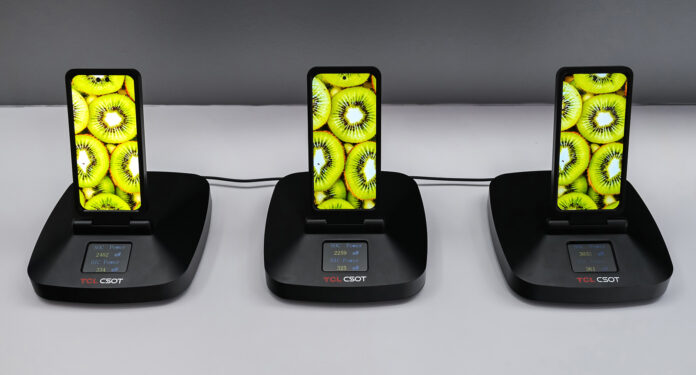
The headline technology at TCL CSOT’s MWC 2026 exhibit is Super Pixel, a self-developed approach that fundamentally re-engineers how pixels are arranged on a display panel rather than simply increasing raw pixel count or driving current harder through conventional subpixels. The results, across three distinct 6.9-inch mobile panel variants, are notable in three separate dimensions: clarity, power efficiency, and refresh rate.
World’s First Super Pixel High-Clarity Mobile Display (6.9″)
The clarity-focused variant achieves a resolution of 1200 by 2608 with a pixel density of 420 PPI on a 6.9-inch panel. The Super Pixel arrangement increases effective subpixel density by approximately 1.8 percent compared to conventional layouts, which produces sharper images, crisper text rendering, and finer texture detail without requiring a brute-force increase in total pixel count. The panel is built on an 8T LTPO backplane and incorporates Full In Active Area (FIAA) technology, which enables ultra-narrow bezels measuring 0.5mm at the top and 0.8mm on the sides. The adaptive brightness range runs from 1 to 2000 nits, giving the panel flexibility across indoor and outdoor environments.
World’s Lowest-Power Consumption Super Pixel Mobile Display (6.9″)
The efficiency-focused variant integrates the same Super Pixel high-pixel-density architecture with an 8T LTPO ultra-low-power backplane design. The combination delivers a 420 PPI display that supports intelligent adaptive refresh rates between 1Hz and 120Hz, alongside pixel-level dynamic dimming. Compared to conventional solutions, this architecture reduces IC power consumption by 10 percent and SOC power consumption by 25 percent. FIAA fine-pitch interlaced array technology and high-efficiency optimization allow the panel to maintain a peak brightness of 2000 nits while significantly extending device battery life at equivalent usage intensity. The practical implication is a display that delivers ultra-high-definition visuals without the battery penalty that typically accompanies them.
World’s First Super Pixel High Refresh Rate Mobile Display (6.9″)
The refresh-rate-focused variant combines Super Pixel ultra-high pixel density with a 165Hz refresh rate, achieving a resolution of 1156 by 2510 and 420 PPI extreme definition on the same 6.9-inch form factor. Against conventional 120Hz displays, TCL CSOT reports a 40 percent improvement in dynamic image smoothness, translating directly into tear-free, blur-free high-speed motion rendering for gaming applications. The panel uses a 7T LTPS architecture and supports intelligent refresh rate adjustment between 60Hz and 165Hz to balance performance and power draw. Leveraging FIAA fine-pitch technology, the left and right bezels are reduced to just 0.75mm and the bottom bezel to 0.79mm. High Brightness Mode peaks at 2000 nits, and Average Picture Level peak brightness reaches 3200 nits, keeping visuals clear and dynamic even under strong ambient light.
Across all three Super Pixel variants, the underlying innovation is the same: by rethinking pixel geometry rather than simply scaling up or down conventional arrangements, TCL CSOT has been able to push three different performance dimensions simultaneously without each improvement cannibalizing the others.
Inkjet-Printed OLED: The Manufacturing Revolution Behind the Display Revolution
If Super Pixel is TCL CSOT’s most visible product story at MWC 2026, Inkjet-Printed OLED is arguably its most strategically significant. IJP OLED represents a fundamentally different way of manufacturing OLED panels, one that simplifies production, reduces material waste, lowers manufacturing costs, and enables performance characteristics that are difficult to achieve through conventional vacuum deposition methods.
TCL CSOT has been working on IJP OLED for over a decade, and the company reinforced its commitment last year by beginning construction of the world’s first 8.6-generation IJP OLED production line, known internally as t8. What MWC 2026 shows is what that investment is now capable of producing.
World’s First Ultra-Thin Rigid IJP OLED Notebook Display (14″)
The most striking physical demonstration of IJP OLED’s manufacturing advantages is a 14-inch notebook display that measures less than 0.77mm in thickness and weighs under 77 grams. To put those numbers in context: this panel is 50 percent lighter than conventional display alternatives of equivalent size. The panel is rigid rather than flexible, which matters for notebook applications where structural stability is essential, and the combination of rigidity and extreme thinness has been achieved through breakthrough innovations in panel construction enabled by the inkjet printing process. The tactile and visual result is a display component that eliminates the heavy, substantial feel of standard displays entirely, offering what TCL CSOT describes as a light-as-air experience.
World’s First Foldable and Portable IJP OLED Monitor Display (28″)
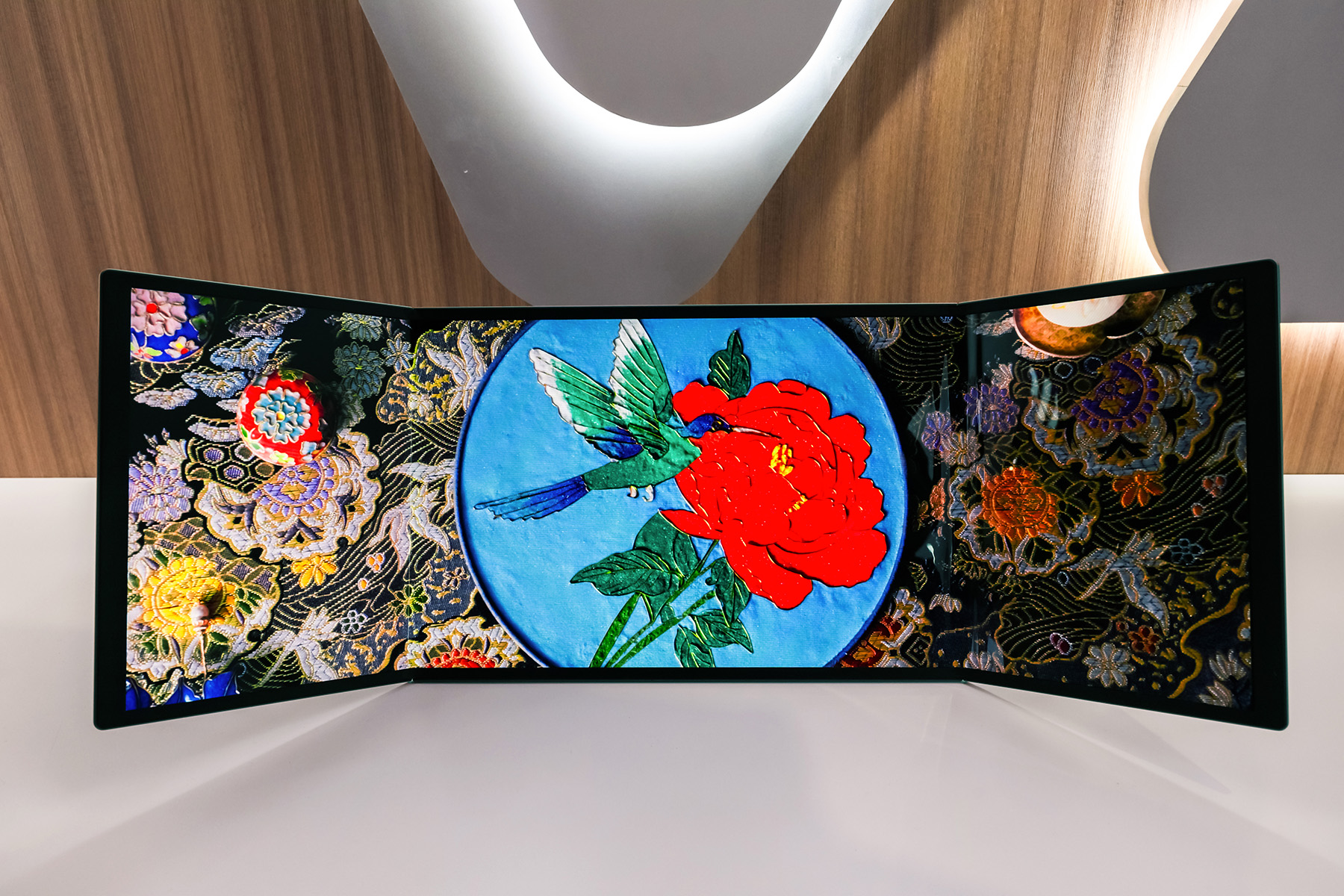
The 28-inch foldable IJP OLED monitor is perhaps the most architecturally ambitious product at the entire MWC 2026 exhibit. It uses a tri-fold design to transform a compact 16-inch device, comparable in footprint to a standard laptop, into a 28-inch ultra-wide immersive screen. The panel achieves an unfolded thickness of just 4.48mm and a folding radius of 1.8mm, which are exceptionally tight tolerances for a display of this size. Central to the mechanical design is the world’s largest waterdrop hinge, which enables seamless transitions between horizontal, vertical, and folded operating modes, as well as multi-angle hovering at various positions between fully open and closed. An integrated rear stand provides stable placement on flat surfaces. The practical use case is clear: a truly portable large-format display that can travel in a bag and deploy as a full ultra-wide workspace wherever needed.
World’s First Real Stripe RGB IJP OLED Mobile Display (5.65″)
The small-format IJP OLED demonstration is technically the most nuanced of the three. TCL CSOT has achieved a 5.65-inch display with a Real Stripe RGB pixel arrangement, enabled by continuous advances in high-precision OLED printing technology. The result is a 390 PPI native resolution, with a visually equivalent diamond-like pixel arrangement that reaches 490 PPI, surpassing current mainstream flagship mobile displays. Real Stripe RGB is significant because it is the premium pixel arrangement in display engineering, delivering the most accurate color reproduction and the finest text rendering, but it has historically been difficult to achieve at competitive pixel densities using inkjet printing. Achieving it at 390 PPI in a smartphone-sized panel signals that TCL CSOT’s IJP OLED manufacturing capability has crossed an important threshold. The company explicitly frames this as a demonstration of its ability to manufacture high-end IJP OLED products across small, medium, and large formats simultaneously, marking what it calls a shift from technological leadership to ecosystem leadership.
The APEX Portfolio: Displays Across Every Performance Dimension
Beyond Super Pixel and IJP OLED, TCL CSOT showed an extensive portfolio of displays aligned to the four APEX pillars. The breadth of the lineup illustrates that the company is not a single-product company but a display technology platform operating across virtually every screen category.
World’s First Narrowest-Bezel OLED Tablet Display (13.2″)
TCL CSOT has developed and begun mass production of a 13.2-inch OLED tablet display with uniform 1.3mm bezels on all four sides. The panel uses a 3:2 aspect ratio and delivers 3.1K resolution at 3120 by 2080 pixels, achieving a 97 percent screen-to-body ratio that is exceptional for a device in this size category. The backplane uses 8T LTPS architecture with adaptive refresh rates between 30Hz and 120Hz. The driver architecture employs a dual Driver IC cascading solution, which reduces system cost compared to conventional TCON and source driver architectures while maintaining performance.
World’s First MP Tandem LTPO Flexible Notebook Display (18″)
This self-developed 18-inch mid-size display combines LTPO and Tandem technologies in a foldable panel designed to function as either an ultra-portable tablet or a laptop screen. A carbon fiber support structure reduces screen weight by more than 25 percent compared to conventional products. Peak brightness exceeds 1600 nits, power consumption is over 25 percent lower than standard OLED displays, and the panel offers a service life more than three times longer than conventional OLED alternatives. The Tandem light-emitting structure is key here: by stacking multiple emitting layers, the display achieves higher brightness and longer lifetime without the aggressive driving currents that degrade conventional OLEDs prematurely.
World’s Brightest OLED Mobile Display (6.9″)
The brightest OLED mobile display ever shown by TCL CSOT features a 6.9-inch panel with 1.5K resolution at 1224 by 2992 pixels. By integrating PLP 4.0 technology, Tandem display architecture, and an advanced optical tuning solution, the panel reaches a record-breaking peak brightness of 15,000 nits with minimal chromatic shift, alongside exceptional transmittance and luminous efficiency. At 15,000 nits, this display remains vividly readable in direct sunlight, a condition that typically washes out conventional mobile displays even at their maximum brightness settings.
World’s Narrowest Border Foldable OLED Mobile Display (6.73″)
This 6.73-inch foldable display combines the flexible form-factor advantages of folding technology with an extremely narrow border design, expanding the screen-to-body ratio while adapting to multiple physical configurations. The engineering balance required to achieve a narrow bezel on a panel that must also fold without mechanical failure represents a significant manufacturing challenge that this panel navigates successfully.
Protective of Eye Health
World’s First Natural-Light-Certified OLED Mobile Display (6.9″)
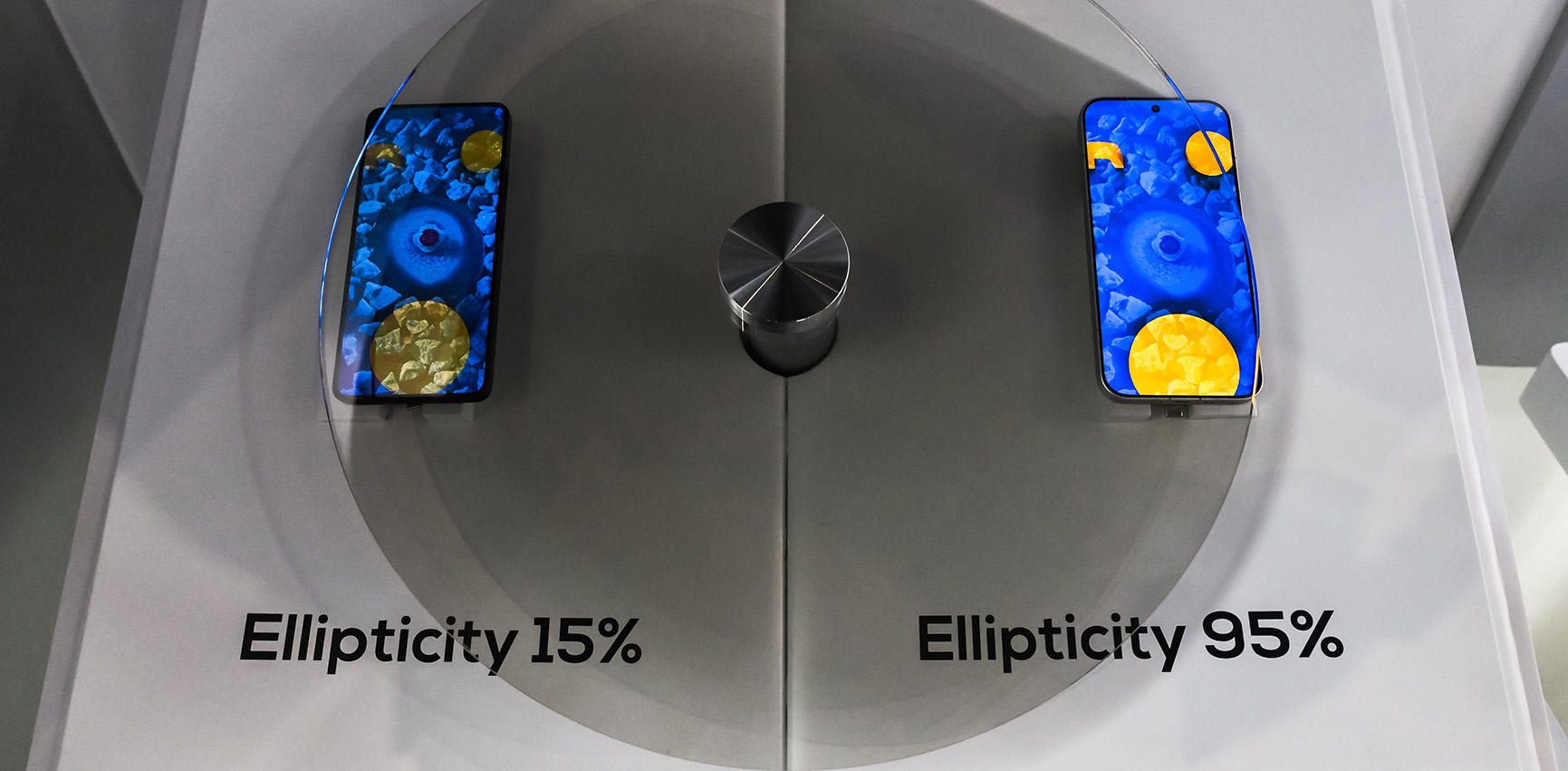
TCL CSOT has independently developed its second-generation circular polarizer technology, achieving an ellipticity of over 95 percent at the 550nm wavelength. In practical terms, this means the display produces polarized light that more closely mimics the behavior of natural diffuse light rather than the single-direction polarization typical of conventional OLED panels. The technology effectively suppresses screen glare while significantly enhancing contrast. Colors appear more vivid and images more layered. The display remains clearly visible even under strong outdoor lighting conditions and when viewed through polarized sunglasses, a combination that has historically defeated many OLED panels entirely. The reduction in single-direction light stimulation minimizes visual fatigue during extended use sessions, whether working, reading, or watching video content.
3.2K Nano-Level Soft Light OLED Tablet Display (14″)
This 14-inch tablet panel delivers 3.2K resolution with a screen reflectance below 3 percent, meaning it remains sharp and visually transparent even in bright ambient environments. A sparkle value below 3, combined with the self-luminous characteristics of OLED, produces soft, low-stimulation light output that the panel positions as hardware-level eye protection. The balance between premium visual performance and professional eye-care properties is targeted specifically at users who spend extended hours in front of their screens.
World’s Narrowest Border Soft-Light OLED Tablet Display (8.8″)
This 8.8-inch display is positioned as the world’s first mass-producible OLED mini-pad with both an ultra-narrow bezel and an ultra-slim design. The pixel density is 343 PPI. The cover glass incorporates three simultaneous optical treatments: anti-glare, anti-reflection, and eye-comfort properties, described collectively as 3A soft-light cover glass. Bezel measurements of 1.15mm on the sides, 0.95mm at the top, and 2.05mm at the bottom enable a screen-to-body ratio of up to 92 percent. Optimized module materials and structural design achieve a total panel thickness of just 5.1mm.
Low-Reflection Low-Power Consumption OLED Mobile Display (6.9″)
This is the world’s first low-reflectance, low-power consumption display to use a Polarizer-Less Process (PLP) FFM architecture. High-transmittance color-filter materials and an innovative panel design reduce panel power consumption by up to 30 percent. Anti-reflection cover glass with a novel micro-structured surface reduces overall screen reflectance to 3 percent, while seamlessly integrating the infrared touch area and the active display area into a visually uniform pure-black appearance. Wide color gamut coverage delivers a rich, true-to-life visual experience.
World’s Lowest-Power Consumption OLED Mobile Display (6.9″)
This panel integrates a tandem light-emitting structure with Polarizer-Less Process technology to achieve a 45 percent reduction in panel power consumption. The 1224 by 2992 resolution display supports an adaptive 1 to 144Hz refresh rate with zone-based frequency adjustment. An innovative microstructure design creates a seamless, uniform pure-black appearance, eliminating the visual distinction between the infrared touch area and the active display area. Wide color gamut coverage rounds out the picture quality. The 45 percent power reduction figure is particularly striking: for a smartphone display that is often one of the largest single contributors to device battery drain, that kind of reduction has meaningful real-world battery life implications.
World’s First Partitioned Frequency Division OLED Tablet Display (13.2″)
This 13.2-inch tablet panel is the world’s first medium-sized narrow-bezel OLED display with regional and multi-frequency refresh capabilities. Uniform 1.7mm bezels on all four sides, a 3:2 aspect ratio, and 3.1K resolution at 3120 by 2080 pixels combine to deliver a 96 percent screen-to-body ratio. The panel is built on an 8T LTPO backplane architecture and supports adaptive refresh rates from 1Hz to 120Hz, with the notable innovation being that different screen regions can simultaneously operate at different refresh rates. A user could have a browser window refreshing at 60Hz, a static document refreshing at 1Hz, and a video playing at 120Hz, all on the same screen simultaneously. This dynamic zone-based adjustment reduces logic power consumption by 15 to 25 percent.
Mixed Reality Display (2.56″)
The Pico 4 VR headset is equipped with a 2.56-inch, 1200 PPI mixed reality display from TCL CSOT. The display powers a dual 4K-plus ultra-clear screen configuration combined with a 105-degree ultra-wide field of view. The headset also features binocular 32-megapixel color perspective cameras that achieve millimeter-level spatial positioning, enabling precise and unbiased fusion of real and virtual environments for immersive gaming and extended reality applications.
World’s Smallest Si-Micro LED Display (0.05″)
The smallest display TCL CSOT has ever produced measures just 0.05 inches, making it suitable for compact, lightweight AR glasses. Despite this near-invisible form factor, the panel achieves a pixel density of 5080 PPI and a peak brightness exceeding 4 million nits, which is required to remain visible in outdoor sunlight. Resolution is 256 by 86 pixels. The pixel pitch is just 5 micrometers. The panel uses a single-color green configuration, which is standard practice for waveguide-based AR display systems where color separation and recombination are handled optically rather than at the pixel level. A low-power CMOS driving backplane keeps total power consumption below 10mW, which is critical for extending the battery life of AR glasses where battery capacity is severely constrained by weight requirements.
What This All Means
TCL CSOT’s MWC 2026 exhibit is notable for the simultaneous breadth and depth of the innovations on display. Most companies at a trade show of this scale show one or two headline products and fill the rest of their booth with iterations on existing work. TCL CSOT showed genuinely new technologies across mobile, tablet, notebook, monitor, VR, and AR categories in a single event.
Several themes emerge from looking across the full portfolio. First, the company is clearly betting heavily on IJP OLED as a manufacturing platform, not just a research project. The construction of the world’s first 8.6-generation IJP OLED production line, combined with world-first IJP OLED demonstrations across three completely different form factors at MWC 2026, signals the technology is moving from lab to factory at scale.
Second, the power efficiency story is increasingly central to TCL CSOT’s positioning. Multiple products across multiple categories now achieve 25 to 45 percent reductions in power consumption compared to conventional alternatives, driven by a combination of Polarizer-Less Process technology, Tandem light-emitting structures, LTPO backplanes, and intelligent refresh rate management. As devices become thinner and battery capacities are constrained by physical dimensions, display power efficiency is becoming a competitive differentiator at the system level.
Third, the eye health and comfort work, particularly the natural-light-certified circular polarizer display, represents a direction that mainstream display engineering has historically underinvested in. As more people spend more hours in front of screens, displays that genuinely reduce visual fatigue rather than simply claiming to do so through software filters represent genuine product differentiation.
The APEX philosophy may read like marketing language on first encounter. Looking at the technical specifics of what TCL CSOT brought to Barcelona, however, it holds up as an accurate description of where the company is directing its engineering resources. Whether these technologies reach consumers at scale in the near term will depend on manufacturing yield, cost curves, and the decisions of the device makers that source panels from TCL CSOT. But as a statement of technical ambition and capability, MWC 2026 was a significant moment for one of the display industry’s most consequential suppliers.
Discover more from SNAP TASTE
Subscribe to get the latest posts sent to your email.