


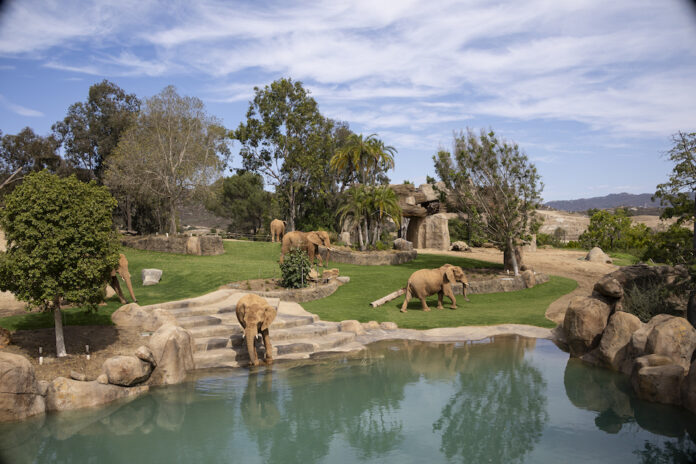

The San Diego Zoo Safari Park has officially opened its newest attraction, Denny Sanford Elephant Valley, giving visitors a new way to experience African savanna elephants up close while learning about global wildlife conservation.
The highly anticipated habitat debuted with a special ceremony featuring leaders from the San Diego Zoo Wildlife Alliance and local officials including Todd Gloria and Marni van Wilpert. Community leaders such as Dane White also attended the opening celebration.
A New Elephant Habitat in San Diego
Elephant Valley was designed to immerse guests in the world of African savanna elephants while inspiring a deeper appreciation for the species and its conservation. Visitors walking through the expansive habitat will find themselves surrounded by elephants on multiple sides, creating a rare opportunity to observe the world’s largest land mammal from unique vantage points.
Guests strolling alongside the herd can notice details like the elephants’ wrinkled skin, long eyelashes and powerful movements while learning about their intelligence and complex social bonds. One of the most memorable features is a bridge that crosses the valley, where visitors walk directly above an elephant underpass modeled after wildlife corridors used in natural habitats.
Shawn Dixon, president and chief executive officer of the San Diego Zoo Wildlife Alliance, said the new space reflects the organization’s long term commitment to conservation. He noted that meaningful conservation success is built through years of research, collaboration and dedication, and that Elephant Valley represents both the African grasslands and the global conservation work supported by the organization.
Meet the Safari Park’s Elephant Herd
The Safari Park’s African elephant herd includes eight individuals: matriarch Swazi, along with Ndlulamitsi known as Ndlula, Umngani, Qinisa called Nisa, Phakamile known as Kami, Khosi, Mkhaya and Umzula Zuli.
The herd’s founding members, Swazi, Ndlula and Umngani, were rescued in 2003. Today, they live together in a social structure that reflects the natural family dynamics found in wild elephant herds.
Elephant Valley offers visitors a chance to learn how elephants shape their ecosystems as “ecosystem engineers,” from clearing vegetation to creating water access points that benefit other wildlife.
Dining With a View at Mkutano House
At the center of Elephant Valley is Mkutano House, a two story restaurant inspired by culinary traditions from across Africa blended with global flavors. The name comes from the Swahili word mkutano, meaning a gathering with purpose.
The restaurant overlooks one of the habitat’s two large watering holes, a 240,000 gallon oasis where the elephant herd wades, swims and socializes. Watching the elephants interact near the water offers visitors a memorable look at their natural behaviors and strong social bonds.
Nearby, Mkutano Park provides an interactive space where educators share stories about African wildlife and conservation efforts.
Pat McTigue, interim executive director of the Safari Park, said the new space celebrates both wildlife and community. He explained that Elephant Valley invites visitors to experience the wonders of nature together while encouraging people to protect wildlife and natural habitats for future generations.
Celebrating Culture and Conservation
Elephant Valley also highlights the cultures and communities of Kenya, where people and elephants coexist. Colorful talking sticks featuring traditional Samburu beadwork appear throughout the area as storytelling markers.
Inside Mkutano House, visitors can see handcrafted pieces created by artisans from BeadWORKS Kenya. The partnership helps women in seminomadic pastoralist communities earn income through traditional beading skills passed down through generations.
The habitat’s landscaping also reflects African ecosystems. More than 350 individual plants were grown for Elephant Valley, including rare and endangered species that recreate the look, scent and atmosphere of African savannas and grasslands.
Supporting Elephant Conservation Worldwide
Elephant Valley connects the conservation work happening in San Diego with global initiatives supported by the San Diego Zoo Wildlife Alliance across Africa.
African savanna elephants are currently listed as endangered on the International Union for Conservation of Nature Red List of Threatened Species. One of the biggest threats to the species is increasing human elephant conflict as human communities expand into elephant habitats.
Research conducted both in Africa and with the Safari Park herd helps scientists develop new strategies and technologies to monitor elephant health, understand their social behaviors and improve protection efforts in the wild.
A New Family Experience at the Safari Park
The new Elephant Valley habitat was made possible by more than 5,200 donors, including a lead gift from philanthropist Denny Sanford.
Located in Escondido, the San Diego Zoo Safari Park spans 1,800 acres and is home to more than 3,000 animals representing over 290 species. The park offers immersive wildlife experiences for visitors of all ages, and Elephant Valley is now included with regular park admission.
For families planning a visit, the new habitat offers a memorable way to see elephants up close while learning about the importance of protecting wildlife and the natural world.
Discover more from SNAP TASTE
Subscribe to get the latest posts sent to your email.