
HomeNewsTechnologyPorsche Leverages Cutting-Edge Mixed Reality in Product Demonstrations

Porsche Leverages Cutting-Edge Mixed Reality in Product Demonstrations

follow us on Google News

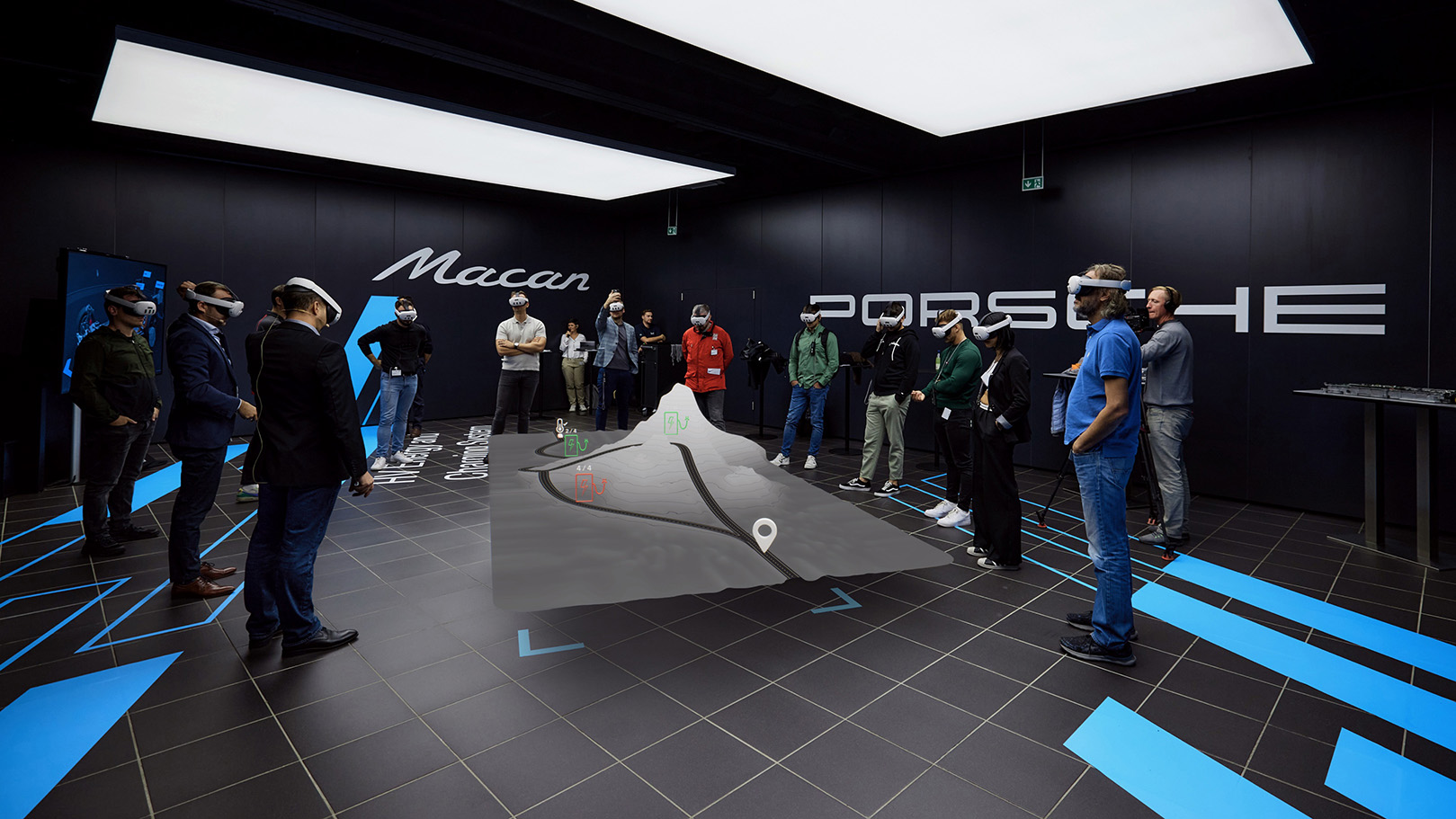
Porsche is embracing cutting-edge mixed-reality and spatial computing technology to bring a new kind of immersive experience to product demonstrations and technical briefings for the media. Attendees at a recent Technology Workshop focused on the new all-electric Macan found themselves in what seemed like a sci-fi movie set or futuristic art installation. Wearing the latest Meta Quest 3 headsets, groups of engineers and media moved with unexpected grace, engaging in activities that resembled a tai chi group doing an improv class.
- Advertisement -
Porsche Leverages Cutting-Edge Mixed Reality in Product Demonstrations

In the past, media event presentations typically involved journalists taking notes while engineers clicked through numerous PowerPoint slides. This traditional format is now being challenged by Porsche’s use of mixed-reality (MR) technology. A few years ago, the Taycan AR Event App showcased how augmented reality could reveal the in-depth engineering details of the Taycan using just an iPhone.

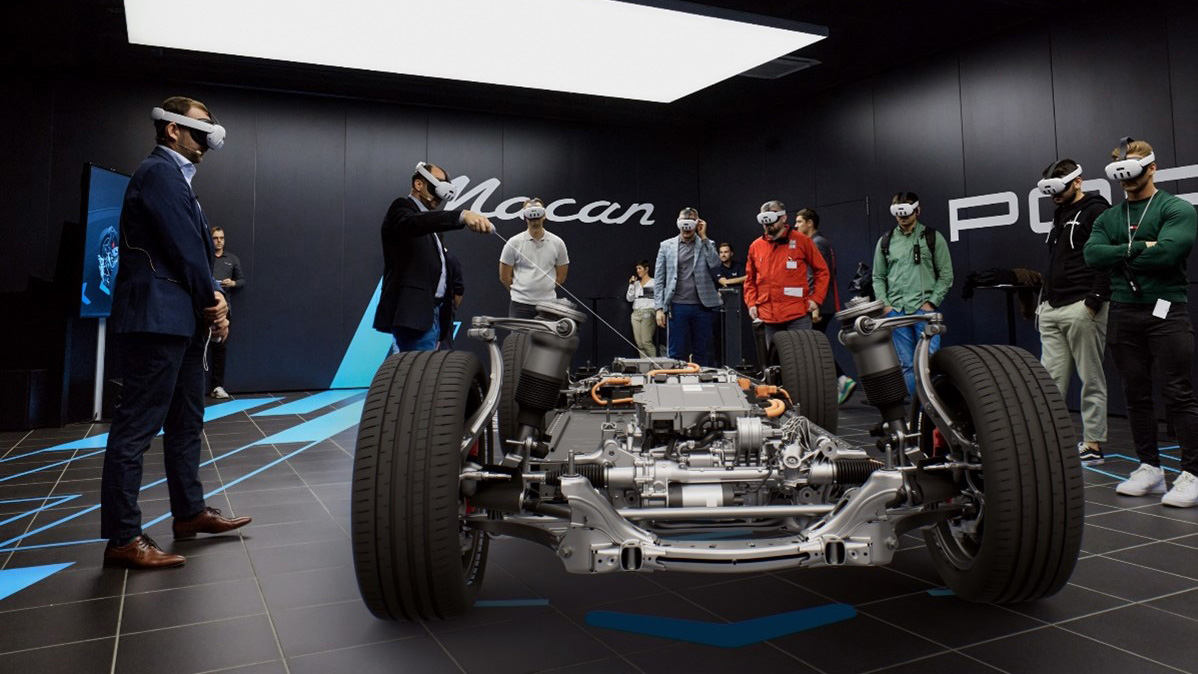
Now, Porsche is taking it a step further with mixed-reality technology, creating a three-dimensional environment where users can move around and interact with virtual objects. This technology allows users to see their real surroundings while also interacting with virtual 3D assets, providing VR levels of immersion while maintaining awareness of the physical space around them.
Porsche Leverages Cutting-Edge Mixed Reality in Product Demonstrations

This application of MR is particularly advantageous as it eliminates the need for physical cut-away models or other assets to be manufactured and shipped globally, potentially saving costs and resources. While physical props are valuable tools for explaining technical features, 3D models in MR offer greater maneuverability within the viewing space. Users can view virtual models from different angles, gaining a deeper understanding more quickly than traditional methods. This approach combines the detail of a technical slideshow with the impact of a physical exhibit, providing a more meaningful and insightful experience for the viewer.

Leave a Reply

More to Explore

Blender 5.1: The Precision Refinement Every Designer Needs

Released on March 17, 2026, Blender 5.1 arrives not as a radical departure, but as a masterclass in refinement. While version 5.0 was the...

How to Set Up Firefox’s New Free Built-in VPN and Use Native Split View

Digital privacy often feels like a full-time job, requiring users to juggle various extensions and subscriptions just to keep their personal data from leaking...

OpenAI Shuts Down Sora as Disney’s $1 Billion Deal Collapses

The sudden closure of OpenAI's AI video platform marks one of the most dramatic reversals in the brief history of generative AI, and leaves...

Sony’s Tokyo Studio Is Where the Future of Filmmaking Gets Made

Sony is bringing its global media production hub network to Japan, opening the Digital Media Production Center Japan (DMPC Japan) inside the company's Group...

Anthropic’s Claude Cowork Lets You Assign AI Tasks From Your Phone and Walk Away

Artificial intelligence is getting better at doing things. The harder challenge has always been getting it to do things without you watching. Anthropic's Claude...

NVIDIA’s Dynamo 1.0 Is Free, Open Source Software That Makes AI Inference Up to 7x Faster

Running AI models at scale is harder than it looks. Training a model is a one-time investment. Inference, the process of actually using that...

Adobe and NVIDIA Are Teaming Up to Reinvent Creative and Marketing Workflows With AI

Two of the most influential companies in creative technology are deepening a partnership that goes back more than two decades. Adobe and NVIDIA have...

NVIDIA Is Trying to Become the Default Platform for Every Kind of Robot

Jensen Huang has a bold prediction: every industrial company will become a robotics company. Whether or not that timeline plays out exactly as he...

NVIDIA and T-Mobile Want to Turn the 5G Network Into a Distributed AI Computer

Most conversations about AI infrastructure focus on data centers, the massive facilities packed with GPU racks that train and run the world's most powerful...

BYD, Nissan, Geely and More Are Building Self-Driving Cars on NVIDIA’s Platform — and Robotaxis Are Coming to Uber by 2027

Self-driving vehicles have been a promise for a long time. The technology has advanced significantly, but wide-scale deployment has remained perpetually just around the...

NVIDIA Wants to Be the Platform That Powers Every Enterprise AI Agent

Autonomous AI agents are moving from experiment to enterprise infrastructure faster than most organizations anticipated. The question is no longer whether companies will deploy...

NVIDIA Is Building a Coalition of AI Labs to Develop Open Frontier Models Together

The race to build the most powerful AI models has largely been a competition, with labs guarding their research, their data, and their techniques...

NVIDIA Is Releasing a Wave of Open AI Models Covering Everything From Robot Brains to Drug Discovery

NVIDIA does not just make chips. It has spent years building a parallel business in AI software and open models, and at GTC this...

NVIDIA’s NemoClaw Brings Security and Privacy to OpenClaw’s Fast-Growing AI Agent Platform

AI agents are getting good enough to actually be useful, and that is precisely when the uncomfortable questions start. If a piece of software...

NVIDIA Is Taking Its AI Chips to Space — Here’s What That Actually Means

NVIDIA has spent the last several years building the infrastructure that powers AI on Earth. Now it is setting its sights considerably higher. The...

Recommended for You

You Might Also Like