



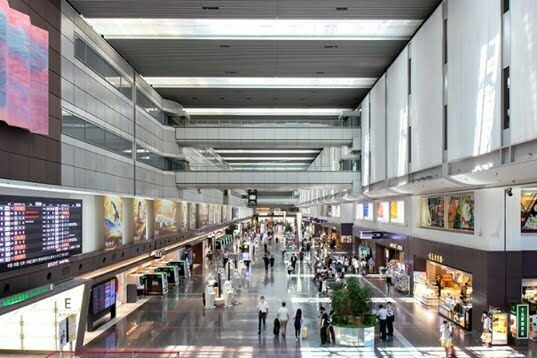
Haneda Airport, one of the largest airports in Japan, has been highly acclaimed in various rankings regarding usability and comfort of airports around the world and welcomed many tourists to Japan and also Tokyo in 2019, with the worldʼs 5th largest number of passengers arriving at and departing.
As of August 2021, two WHILL stations are implemented and working inside Haneda Airportʼs Terminal 1 and Terminal 2, respectively. The final goal is to have eight stations, four in each of the Terminals 1 and 2, with three WHILL devices per station for a total of twenty-four devices. While they currently sport a simple, Japanese-only interface with a limited number of destinations, the number of languages and destinations available can be easily increased and customized. Furthermore, application to Terminal 3 (International Terminal) is to be considered in collaboration with international airlines in the future.
The WHILL Autonomous Mobility Service looks like a common wheelchair, but it is completely automatic and moves without the need for any airport staff, carrying people to various destinations within the airport. This is the worldʼs first implementation of autopilot personal mobility services at airports.
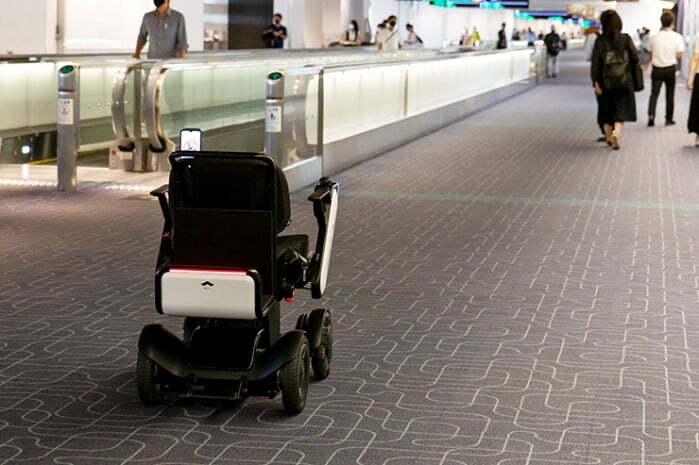
The WHILL Autonomous Mobility Service can be used by anyone free of charge. WHILL stations are located in several places inside the airport, such as near the entrance to the gates area after the security check. The station is unmanned, with instruction signs (currently in Japanese and English). To use the Autonomous Mobility Service, the user just sits on one of the chairs, which also have a baggage slot on the back. The integrated tablet prompts the user to choose one of the available destinations. Once the destination is entered, a countdown starts and the WHILL sets in motion. The user can stop the ride at any time by simply tapping the “pause” icon on the screen, and resume whenever they want. Once arrived at the destination, WHILL can be left where it is and it will automatically return itself to its designated station. The user can also pause and dismount before arriving at the destination, and leave WHILL to return itself to the station.
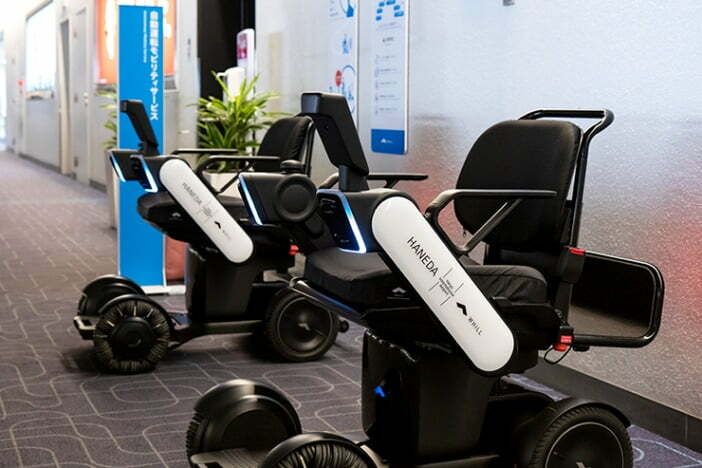
WHILL is equipped with sensors to recognize obstacles in its path, and it automatically stops if it detects something or someone in front of it. Once the way is clear, it automatically resumes its course. Its main target are people with reduced mobility and disabilities, but it is available for anyone to use. Compared to the traditional wheelchair, WHILL minimizes contact with airport staff, making it a preferable solution to manned services. Some users might also feel more comfortable with a fully automatic system that does not require them to ask for help.
Haneda Robotics Lab is working on a number of other useful services, some of which are already available inside the airport, including information robots, cleaning robots, and a face mask with incorporated translation features.

