



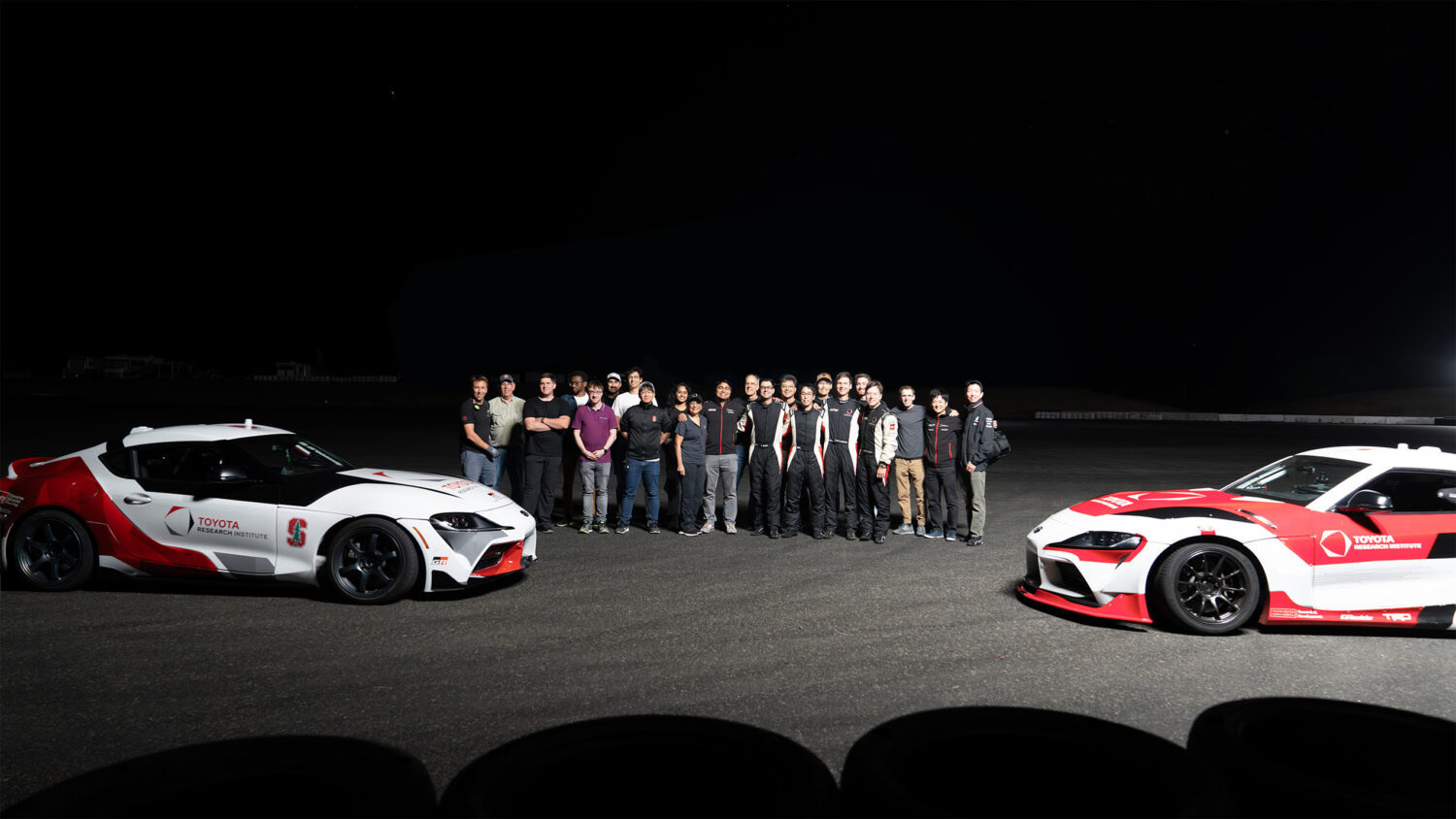
Today marked a groundbreaking achievement in driving research as the Toyota Research Institute (TRI) and Stanford Engineering unveiled a world first: the autonomous drifting of two cars in tandem.
For nearly seven years, these teams have collaborated on pioneering research aimed at enhancing driving safety. Their experiments focus on automating a complex motorsports maneuver known as “drifting,” where a driver skillfully controls a vehicle’s direction after losing traction by spinning the rear tires. This technique has practical applications for recovering from slides on snow or ice. By introducing a second car to drift in tandem, the researchers have closely simulated real-world dynamic conditions where vehicles must rapidly respond to other cars, pedestrians, and cyclists.
“The physics of drifting are actually akin to what a car might encounter on snow or ice,” explained Chris Gerdes, a professor of mechanical engineering and co-director of the Center for Automotive Research at Stanford (CARS). “Insights from this autonomous drifting project have already contributed to new methods for safely controlling automated vehicles on ice.”
In these autonomous tandem drifting sequences, two vehicles—a lead car and a chase car—navigate a course within inches of each other, operating at the edge of control. The team’s advanced AI techniques include a neural network tire model that allows the system to learn from experience, similar to an expert driver.
“The track conditions can change significantly within minutes as the sun sets,” Gerdes noted. “The AI developed for this project learns from every track session to handle such variations.”
With car crashes causing over 40,000 fatalities annually in the US and approximately 1.35 million worldwide, many of these incidents result from a loss of vehicle control in sudden, dynamic situations. Autonomous driving technology holds significant promise for helping drivers react correctly.
“When a car begins to skid or slide, drivers depend entirely on their skills to avoid collisions with other vehicles, trees, or obstacles. Most drivers struggle in these extreme scenarios, where a split second can be the difference between life and death,” added Balachandran. “This new technology can activate precisely in time to safeguard a driver, managing loss of control just as an expert drifter would.”
“Achieving what has never been done before truly demonstrates what is possible,” Gerdes concluded. “If we can accomplish this, imagine the potential advancements we can make to improve car safety.”
Technical Details
Experiments were conducted at Thunderhill Raceway Park in Willows, California, using two modified GR Supras: Algorithms on the lead car were developed at TRI, while Stanford engineers developed those on the chase car.
TRI focused on developing robust and stable control mechanisms for the lead car, allowing it to make repeatable, safe lead runs. Stanford Engineering developed AI vehicle models and algorithms enabling the chase car to dynamically adapt to the motion of the lead car, ensuring it can drift alongside without colliding.
GReddy and Toyota Racing Development (TRD) modified each car’s suspension, engine, transmission, and safety systems (e.g., roll cage, fire suppression). Though subtly different from each other, the vehicles were built to the same specifications used in Formula Drift competitions to help the teams collect data with expert drivers in a controlled environment. Both are equipped with computers and sensors that control their steering, throttle, and brakes while also sensing their motion (e.g., position, velocity, and rotation rate).
Crucially, they share a dedicated WiFi network that allows them to communicate in real time by exchanging information such as their relative positions and planned trajectories. To achieve autonomous tandem drifting, the vehicles must continually plan their steering, throttle, and brake commands and the trajectory they intend to follow using a technique called Nonlinear Model Predictive Control (NMPC).
In NMPC, each vehicle starts with objectives, represented mathematically as rules or constraints that it must obey. The lead vehicle’s objective is to sustain a drift along a desired path while remaining subject to the constraints of the laws of physics and hardware limits like maximum steering angle. The chase vehicle’s objective is to drift alongside the lead vehicle while proactively avoiding a collision. Each vehicle then solves and re-solves an optimization problem up to 50 times per second to decide what steering, throttle, and brake commands best meet its objectives while responding to rapidly changing conditions.
By leveraging AI to constantly train the neural network using data from previous tests, the vehicles improve with every trip to the track.