



There is a moment, specific to the French Riviera and to nowhere else, when the season turns. The light shifts first, softening against the ochre facades, making them glow rather than simply stand. Then the scent arrives, that particular marriage of brine and stone and something older underneath. And then, as if on cue, the houses open.
Two of them open this spring with particular significance. La Ponche returns to its cobblestoned corner of Saint-Tropez on March 26. The Beach Hotel reappears on its Cap d’Antibes promontory on April 2. Neither announcement reads like news, exactly. It reads more like a reassurance: that some things continue, that the Riviera still knows what it is.
La Ponche, or the Art of Not Trying
To arrive at La Ponche is to feel, briefly, that you have found something the rest of the world has not. There is no grand entrance. No doorman in ceremonial dress, no lobby engineered to overwhelm. A narrow alley, a door, and then the hotel, nestled into the fabric of the old village as though it grew there, which in a sense it did. Since 1938, the house has operated on the conviction that discretion is its own form of luxury. There was never a guestbook. There never needed to be.
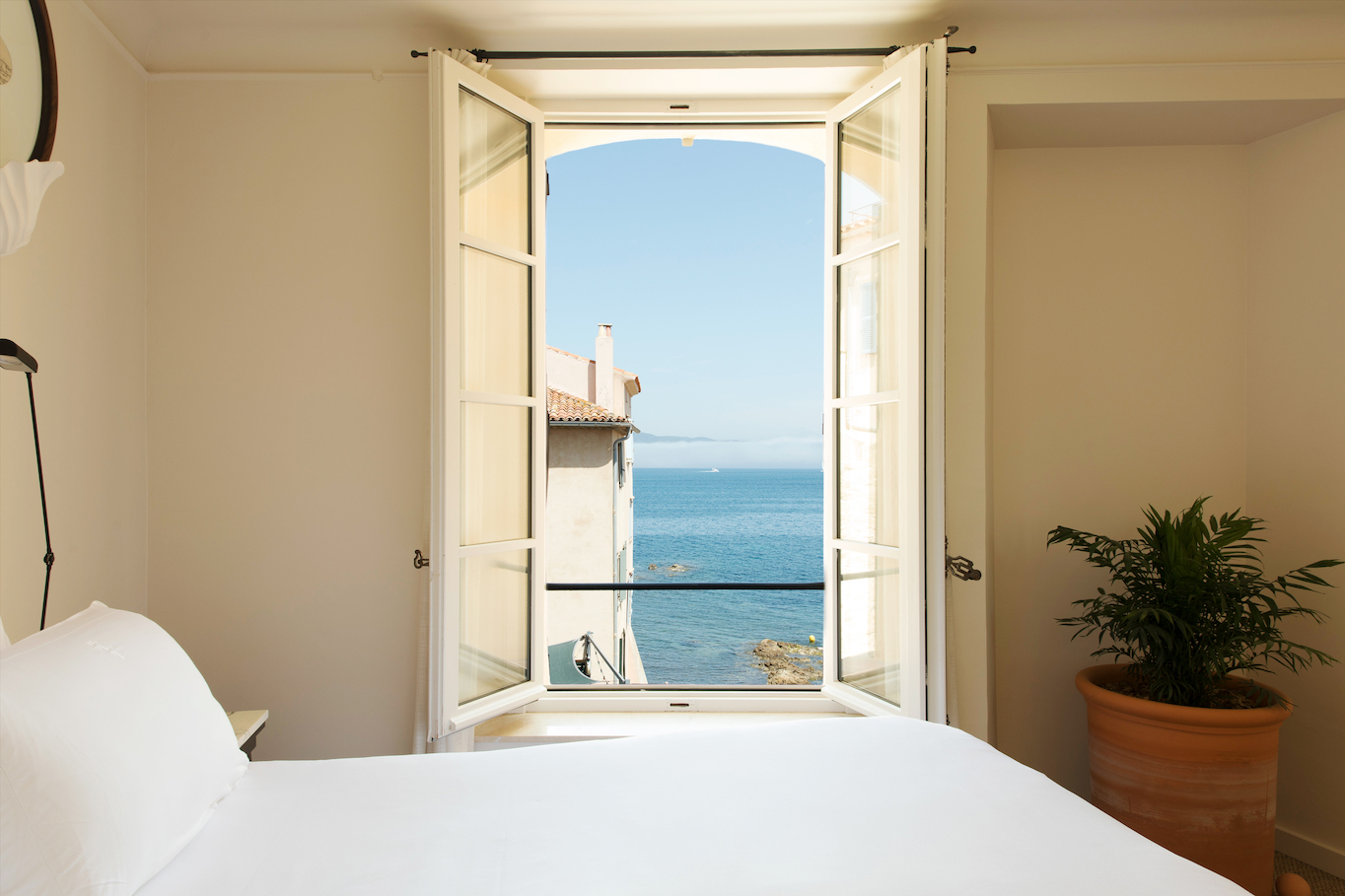
What the house collected instead was a different kind of record, the kind that lives in the air of a room, in the particular creak of a stair. Simone Duckstein, who grew up within these walls, remembers guests arriving from the Train Bleu in Saint-Raphaël, sleepy-eyed and expectant, drawn to Saint-Tropez because it was, as she put it, “a little paradise.” They were met with hot coffee and toast. Françoise Sagan arrived in a Jaguar. The Bardot-Vadim romance unraveled here, under Michel Trintignant’s gaze, during the filming of “And God Created Woman.” Boris Vian slipped behind the bar between trumpet notes to pour drinks for Daniel Gélin, Michel Piccoli, and Sartre. From room 19, Sagan wrote the lines the house has kept ever since: “I opened the shutters, and the sea and the sky threw the same blue, the same pink, the same happiness at my face.”
The rooms still carry those names, those histories. Each dark walnut door is its own address. Room 8, Romy Schneider and Daniel Biasini’s room, sits on the top floor, its terrace suspended over the bell tower and the rooftops and the sea, as generous in proportion as the view it commands. Room 1 was Bardot and Gunter Sachs. Room 20, Bernard Buffet and Annabel. Guests returned not because they were loyal to a season, but because they were loyal to a room number, and to whatever a room number, in a place like this, comes to mean.
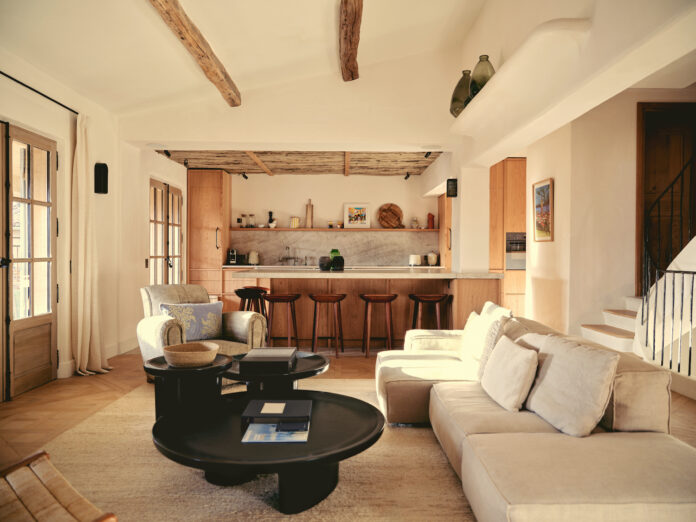
When Fabrizio Casiraghi approached the 2021 renovation, he began not with a brief but with a story: a man in his forties who inherits his grandmother’s house. Not a hotel. A home. He sourced objects, armchairs, and lighting fixtures the way one does when the goal is comfort rather than statement: terracotta tiles, Persian rugs in the hallways, Picasso lithographs near the entrance, round walnut mirrors that recall the wheel of a ship. Nothing announces itself. Everything belongs.
This season, the hotel adds the House: 240 square meters, a rooftop open to the bell tower and the Mediterranean, a long table around which people gather as though they already know each other. It is the kind of space that changes the texture of a stay, more inhabited, more private, more like the thing La Ponche has always suggested but rarely spelled out.
On the Cultural Life of a Bar
For a generation of Parisian intellectuals, Saint-Tropez was not really a beach town. It was more of an annex of Saint-Germain-des-Prés that happened to have better weather. The center of that world, more often than not, was La Ponche’s bar, a room that held the belief, and demonstrated it nightly, that celebration and thought are not in opposition. Vian poured drinks. Sartre sat nearby. The night took its time.
Something of that spirit has never fully left. Beginning May 14, every Thursday at 8 PM, Martin Brucker and Nino Martinez will revive it through vinyl and the loose, generous energy of the Roaring Twenties. The SAINT-GERMAIN evenings are less an event series than an argument: that a night worth remembering has always been possible here.
On May 29, La Ponche hosts the fifth edition of its Literary Prize, organized around a quiet but pointed conviction: there are French novels that disappear simply because they arrive too early for the major literary seasons. The jury, presided by Lisa Vignoli and including David Foenkinos, Nathalie Azoulai, Sophie Fontanel, and several others, will gather at the hotel before the winner signs their book. A spring prize, for a spring house.
What the Kitchen Knows
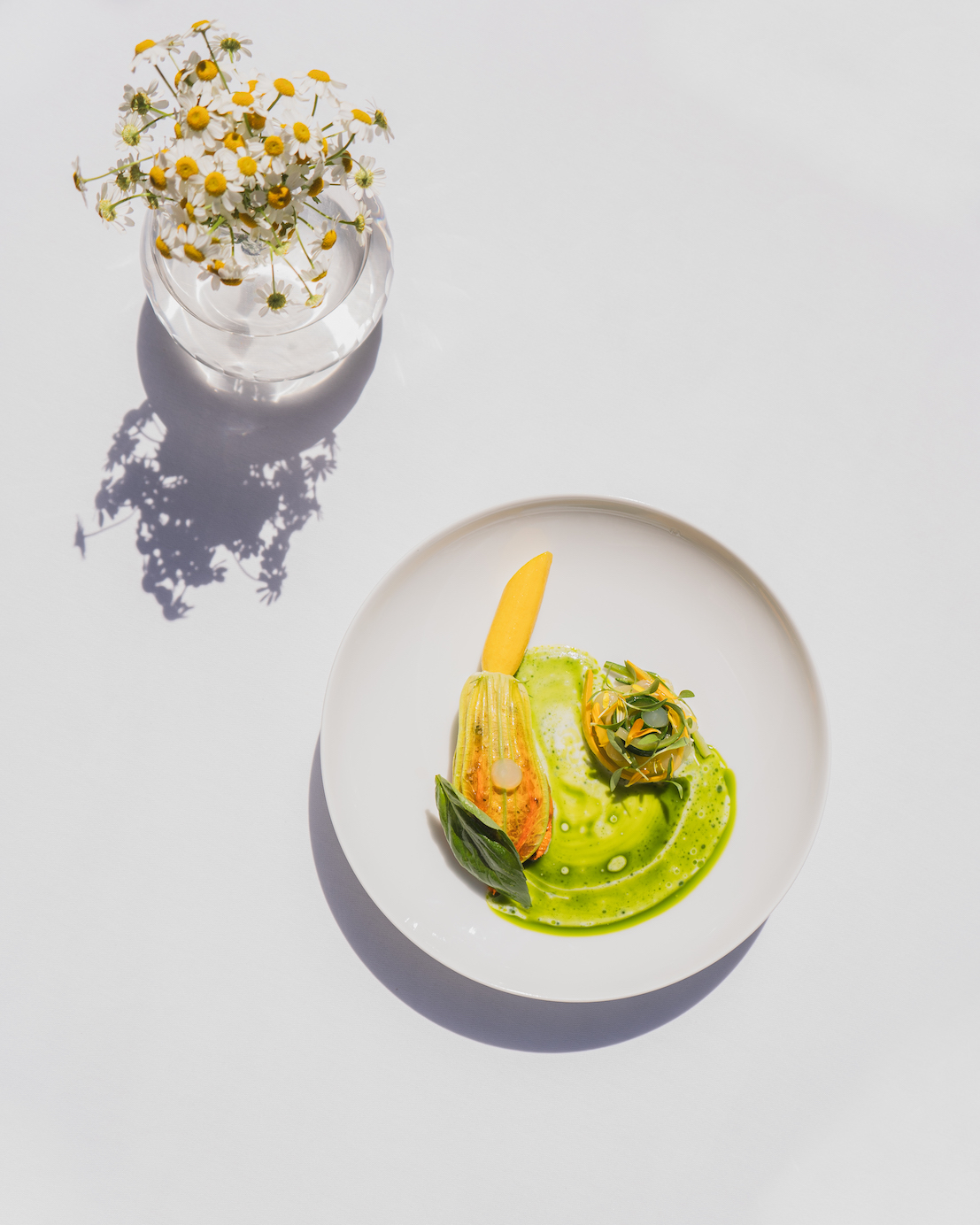
Chef Simon Pinault, who trained at Galanga de Monsieur George and helped earn its first Michelin star in 2023, has taken over the kitchens with a sensibility that feels native to this place: generous, solar, unhurried. His menu follows the Gulf of Saint-Tropez, red tuna, centrolophus, whatever the market offers that morning. The bouillabaisse returns, simmered for two, a dish that has always functioned here less as a recipe than as a ritual.
Mornings begin on the terrace facing the dock, in the particular light of the early hours. A brunch menu runs from noon to 3 PM, followed by an afternoon of orange blossom waffles and red fruits eaten slowly by the water. In the evening, the candles come out, and the flavors deepen in that way that evenings on the Riviera have always managed to deepen: unhurriedly, without announcement.
Before the village stirs, there is a quieter hour: a detox infusion taken in the still-sleeping house, then down the hotel steps, across the small pier, and out to face the sea with a yoga mat. Gentle sessions begin at 7:30 AM. This season also marks the arrival of the first PERS wellness space in any hotel, a French skincare brand born from three years of research in an aesthetic doctor’s office, built on the belief that scientific rigor and sensory pleasure are not mutually exclusive values. In November, from the 7th to the 11th, the house will host a wellness retreat conceived by Magoma and Élodie Garamond: daily yoga, body practices, and long stretches of intentional silence.
The Beach Hotel, or Light as Architecture
Cap d’Antibes does not announce itself. That is, perhaps, its defining quality. It has none of Cannes’ formal ambition, none of Saint-Tropez’s performative wildness. What it has is something harder to name: a quiet autonomy, a light that arrives at a different angle, a sense that the Mediterranean here is something to be felt rather than displayed.
Hitchcock understood it and filmed “To Catch a Thief” along these roads. Picasso returned to Antibes to find what the Mediterranean does to color and form. Nicolas de Staël stood at the edge of it and painted the moment when sun dissolves into sea. The restaurant La Maison des Pêcheurs had already been holding its corner since 1954, long before any of that became mythology. Eddy Barclay came. Bardot came. Johnny Hallyday. The cap was collecting quiet evidence of itself long before the world caught up.
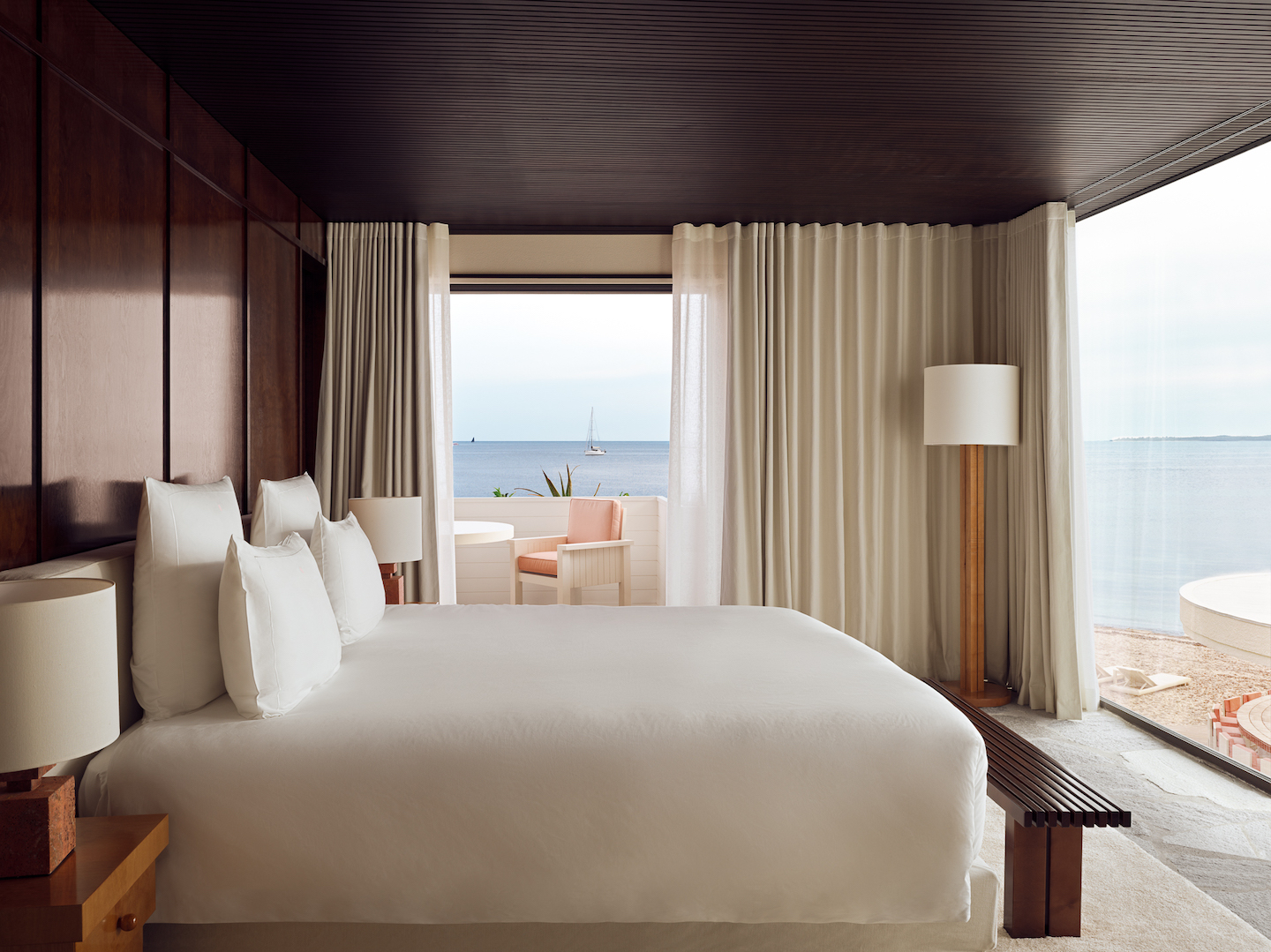
Bernard Dubois conceived the Beach Hotel the way one might approach a house in Palm Springs, if that house happened to sit above the Mediterranean. Simple geometry. Clean lines. Mineral surfaces that absorb rather than reflect. Open to the outside as a matter of principle, not design choice. Thirty-five rooms and suites, all oriented outward: below, private gardens where the sea appears between palm trees; above, the Bay of Antibes and the Lérins Islands unfolding toward the horizon. And at the apex, The Cap, 66 square meters suspended above the water, a room that functions more like a point of view than a place to sleep.
Two Tables
On the sand, BABA brings a Levantine sensibility and something close to controlled joy. Chef Assaf Granit, the culinary mind behind Shabour, Tekes, and Shana, builds meals around mezze that circulate, grills that smoke, tables designed for noise and proximity. “Ba” means to come in Hebrew, and the name carries its own logic: the point is the gathering, as much as anything on the plate. Noon to midnight, the table remains in motion.
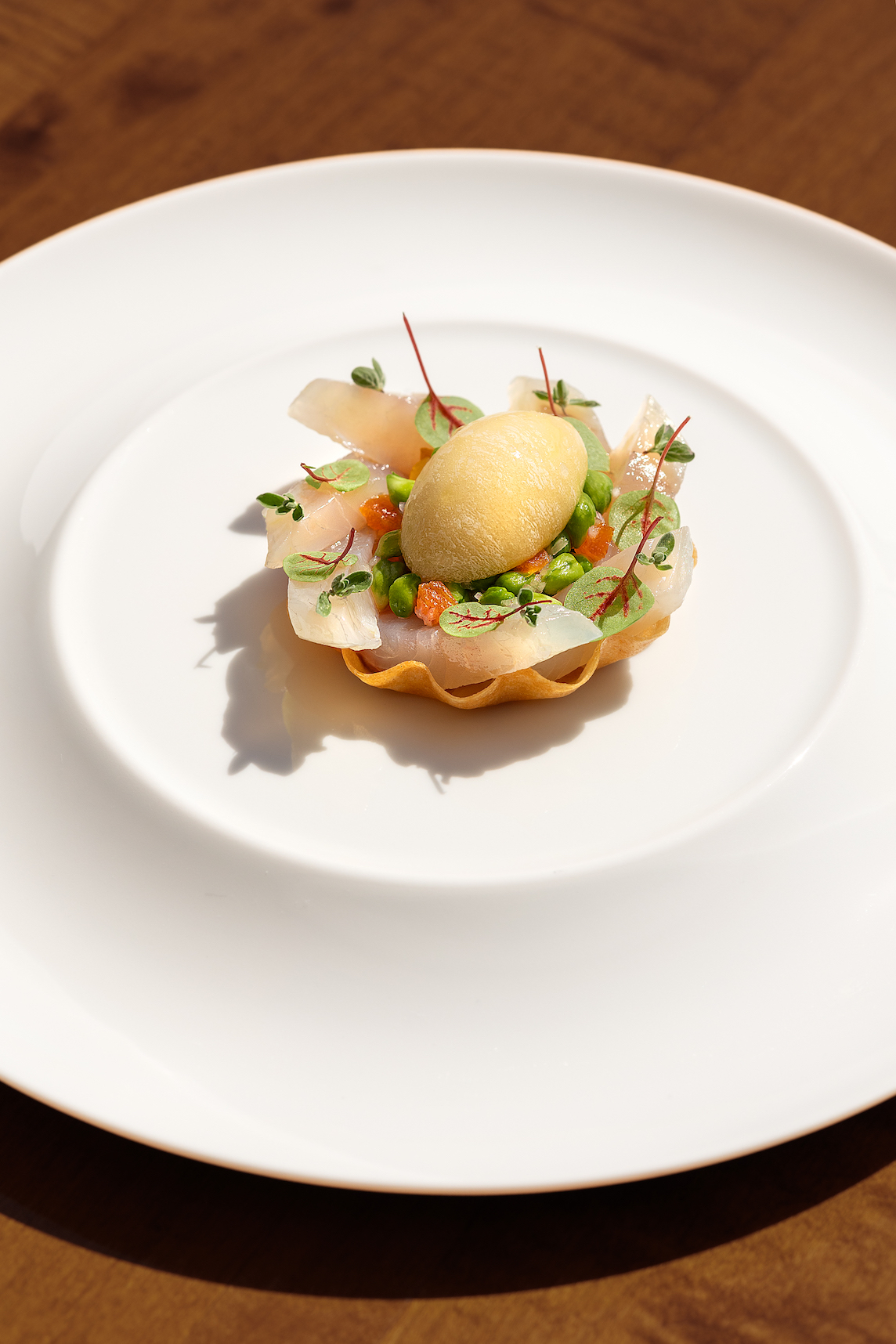
Up a mahogany staircase, in a different register entirely, Les Pêcheurs reveals itself as a room that knows what it is: bay windows on the sea, chrome columns, red travertine that grounds the whole composition. Chef Nicolas Rondelli, who grew up in Nice and trained at Negresco and Chibois, composes his menu each morning from what the fisherman at the adjacent port brings in. “I see cooking with humility,” he has said, “composing according to the sea. Like a navigator.” The Michelin Guide renewed his star on March 16, for the tenth consecutive year.
The spa this season works with Lymfea protocols and Monastery products, a botanical brand founded in San Francisco by Athena Hewett, who formulates each product by hand in her Californian laboratory. Sage, Damask rose, reishi, jasmine: no alcohol, no chemical preservatives, no unnecessary additions. The brand is still largely unknown in France, and will be discovered this season exclusively in the massage huts tucked within the hotel’s exotic garden, which feels like exactly the right introduction.
From April 19 to 22, the retreat “The Breath of Spring,” led by Élodie Garamond and Alice Dugast, will move through yoga, song, swimming, and walking, with the shared premise that spring is something worth marking on the body as much as the calendar. Along the coast, bikes are available. A pedal boat can take guests to the port at Crouton. The American brand Hartford has taken over the hotel shop with the vocabulary of a summer wardrobe assembled without effort.
What Both Houses Share
La Ponche carries the memory of a Saint-Tropez that existed before it became a symbol of itself: the bright nights, the secret winters, the particular intellectual electricity of a bar that knew how to hold a conversation. The Beach Hotel carries something else: a relationship to landscape, to wildness, to the quality of light that once made artists travel from everywhere to sit at the edge of that sea.
What they share is subtler, and more telling. Neither house reaches for impression. Neither mistakes grandeur for meaning. The luxury each offers is the kind that requires a certain fluency to recognize, found in a terrace suspended over a bell tower, in a bouillabaisse simmered for two, in a yoga mat unrolled at 7:30 in the morning while the water does its work below. The season, as it always does, begins here.
Discover more from SNAP TASTE
Subscribe to get the latest posts sent to your email.