


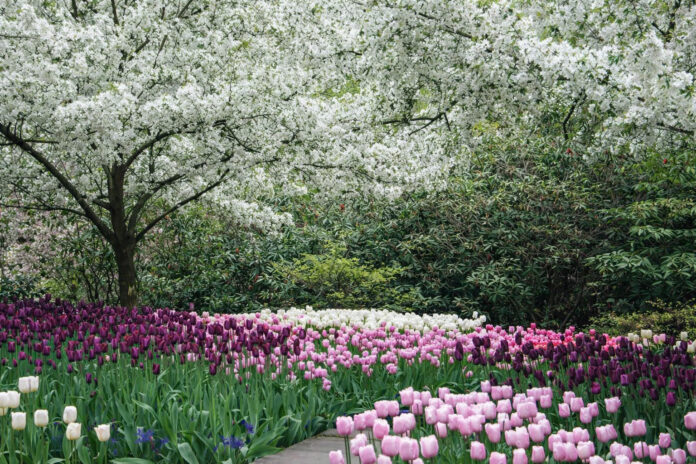

There is something irresistible about a garden glimpsed but never entered. A hedge becomes a threshold. A closed gate, a provocation. Private gardens hold their silence with the composure of old money and the allure of a well kept secret, suggesting worlds shaped not for spectacle, but for devotion.
Each year, the Garden Conservancy Open Days program quietly alters that equation. For a handful of hours on select days from spring through late autumn, some of America’s most arresting private landscapes concede their privacy. Since 1995, more than 1.5 million visitors have stepped across these thresholds, wandering through 4,500 gardens in 40 states, each one revealing not only horticultural ambition but the temperament of its maker.
In 2026, more than 350 gardens across 26 states will open between spring and November. Over 100 are new to the program this year, adding fresh voices to a national conversation about land, design, and the intimate art of cultivation. The settings vary widely: urban rooftops suspended above city rhythms, organic farms tuned to the seasons, suburban plots transformed into sculptural environments, historic estates where time feels layered rather than linear. What unites them is not scale or style, but authorship.
Connecticut: Orchestrated Landscapes and Botanical Intimacy
In Greenwich, Sleepy Cat Farm unfolds across 13 and a half acres like a carefully composed symphony. Open June 7 and August 29, it reveals itself in movements: a long reflecting pool that gathers the sky into its stillness, a pebble mosaic terrace animated by water, an expansive greenhouse humming with quiet industry, and sculptural tableaux framed by disciplined boxwood. The effect is not ostentation, but orchestration. One moves through it as through a sequence of rooms in a grand house, each calibrated for surprise.
The Avon Flower House in Avon, open August 1, feels more idiosyncratic, almost theatrical. Rare conifers and ornamentals rise from tall pedestals like actors on a stage, while exuberant annuals supply color with unapologetic flair. The three acre property is tended by its owners with a collector’s eye and a sculptor’s hand, trees coaxed into playful topiaries. Inside the 1810 home, antiques and art extend the aesthetic narrative, blurring the line between domestic and botanical curation.
In New Canaan, Ann and Haig’s Garden, open May 31, is a meditation in green. More than 120 varieties of ferns unfurl across four acres, their textures shifting from feathery to architectural. Dogwoods, viburnums, rhododendrons, and Japanese maples create a layered canopy, while hydrangeas and specimen oaks anchor the composition. Woodland ground covers form a tapestry underfoot, and a woodchip path winds gently through the landscape, as though inviting the visitor into a slower register of time.
Nomadica in Weston, open September 19, approaches the garden as living laboratory. On half an acre, beauty and biodiversity share equal billing. Production beds of flowers, vegetables, fruits, and gourds sit alongside perennials and a native mini meadow, stitched together by a stream. Beehives and chickens contribute to an ecosystem that links soil to table. Here, ecological design is not an abstraction but a daily practice, intimate in scale and quietly radical in intent.
New York: Between Formality and the Sea
In East Hampton, the gardens of Alexandra Munroe and Robert Rosenkranz, open June 27, surround a 1928 beachfront house with a studied interplay of structure and looseness. Meadows sway with perennials and grasses; cutting and cottage gardens feel painterly and abundant. A yew enclosed rose bed suggests European formality, while woodland trails planted with Asian species introduce a more contemplative register. A parterre with a croquet lawn nods to tradition, yet the kitchen terrace, opening onto vegetable and cutting gardens, keeps the composition grounded in use. The Atlantic light binds it all together.
Nearby, the Garden of Marshall Watson, also open June 27, occupies a bluff above Gardiner’s Bay. One section remains exposed to ocean winds and deer, the other partially sheltered, as though the garden were negotiating with its environment in real time. Now transitioning to organic practices, it layers holly hedges and rhododendrons with a potager, a wisteria draped carriage house, and a neoclassical gazebo. Gravel paths edged in boxwood lead to espaliered fruit trees, topiary lilacs, and a reflecting pool that mirrors the shifting sky. Versailles planters brim with roses and figs, while a sea garden of deer resistant plants acknowledges the realities of coastal life. It is at once romantic and pragmatic, a study in cultivated resilience.
Entwood Garden in Bridgehampton, begun in 1992 and open June 27, reads like a private park. Two large naturalized koi ponds shimmer beside the fairway of a par three golf hole, and an arboretum mingles with densely planted borders. Hidden recreational spaces reveal themselves gradually, rewarding those who linger. In contrast, Entwood Glade was conceived with deliberate integration in mind, weaving restored seventeenth and eighteenth century structures into a pastoral setting that feels both historical and composed.
Pennsylvania: Rooms Within a Room
Havenwood House and Gardens in Grove City, opening June 6, distills British garden romance into a one acre canvas. Developed over 12 years, it is divided into distinct outdoor rooms, each with its own mood and microclimate. Yew arches and hornbeam hedges define thresholds; a formal pool reflects disciplined geometry. A boxwood parterre converses with a meadow birch garden, while a pergola walk draped in wisteria introduces a note of softness. A fruit tunnel, rambling roses, a wildlife pond, and bog gardens planted with candelabra primula create a choreography of enclosure and release. The garden feels composed, yet intimate, as though it were confiding in the visitor.
The Midwest: Architecture as Landscape, Landscape as Room
In Detroit, the Turkel House, open June 27, represents the largest example of Frank Lloyd Wright’s Usonian Automatic style, designed in 1955. After restoring the house, the owners turned outward, embracing Wright’s conviction that the garden is the most important room of the home. Across roughly one and a half acres, meadow, woods, sculpture courtyard, and terrace form distinct yet interconnected spaces. The landscape does not decorate the architecture; it completes it, extending the house’s geometric clarity into living form.
The Sievert Garden in Waukesha, opening July 25, is an act of singular devotion. Shaped almost entirely by its owner, the one acre property is lush with shade gardens holding more than 800 hostas, their leaves ranging from inky to chartreuse. Local mosses soften stone and wood, while a water garden composed of three elements introduces sound and reflection. Japanese inspired plantings, cactus and succulent beds, a sunken garden, hillside terraces, and three stumperies unfold in succession. Salvaged bricks and cobblestones trace paths and define planters, lending the space a patina that feels earned rather than imposed.
California: Desert Poetics and Mediterranean Reverie
In Palm Springs, Villa Vecchia, open March 21, dates to 1931, a rare two story California Spanish style house once standing alone in the desert. Tamarisk trees originally served as windbreak and veil. Under the stewardship of professional landscapers, the property has undergone a multiyear transformation. Exotic and native species mingle with succulents and rare specimens including bombax, cycads, boojum, cactus, aloes, and palms. Stone sourced from nearby deserts anchors the design in place. A casita wall adorned with more than 300 ceramic plates offers a flash of whimsy, a mosaic of memory against the austere landscape.
In Pasadena, Mi Sueno del Sur Garden, open April 19, surrounds a 1916 Spanish Revival home with Mediterranean inflection. Revived after years of neglect, the garden draws inspiration from European precedents and the Getty Villa in Malibu. Olive trees, citrus, bay laurels, and Italian cypress lend structure and fragrance, while bronze and steel sculptures punctuate the plantings with gravitas. A restored reflecting pool anchors the front yard, catching the light as the day tilts toward evening. At sunset, the garden seems to exhale, its surfaces warmed to gold.
La Fleur Lochinvar Garden in San Rafael, open April 25, offers a quieter composition. Conceived as a serene counterpoint to a mid century and Scandinavian influenced home, it centers on succulents, cacti, grasses, and citrus in a restrained palette of greens, silvers, and blues. Long sliding glass doors dissolve the boundary between interior and exterior. Beyond, pine trees and the hills of China Camp State Park provide a cinematic backdrop. A cedar hot tub nestles among succulents and Euphorbia known as Sticks on Fire; a central lawn is bordered by olives, acacia, aloe, and more sculptural plantings; raised beds brim with zinnias, dahlias, vegetables, and herbs. The mood is contemplative rather than exuberant, a study in texture and restraint.
New Mexico: Alpine Drama on a Mountainside
In Santa Fe, Robin Magowan’s Rock Garden, open May 30, clings to a mountainside in a feat of botanical choreography. More than a thousand alpine species from granitic soils around the world inhabit a crevice garden shaped by stone and patience. Two mason built staircases rise through dwarf plantings set among carefully placed rocks. Tiered gardens and preserved piñon trees surround the house, leading past studios to an outcrop with expansive views. Despite minimal water, alpine transition plants thrive, as though defying the arid air.
The Art of Access
Practicalities remain discreet but essential. The 2026 Open Days gardens are listed on the Garden Conservancy website, with tickets released online roughly two months in advance, typically at the start of each month. Registration is modestly priced, with reduced rates for members, and children under 12 admitted free with an accompanying adult. All reservations are handled online.
Yet the true currency of Open Days is not efficiency, but access. To step into a private garden is to glimpse the inner life of a place and the imagination that shaped it. For a few unhurried hours, the hedges part, and what was once hidden becomes, briefly, shared.
Website: https://www.gardenconservancy.com/open-days