


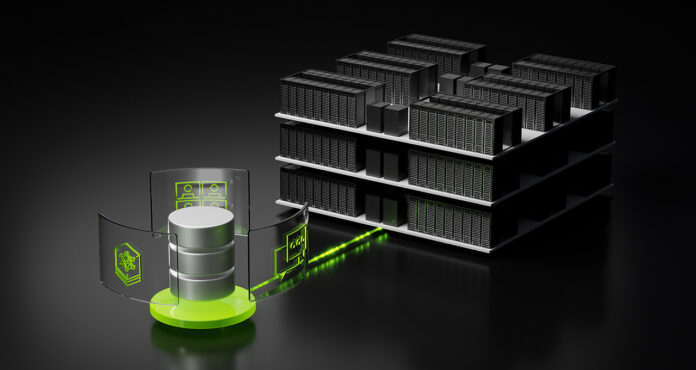

Artificial intelligence is getting harder to run. Not because the models themselves have become more difficult to build, but because the way those models are being used has fundamentally changed. Agentic AI systems, the kind that reason across long sequences of steps, maintain context across sessions, and interact with multiple tools in real time, place demands on infrastructure that traditional data center storage was never designed to meet. NVIDIA has announced BlueField-4 STX, a modular reference architecture intended to close that gap by rethinking how storage fits into the modern AI factory.
The Problem With Traditional Storage
Conventional data center storage was built for a world where applications retrieved data in relatively predictable patterns, processed it, and moved on. It is optimized for capacity and general-purpose throughput, qualities that served most enterprise workloads well for decades. Agentic AI breaks those assumptions entirely.
When an AI agent is working through a complex multi-step task, it needs continuous, low-latency access to a large and constantly evolving pool of contextual information. This includes the history of the current conversation, the results of prior reasoning steps, retrieved documents, and intermediate outputs from tool calls. All of that data must be available immediately and consistently, because any delay in retrieving context slows the agent down, makes its responses less coherent, and reduces the utilization of the expensive GPU infrastructure doing the actual inference.
As context windows grow longer and agents take on more complex workflows, traditional storage architectures and the data paths they rely on become a genuine bottleneck. GPU utilization drops, throughput falls, and the economics of running large-scale agentic systems deteriorate. NVIDIA designed STX specifically to address this problem by creating a storage tier that is native to AI workloads rather than adapted from general-purpose enterprise infrastructure.
What BlueField-4 STX Actually Is
STX is a modular reference architecture that gives enterprises, cloud providers, and AI service operators a standardized blueprint for deploying accelerated storage infrastructure purpose-built for agentic AI. The first rack-scale implementation built on this architecture is the NVIDIA CMX context memory storage platform, which extends GPU memory with a high-performance context layer designed for scalable inference and agentic systems.
The performance numbers NVIDIA cites are substantial. STX delivers up to five times higher token throughput compared with traditional storage, achieves four times greater energy efficiency compared with conventional CPU-based high-performance storage architectures, and enables two times faster data ingestion, measured in pages per second, for enterprise AI data pipelines.
At the hardware level, STX is powered by a new storage-optimized version of the NVIDIA BlueField-4 processor, which combines the NVIDIA Vera CPU with the NVIDIA ConnectX-9 SuperNIC in a single integrated chip. The architecture is completed by NVIDIA Spectrum-X Ethernet networking, which handles the high-bandwidth connectivity requirements of rack-scale storage, alongside NVIDIA DOCA and NVIDIA AI Enterprise software layers that manage and orchestrate the full system.
The platform is accelerated by and designed to operate within the broader NVIDIA Vera Rubin ecosystem, which means it integrates naturally with the compute and networking infrastructure that AI factories are already being built around. STX is not a standalone storage appliance but a coordinated component of a larger system architecture, which is central to how NVIDIA is thinking about infrastructure at this scale.
A New Software Layer for Context Memory
One of the key software components enabling STX performance is NVIDIA DOCA Memos, a new framework within the DOCA software stack that dedicates BlueField-4 processing capacity specifically to key-value cache storage operations. KV cache data is generated continuously during AI inference, particularly during multi-turn interactions where the model must retain and access a growing record of context across each step of a conversation or task.
By offloading KV cache storage processing from general-purpose compute resources to dedicated BlueField-4 infrastructure, DOCA Memos frees up GPU capacity for the actual work of inference while also reducing the latency of context retrieval. The result is faster and more consistent multi-turn interactions, more scalable agentic services, and higher overall utilization of the infrastructure investment. For organizations running AI services at meaningful scale, each of those outcomes has a direct impact on operating costs and user experience.
Who Is Building on STX
The breadth of the partner ecosystem that has already aligned around STX reflects how widely the storage bottleneck is recognized across the industry.
Storage providers and established infrastructure manufacturers codesigning next-generation AI storage systems based on STX include Cloudian, DDN, Dell Technologies, Everpure, Hitachi Vantara, HPE, IBM, MinIO, NetApp, Nutanix, VAST Data, and WEKA. These are companies with deep experience building enterprise storage infrastructure, and their involvement signals that STX is being treated as a serious architectural foundation rather than a niche accelerator.
On the manufacturing side, AIC, Supermicro, and Quanta Cloud Technology are building STX-based systems. Their participation accelerates the path to broad availability by giving the market a range of hardware options built on the same reference design.
Early adopters planning to deploy STX for context memory storage include CoreWeave, Crusoe, IREN, Lambda, Mistral AI, Nebius, Oracle Cloud Infrastructure, and Vultr. These organizations represent some of the most active operators of large-scale AI infrastructure today, and their early commitment to STX provides real-world validation of the architecture at a time when agentic workloads are growing rapidly.
Why This Matters Beyond the Data Center
The announcement of STX reflects something larger than a product refresh in the storage category. It represents a recognition that the infrastructure stack for AI needs to be rethought at every layer, not just at the level of compute. Chips and racks have received the bulk of attention as AI has scaled, and for good reason. But as the complexity of AI workloads increases, the supporting systems around compute, including networking, memory, and storage, become equally critical to system-level performance.
Jensen Huang, founder and CEO of NVIDIA, framed the challenge in straightforward terms at the announcement, noting that AI systems that reason across massive context and continuously learn require a new class of storage, and that STX is intended to provide a modular foundation for AI-native infrastructure that keeps AI factories operating at peak performance.
That framing is telling. The term AI factory has become central to how NVIDIA describes modern AI infrastructure, and it implies a level of integration and coordination across all components that general-purpose data center thinking does not support. STX is another piece of that factory being designed from the ground up for AI rather than retrofitted to accommodate it.
Availability
STX-based platforms from storage providers and manufacturing partners are expected to be available in the second half of this year. Given the scale of ecosystem support already in place, deployment across cloud providers and enterprise environments is likely to follow quickly once hardware reaches market.
For organizations building or scaling agentic AI infrastructure today, the arrival of STX offers a clearer path to resolving one of the most persistent and underappreciated constraints in modern AI deployment. Getting context retrieval right, at scale and at speed, is not a secondary concern for agentic systems. It is foundational to making those systems work the way they are supposed to. STX is NVIDIA’s answer to that challenge, and the strength of the ecosystem forming around it suggests the industry agrees it is an answer worth building on.
Discover more from SNAP TASTE
Subscribe to get the latest posts sent to your email.