


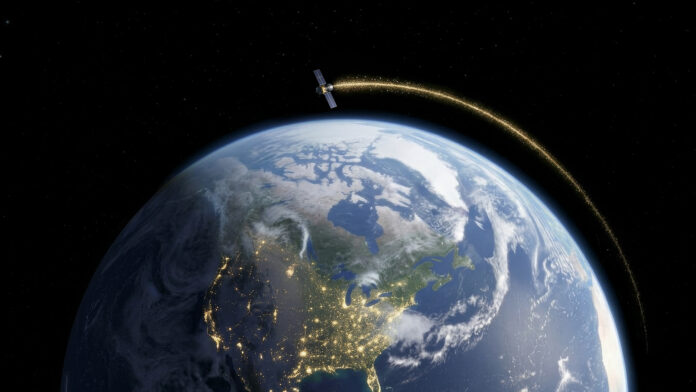

NVIDIA has spent the last several years building the infrastructure that powers AI on Earth. Now it is setting its sights considerably higher. The company has announced a new line of space-optimized computing platforms designed to bring data-center-class AI performance into orbit, opening up a new category it is calling space computing.
The announcement covers several products targeting different parts of the space computing problem, from high-powered orbital data centers to compact satellite-mounted processors, along with ground-based systems that tie everything together. Six space industry companies are already using NVIDIA platforms for active and next-generation missions, and the applications range from real-time Earth imaging to autonomous spacecraft operations.
Why Putting AI Chips in Space Is Harder Than It Sounds
Before getting into the products, it helps to understand the core engineering challenge. Satellites and spacecraft operate under what engineers call SWaP constraints, which stands for size, weight, and power. Every gram of payload costs money to launch, every cubic centimeter of space inside a satellite is precious, and every watt of power has to be carefully rationed because there is no way to plug into a wall socket in orbit.
Traditional data center hardware is designed with none of these constraints in mind. A GPU that delivers exceptional performance in a server rack may be far too large, heavy, and power-hungry to work on a satellite. The result has been a longstanding gap between what AI can do on the ground and what it can do in space, where processing power has historically been limited and most data has had to be sent back to Earth for analysis.
NVIDIA’s space computing platform is designed to close that gap by packaging its most advanced AI silicon into form factors that can survive and operate in the space environment while delivering the kind of compute that has previously only been possible in a ground-based data center.
The New Products
NVIDIA Space-1 Vera Rubin Module
The most powerful new addition to NVIDIA’s space computing lineup is the Space-1 Vera Rubin Module, which brings the Rubin GPU into a space-qualified form factor. Compared with the NVIDIA H100 GPU, the Rubin GPU in this module delivers up to 25 times more AI compute for space-based inferencing. That is a substantial leap in on-orbit processing capability and opens the door to running large language models and advanced foundation models directly in space rather than sending raw data to the ground for processing.
The module features a tightly integrated CPU-GPU architecture with a high-bandwidth interconnect that provides both the performance and memory capacity needed to handle the massive data streams generated by space-based instruments in real time. It is designed for orbital data centers, advanced geospatial intelligence processing, and autonomous space operations. Availability for the Space-1 Vera Rubin Module has not yet been announced and will come at a later date.
NVIDIA IGX Thor
The IGX Thor platform brings industrial-grade durability and enterprise software support to mission-critical edge environments in a power-efficient package. It supports real-time AI processing, functional safety, secure boot, and autonomous operation, which makes it suitable for spacecraft that need to process sensor data locally, manage bandwidth intelligently, and operate with greater autonomy while staying connected to ground control systems. IGX Thor is available now.
NVIDIA Jetson Orin
Jetson Orin is NVIDIA’s compact, energy-efficient AI inference module designed for the most constrained edge deployments. It handles real-time processing of vision, navigation, and sensor data directly onboard spacecraft and is built specifically for environments where size, weight, and power are the primary constraints. The Jetson platform comes with NVIDIA’s full AI software ecosystem and CUDA acceleration, making it compatible with a wide range of AI models and applications. Jetson Orin is available now.
NVIDIA RTX PRO 6000 Blackwell Server Edition
On the ground side of the equation, the RTX PRO 6000 Blackwell Server Edition GPU handles the large-scale geospatial intelligence processing that still happens on Earth. Ground-based geospatial imaging systems have historically relied on CPUs, which results in slow processing turnaround for large imagery archives. The RTX PRO 6000 Blackwell Server Edition delivers up to 100 times faster performance compared with legacy CPU-based batch processing systems when analyzing massive satellite imagery archives. It is available now.
What These Platforms Are Actually Being Used For
Orbital Data Centers
One of the most ambitious applications of NVIDIA’s space computing platform is the concept of the orbital data center, a facility in space that can run cloud and AI workloads directly in orbit rather than on the ground. Starcloud is building what it describes as purpose-designed orbital data centers using NVIDIA hardware. The company’s CEO Philip Johnston said the platform enables true hyperscale-class AI computing in orbit, allowing customers to process data at the source, reduce how much data needs to be sent back to Earth, and run both training and inference workloads in space for the first time.
Aetherflux, which is working on space-based power and compute infrastructure, is using the NVIDIA Space-1 Vera Rubin Module to enable autonomous operations and mission-critical services powered by solar energy in orbit. Founder and CEO Baiju Bhatt described it as enabling scalable, space-based AI infrastructure beyond Earth.
Satellite Connectivity and Data Networks
Kepler Communications is building a next-generation data network for real-time connectivity in space using NVIDIA Jetson Orin on its satellites. CEO Mina Mitry said the platform allows the company to intelligently manage and route data across its constellation, turning its network into a smarter and more efficient system that reduces latency and delivers secure connectivity at global scale.
Earth Observation and Geospatial Intelligence
Planet, which images the entire Earth every day, is integrating NVIDIA’s accelerated platform across both its space and ground operations. Using NVIDIA CorrDiff AI models, the company is working to move from raw satellite pixels to actionable insights in near real time. Cofounder and CEO Will Marshall described the collaboration as enabling a revolutionary leap in planetary intelligence, helping organizations make faster decisions in response to global changes.
The geospatial intelligence applications extend across several critical areas. AI-accelerated processing of high-resolution imagery enables immediate identification of wildfires, floods, and oil spills for rapid disaster response and environmental monitoring. Advanced atmospheric data analytics enable more precise climate and weather predictions. Automated object detection and trend analysis power autonomous monitoring of global energy grids, transportation networks, and agricultural health. The combination of on-orbit processing with NVIDIA’s ground-based GPU acceleration means insights that previously took hours or days to generate can be produced in near real time.
Hosted Orbital Computing Platforms
Sophia Space is building modular, passively cooled computing platforms that give customers dedicated infrastructure to run applications directly in space. CEO Rob DeMillo said NVIDIA Jetson Orin enables the company to embed AI capability into that infrastructure, supporting real-time processing and autonomous operations within strict size, weight, and power constraints. He described the result as bringing cloud-like flexibility to space and making orbital computing commercially accessible.
Human Spaceflight
Axiom Space, which builds and operates commercial space stations and conducts missions to the International Space Station, is also among the NVIDIA partners using its accelerated computing platforms for next-generation space missions.
The Bigger Picture
The commercial space industry is growing rapidly, and with that growth comes an enormous increase in the volume of data being generated in orbit. Hundreds of satellites image the Earth daily, generating petabytes of data. Space-based communication networks are expanding. Autonomous spacecraft are taking on more complex missions that require real-time decision-making. All of that requires compute, and the historical approach of sending raw data back to Earth for processing is increasingly impractical at scale.
Bringing powerful AI directly to where the data is generated solves several problems at once. It reduces the volume of data that needs to be transmitted back to Earth, which is one of the most significant bottlenecks in satellite operations. It enables faster insights because processing happens in orbit rather than waiting for a downlink window. And it opens up entirely new mission profiles where spacecraft need to make intelligent autonomous decisions faster than ground control communication latency would allow.
NVIDIA CEO Jensen Huang framed the announcement as an extension of the company’s broader AI infrastructure ambitions beyond the planet, noting that intelligence must live wherever data is generated and that the goal is transforming orbital data centers into instruments of discovery and spacecraft into self-navigating systems.
That framing captures how NVIDIA is thinking about space computing, not as a niche product line for a specialized market, but as a natural extension of the same AI infrastructure build-out happening on Earth. The same chips, the same software stack, the same architectural principles, scaled and hardened for the most extreme operating environment imaginable.
Whether the orbital data center concept takes off commercially in the near term remains to be seen. But the combination of rapidly falling launch costs, growing demand for real-time Earth intelligence, and now a credible hardware platform from one of the world’s most influential chip companies suggests the conditions for space computing to become a meaningful industry are coming together faster than most people expected.
Discover more from SNAP TASTE
Subscribe to get the latest posts sent to your email.