


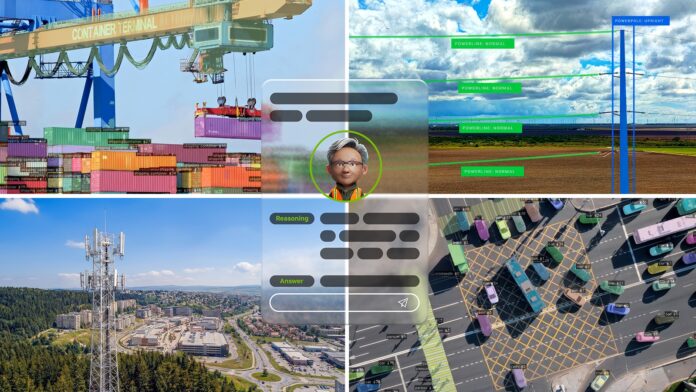

Most conversations about AI infrastructure focus on data centers, the massive facilities packed with GPU racks that train and run the world’s most powerful models. But a growing category of AI applications does not work well when all the processing happens in a distant data center. Vision AI agents monitoring a busy intersection, safety systems detecting hazards on an oil rig, and robots navigating industrial facilities all need to process data and respond in real time, faster than a round trip to the cloud allows. NVIDIA and T-Mobile think the answer is to turn the cellular network itself into a distributed AI computing platform, and they are announcing a collaboration at GTC this week to start making that real.
The partnership brings together NVIDIA’s AI-RAN infrastructure, T-Mobile’s nationwide 5G standalone network, Nokia’s anyRAN software, and a growing ecosystem of physical AI developers building applications that run at the network edge. The City of San Jose is among the first entities assessing the technology, and early use cases range from smart city traffic management to automated power line inspection to real-time industrial safety monitoring.
What AI-RAN Actually Means
AI-RAN stands for AI Radio Access Network, and the concept is straightforward even if the technology behind it is complex. A traditional cellular network is primarily a communications infrastructure, moving data between devices and the internet. AI-RAN transforms that same infrastructure into a computing platform by embedding AI processing capability directly at the cell site and mobile switching office level, putting compute close to where data is being generated rather than routing everything to a centralized data center.
NVIDIA’s AI-RAN portfolio covers two tiers of deployment. NVIDIA ARC-Pro, built on the NVIDIA RTX PRO 4500 Blackwell Server Edition, is designed for power-constrained cell sites where physical space and energy availability are limited. The NVIDIA RTX PRO 6000 Blackwell Server Edition handles higher-capacity mobile switching offices where more substantial compute can be deployed. Together, these two tiers create a distributed computing fabric that spans the cellular network from individual cell towers to regional switching facilities.
T-Mobile was the first carrier in the United States to pilot NVIDIA’s AI-RAN infrastructure with Nokia’s anyRAN software, and it is now working with a select group of NVIDIA physical AI partners to demonstrate how cell sites and mobile switching offices can support distributed edge AI workloads while continuing to deliver standard 5G connectivity simultaneously.
Srini Gopalan, Chief Executive Officer of T-Mobile, described the company’s position in terms of the infrastructure requirements for physical AI at scale, noting that ultra-low latency and space-time coherency at the network edge for billions of endpoints is what T-Mobile has built toward with its first nationwide 5G Standalone and 5G Advanced network. The argument is that intelligent systems should not have to wait on the cloud but should be able to act in real time through intelligent networks.
Jensen Huang, founder and CEO of NVIDIA, framed the cellular network in terms that reflect how fundamentally this changes the AI infrastructure picture, describing the 5G network as a distributed AI computer and calling this collaboration a scalable blueprint for the world’s edge AI infrastructure.
Why the Network Edge Matters for Physical AI
The practical case for edge AI processing comes down to latency, coverage, and cost. Wi-Fi can provide fast local connectivity, but it is limited in range, inconsistent in quality, and not well suited to securing mission-critical communications across large physical environments like city streets, utility corridors, or industrial facilities. Sending everything to a cloud data center adds latency that makes real-time response difficult or impossible for time-sensitive applications.
T-Mobile’s 5G standalone network addresses both problems by providing wide-area coverage with guaranteed quality of service, the kind of reliable, low-latency connectivity that complex AI agents need to operate in environments ranging from busy urban intersections to remote rural areas.
The edge computing model also changes the economics of deploying AI at scale. When heavy computation can be offloaded from individual devices to the nearest edge location on the network, the hardware requirements for cameras, sensors, and robots become much simpler and cheaper. Rather than equipping every camera with an expensive onboard AI processor, developers can use simpler and less expensive devices and rely on the network edge for the processing. That makes it economically viable to deploy sophisticated AI models across billions of interconnected devices in a way that onboard processing alone could not support.
What Developers Are Already Building
Four physical AI companies are working with NVIDIA and T-Mobile to build and test applications on the AI-RAN infrastructure, and their use cases illustrate the range of problems this kind of edge AI deployment can address.
Fogsphere is providing safety AI agents for SAIPEM, an energy infrastructure company, to detect and respond in real time to hazardous events in high-risk construction, offshore, and drilling environments. Specific scenarios the system monitors for include workers positioned under suspended loads and hydrocarbon spills. The agents are already running continuously without reliance on Wi-Fi, and Fogsphere is now validating how AI-RAN infrastructure can enhance their capabilities and performance over a secure and distributed network.
LinkerVision is working with Inchor and Voxelmaps on integrated computer vision-based City Operations Agents and a digital twin for the City of San Jose that can perceive, simulate, and optimize traffic light timing. The system is targeting incident response times that are five times faster than current approaches, and San Jose is among the first cities to assess the technology.
Levatas and Skydio are collaborating on automated inspection of transmission lines over 5G with NVIDIA compute. The system is designed to detect anomalies including leaning power poles, corrosion, and thermal hotspots across hundreds of thousands of miles of transmission line infrastructure five times faster than current methods, and the team is evaluating AI-RAN infrastructure to further reduce costs, improve storm recovery time, and accelerate the shift from reactive to predictive maintenance.
Vaidio is using the NVIDIA Metropolis VSS Blueprint to build facility management agents that go beyond simple sensor monitoring to perform threat detection and failure forecasting, triggering automated workflows to improve facility management in commercial and industrial environments.
Siemens Energy is also among the partners using the VSS blueprint, alongside Caterpillar, KION, Hitachi, HCLTech, Tulip, and Telit Cinterion, to optimize operations and enhance safety across industrial applications.
The Metropolis VSS 3 Blueprint
Underlying many of these applications is the NVIDIA Metropolis Blueprint for Video Search and Summarization, now in its third version. VSS 3 is a framework for building AI agents that can reason over video footage, and the scale of the problem it addresses is significant. More than 1.5 billion cameras capture footage globally, and less than one percent of that footage is ever reviewed by a human. The vast majority of what those cameras record is effectively invisible, stored but never analyzed.
VSS 3 enables AI agents to change that by making video footage searchable and summarizable at scale. The key capabilities in the new version include agentic information retrieval, where AI agents can decompose complex natural language queries and search across video footage to find specific events in under five seconds. A modular architecture allows development teams to adapt VSS 3 to diverse environments from retail stores to warehouses without having to rebuild the core infrastructure for each deployment. The system can also summarize long-form video up to 100 times faster than manual review, which dramatically reduces the cost and labor involved in monitoring large volumes of footage.
The practical effect of these capabilities is that organizations with large camera networks can deploy AI agents that continuously monitor footage, surface relevant events automatically, and respond to queries in natural language, turning passive recording infrastructure into an active intelligence layer.
The collaboration between NVIDIA and T-Mobile represents a meaningful expansion of where AI infrastructure lives. The conventional model places AI compute in large centralized facilities and moves data to it. The AI-RAN model moves compute to where data is being generated, embedding it throughout the cellular network. For applications that require real-time response in the physical world, that architectural shift is not just a performance improvement. It is what makes the applications possible at all.
The early use cases being tested across smart city operations, utility infrastructure, industrial safety, and facility management represent a small sample of what becomes viable when low-latency AI processing is available wherever a cellular signal reaches. As 5G coverage continues to expand and the cost of AI-RAN infrastructure decreases, the range of physical AI applications that can be economically deployed at scale will grow substantially.
Whether the AI-RAN model becomes a dominant architecture for edge AI or one of several competing approaches is still an open question. But the combination of NVIDIA’s hardware and software platform, T-Mobile’s network infrastructure, and a growing ecosystem of developers building real applications on top of both gives this collaboration more substance than most early-stage infrastructure announcements. The use cases being tested today are not hypothetical. They are running, and the results will determine how fast this technology spreads.
Discover more from SNAP TASTE
Subscribe to get the latest posts sent to your email.